








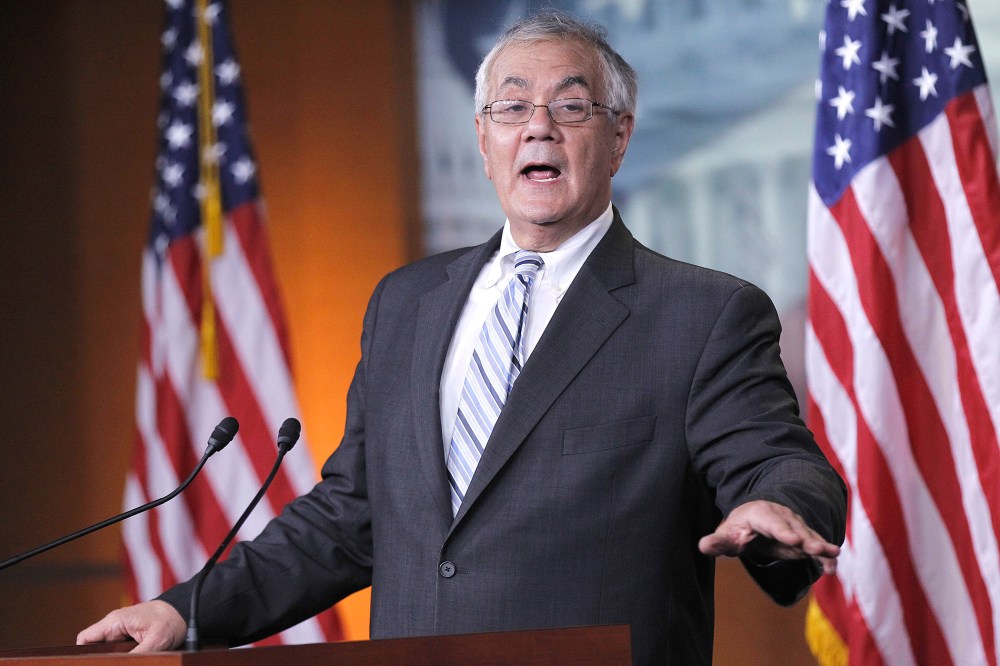
As the country stands on the precipice of nationwide marriage equality, with openly-LGBT leaders holding high-level positions in government, business, sports and media, former U.S. Rep. Barney Frank offers a stark reminder of the way things used to be for a gay man living a public life at the end of the Reagan Era.
“In 1986, I was as ready to leave the closet as I would ever be — but how would I do so?” writes the former congressman in his new memoir, “Frank: A Life in Politics from the Great Society to Same-Sex Marriage,” published this month by Farrar, Straus and Giroux. A lengthy excerpt from the book appears in the latest edition of Politico Magazine.
%22If%20the%20official%20voice%20of%20the%20national%20Republican%20Party%20continued%20to%20use%20…%20homosexuality%20as%20a%20political%20weapon%2C%20I%20would%20identify%20those%20members%20of%20the%20party%20who%20chose%20to%20benefit%20from%20this%20tactic%20while%20concealing%20their%20own%20sexual%20orientation.%22′
“For many years, I was ashamed of myself for hiding my membership in a universally despised group,” Frank writes. “I’d been afraid of exposure, and angry at myself for my self-denial. I’d felt shame as I watched younger gay men and lesbians confront the bigots openly with a courage that I lacked. After all those years, lying to people was much easier emotionally than finally admitting my lie.”
The book presents an illuminating account of the hardships facing Gay America not too long ago, and details Frank’s journey from a closeted congressman to a leading voice for equality. Frank eventually did come out, but only after a process of careful introspection and being “implicitly, but unmistakably” outed in the memoir of a former Republican lawmaker, Robert Bauman.
That book prompted Frank to reveal the truth about himself to the former Democratic Speaker of the House, Tip O’Neill, and his then-press secretary, msnbc’s Chris Matthews.
“He looked stricken, though he immediately made clear it was not my sexuality that troubled him but the negative impact its disclosure would have on my career,” Frank writes of O’Neill’s reaction. “Meanwhile, O’Neill set about warning his press secretary, Chris Matthews. ‘Chris,’ he said, ‘we might have an issue to deal with. I think Barney Frank is going to come out of the room.’”
“With his unerring ability to translate O’Neill’s malapropisms, Matthews quickly made the necessary metaphoric adjustment,” Frank writes.
In addition to the harsh realities of being gay at that time, the book also details the congressman’s surprise at how he was accepted. After Frank decided to go public with his sexuality — which he did by responding “Yeah. So what?” when a Boston Globe reporter asked him if he was gay — he was for the most part welcomed by his colleagues and constituents. On the evening that the Boston Globe ran its scoop, Frank attended a Cirque du Soleil performance where he received a prolonged standing ovation.
“It was the only time in my experience that an entertainment-oriented crowd gave a politician a greater ovation than a genuine star,” he writes. “For the first time, I realized that coming out could have political advantages as well as liabilities.”
Frank was also able to handily win his reelection bid in 1989 with 66% of the vote. Of course, there were also the expected struggles. Shortly after Frank came out, The New York Times published a piece titled, “Public Man, Private Life: Why a Congressman Told of His Homosexuality,” that referred to his “homosexual acquaintances” and support for “homosexual rights.”
“‘Homosexual’ was not explicitly derogatory, but it was the preferred term among those who wanted to maintain some semantic distance from our cause,” writes Frank. “In the phrasing of certain aptitude tests, you might say that ‘homosexual’ was to ‘gay’ as ‘Negro’ was to ‘black.’ It wasn’t exactly an insult, but it was a message to the minority in question that the majority would decide what to call us, rather than let us pick a name we liked.” Later in 1989, Frank would suffer a more serious blow at the hands of a different media outlet — The Washington Times — which exposed his two-year relationship with a male prostitute, Steven Gobie. That same year, Frank was featured in a Republican National Committee leaflet designed to perpetuate rumors that the newly-sworn in Democratic House Speaker, Tom Foley, was gay. Frank was able to shut down the attacks with a bold threat to out closeted Republicans. “Obviously, I said, I did not consider being gay a defect in any way, shape, or form, but precisely for that reason I was very angry that the Republicans were treating it as if it were,” writes Frank. “Although I had no reason to believe that Foley was gay, I continued, I knew that there were closeted Republicans in the House. If the official voice of the national Republican Party continued to use the imputation of homosexuality as a political weapon, I would identify those members of the party who chose to benefit from this tactic while concealing their own sexual orientation. I would out them if I had to. It was big news.” For the most part, however, Frank’s account highlights how he was able to use his position to advance the cause of LGBT equality — particularly with regard to AIDS spending and the military’s ban on gay service members. He was even able to convince President Bill Clinton to pass over Sam Nunn for secretary of state due to Nunn’s “consistent record of homophobia.” “I must acknowledge that I got some personal satisfaction from apparently frustrating Nunn’s aspiration to be secretary of state,” Frank writes. “But I also thought that something crucial was at stake: Being a leading opponent of fair treatment for LGBT people should be considered a disqualification for high honor within the Democratic Party. No comparable opponent of fair treatment for African-Americans, women or any other group would have been considered for such a post. I am proud that I helped establish the principle that we should receive equal consideration.”
Emma Margolin
Emma Margolin is a reporter at MSNBC.com. Recommended


