








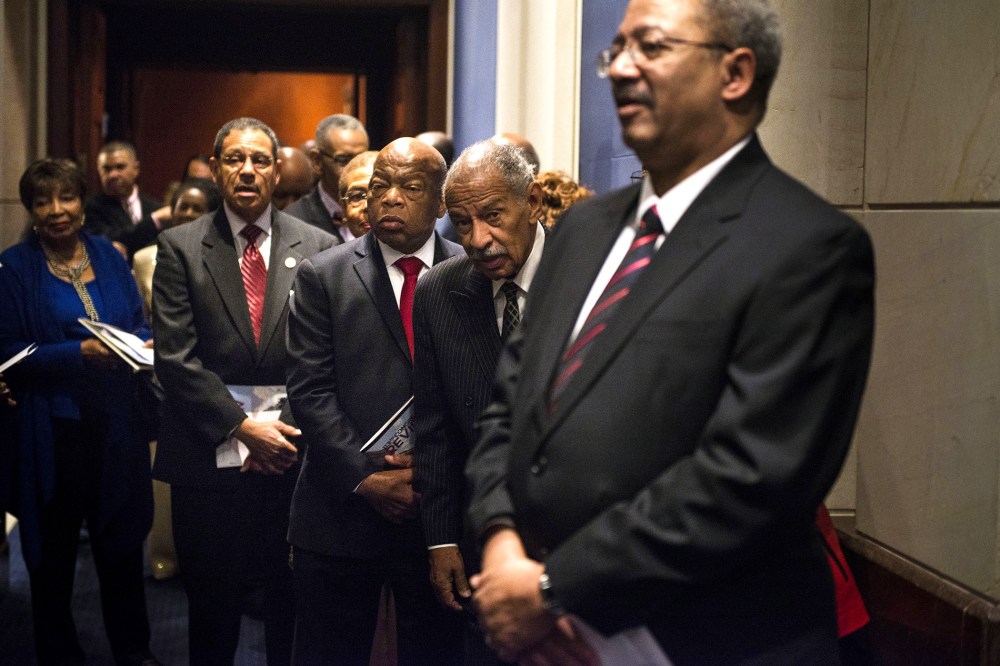
As the nation begins to celebrate Black History Month, it is a fitting time to note that the 114th Congress has convened with a record number of African American members. For the first time in history, the U.S. Congress has 48 persons of African descent: forty-six in the House (including two non-voting delegates), and two in the Senate. The 114th Congress is also historic because of the record 20 African American women serving in the House.
%22The%20sense%20of%20urgency%20is%20well%20placed.%20The%20past%20year%20has%20been%20a%20stark%20reminder%20of%20the%20need%20for%20a%20renewed%20focus%20on%20issues%20that%20have%20prevented%20the%20nation%E2%80%99s%20economic%20recovery%20from%20reaching%20too%20many%20black%20households.%22′
Considering the makeup of the rest of Congress, will the record number of African Americans in Congress make any difference in the everyday lives of blacks and other minorities? The breakdown in the House is 246 Republicans and 188 Democrats; in the Senate there are 44 Democrats, 54 Republicans and 2 Independents. Since all the black members with seniority are Democrats, there will be no African Americans in leadership positions.
Yet, if the African American members of the 114th Congress embrace the founding ethos of the Congressional Black Caucus (CBC), to serve as the “Conscience of the Congress,” they can have a positive impact on the lives of many African Americans despite their minority status.
That’s true even though close to half of the black members of Congress represent districts that are not predominantly black – meaning their obligations to their constituents may sometimes conflict with their ability to promote an “African American” agenda. Furthermore few of the Republicans presently serving in Congress are cut from the same cloth as former lawmakers Connie Morella, Jacob Javits or Jack Kemp. In fact, a number are Tea Party conservatives who seem intent on thwarting any progressive legislation.
Nevertheless, Rep. G.K. Butterfield (D-NC), the new CBC Chairman, made clear in his first speech that he and other CBC members did not come to the 114th Congress waving a white flag of surrender. “If anyone has any doubt that this Chairman and this CBC will have any reluctance to fight for our communities,” Butterfield said, “you are mistaken.” He went on to outline an agenda that includes restoring Section 5 of the Voting Rights Act, strengthening Historically Black Colleges and Universities (HBCUs), targeted funding for poverty-stricken communities, and criminal justice reform.
Chairman Butterfield’s sense of urgency is well placed. The past year has been a stark reminder of the need for a renewed focus on issues, from the need for criminal justice reform in cases like the killings of Trayvon Martin, Michael Brown, Eric Garner and Tamir Rice, to a distressing increase in discriminatory voting laws and practices, to the persistent opportunity gaps that have prevented the nation’s economic recovery from reaching too many black households. Fifty years ago, when civil rights advocates fought to pass the Voting Rights Act, their hope was that greater representation in the halls of Congress would lead to greater opportunity, and greater justice.
So it is important to keep in mind that while black lawmakers are a minority in Congress, they make up 10% of the House of Representatives. When the CBC was founded, there were only 13 blacks in Congress, but by presenting a united front they commanded the attention of the president, their colleagues and the country. For example, a boycott of President Nixon’s State of the Union Address convinced Nixon to meet with the CBC. %22When%20the%20majority%20party%20is%20looking%20to%20pass%20legislation%2C%20or%20to%20pass%20veto-proof%20legislation%2C%20forty%20votes%20can%20form%20a%20critical%20bloc%20to%20obtain%20a%20majority.%22′ In the months ahead, black members of Congress can join forces to remove objectionable provisions from proposed legislation. They can add items to bills that are designed to serve and protect the interests of the country’s, poor and underserved citizens, especially its African American citizens. And when the majority party is looking to pass legislation, or to pass veto-proof legislation, forty votes can form a critical bloc that is needed to obtain a majority. Black members of Congress can also maximize the power of their votes by forming coalitions with groups such as the Congressional Hispanic Caucus (CHC) and the Congressional Asian Pacific American Caucus (CAPAC) on legislative issues such as voting rights and poverty. Finally, by championing an agenda that advances the causes of equity, protects the rights of low-income Americans, and serves as a voice for the voiceless in the halls of Congress, the black members of the 114th Congress can not only serve as champions for black America, they can be a powerful force for the good of the entire country. Elsie L. Scott, Ph.D., is the founding Director of the Ronald W. Walters Leadership and Public Policy Center at Howard University, and the former president and chief executive of the Congressional Black Caucus Foundation from 2006-2012.
Elsie Scott Recommended


