








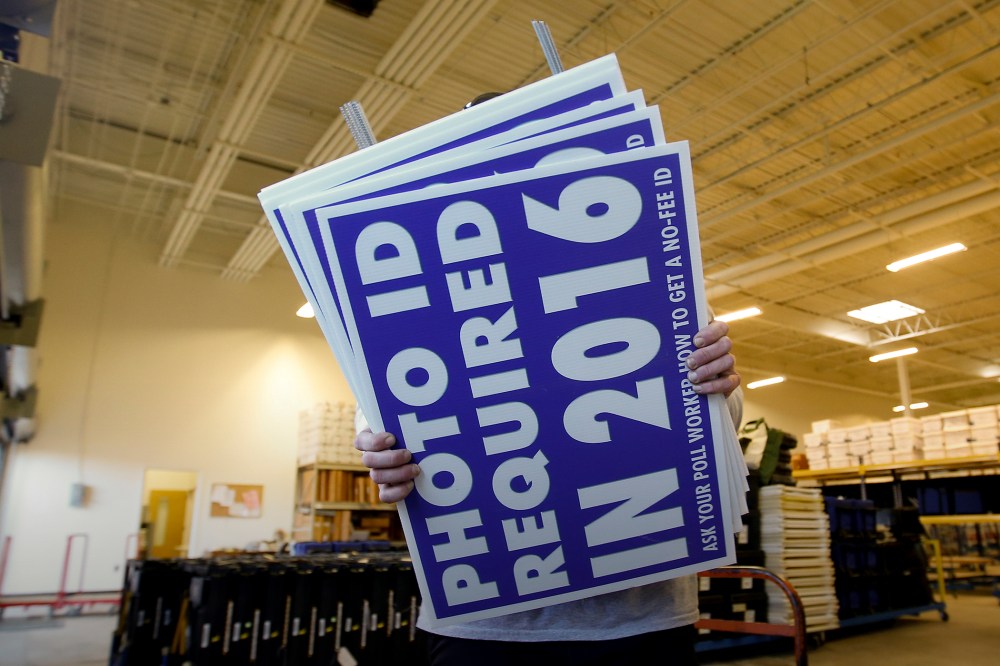
Voting rights advocates say confusion around South Carolina’s voter ID law could keep would-be voters from the polls in the state’s pivotal Democratic primary. And they claim Republican state officials, including Gov. Nikki Haley, are in part to blame.
It’s impossible to say how significant the law’s impact might be when Democrats cast their ballots Saturday. But the concerns highlight how even relatively lax laws around photo IDs and voting can nonetheless end up suppressing the vote if they’re poorly understood by voters and poll workers.
South Carolina could play a key role in the Democratic contest, in which Hillary Clinton and Bernie Sanders are in a heated battle. In 2008, black voters, who could be disproportionately affected by the ID law, made up over half of all voters in the state’s Democratic primary. This year, polls suggest blacks in the state favor Clinton, but Sanders has been working to make inroads.
According to the state’s numbers, 178,000 South Carolinians, disproportionately non-whites, don’t have any of the forms of photo ID that the law calls for. Crucially, people are in fact allowed to vote even without a photo ID, as long as they sign an affidavit stating why they don’t have one. But those working to mobilize voters say which documents are and aren’t required is not well understood.
“I think people are confused,” said Jan Leonard, an official with the Charleston County Democratic Party. “People ask me all the time: What about this, what about that?”
Murky messaging on what’s required
Leonard and others say the state has helped stoke that confusion through its public education campaign about the law. Handouts and polling place posters created by the state election commission declare: “Photo ID Requirements Now In Effect: Voters will be asked to show one of these photo IDs before voting in person.” Only in much smaller text below that—and even there, not until the third paragraph—do voters learn that they can vote without ID.

“The official language is basically: Yeah, you need an ID,” said Leonard. She said that message could deter some voters, especially students or those voting for the first time.
Public comments by Haley, who signed the law, have reinforced the false idea that ID is needed to vote.
“Requiring people to show a photo ID before they vote is a reasonable measure,” Haley, who’s being eyed as a possible Republican vice presidential pick, said during a speech at the National Press Club in Washington, D.C., last September, omitting that her state’s law does not require it. “Let’s figure out ways to make it easy and cost-free for every eligible voter to obtain a photo ID. That way, everyone who wants to vote can vote.”
RELATED: Obama pushes for automatic voter registration
There’s concern, too, that some poll workers might not enforce the law correctly. People without ID are supposed to be allowed to vote simply by signing an affidavit saying they had a “reasonable impediment” that stopped them from getting one and explaining what the impediment was. They can give essentially any reason. But Leonard, a trained poll worker herself, said she’s not at all confident that all poll workers will know the rules.
“It’s not clear to poll workers that they should accept any reason,” she said, “It’s not emphasized in the poll worker training.”
Legal battles lead to further confusion
Some of the confusion stems from the ID law’s passage through the courts. After it was signed into law in 2011, the Justice Department objected to it under Section 5 of the Voting Rights Act, citing the impact on minorities. At that time, South Carolina and most other southern states had to have all changes to election rules approved by the federal government. Ultimately, a three-judge federal panel upheld the law in 2012, but the judges made clear that the state had to accept almost any “reasonable impediment” that voters offered as a reason why they didn’t have ID. That made the law far less restrictive than it might otherwise have been. In fact, the state had already been using that more lenient interpretation. But at the time the law was passed and the issue was in the public spotlight, it wasn’t clear that it would do so. Indeed, just as she did last year, Haley talked about the law in 2011 in terms that suggested it required ID. “If you can show a picture to buy Sudafed, if you can show a picture to get on an airplane, you should be able to show a picture ID to [vote],” Haley said as she signed the bill into law. The media, too, reported that the new law required voters to show ID. As Judge John Bates wrote in his concurring opinion approving the ID law under the looser interpretation, “to state the obvious, [the law] as now pre-cleared is not [the law] enacted in May 2011.” We won’t know until after the primary, if then, how much the convoluted saga will end up keeping potential voters from the polls. Still, opponents of the law say even though they succeeded in convincing the court to weaken it, it was only a half-victory at best, because many people still don’t understand that ID isn’t required. “We won the battle and lost the war,” said Brett Bursey, a progressive activist in South Carolina who fought against the ID law, “because the confusion serves the original purpose of suppressing the Democratic vote.” This article was updated on February 27, 2016.
Zachary Roth Recommended


