








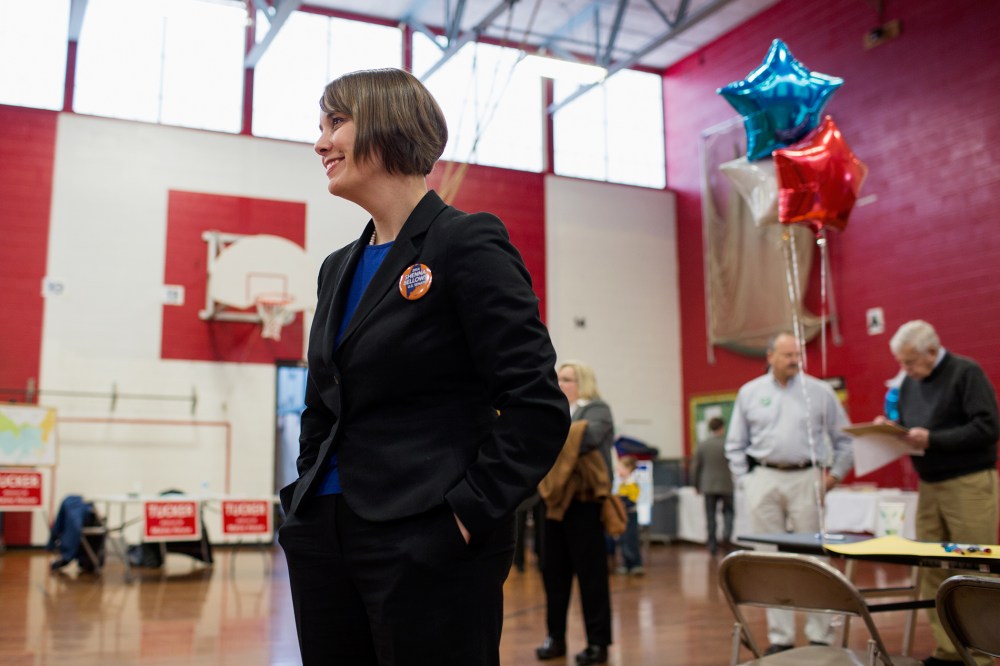
BRUNSWICK, Maine – On the day of the state Democratic caucuses earlier this month, Shenna Bellows trekked from the northern city of Bangor to the town of Kittery, on the New Hampshire border, asking local men and women to help her in what she called a “David and Goliath” Senate race against popular three-term incumbent Republican Susan Collins. Bellows is betting that an aggressive grassroots campaign and a platform that has led one progressive group to call her “the Elizabeth Warren of civil liberties” can earn her an upset victory.
“We have to try to change things. We need more honesty and courage in politics,” Bellows, 38, told msnbc as she drove between caucus appearances.
Bellows spent eight and a half years as head of Maine’s chapter of the American Civil Liberties Union, where she led coalitions dedicated to restoring voting rights and winning marriage equality. She has a record of working with Republicans and Democrats in the Maine legislature to on issues like protecting reproductive rights and requiring warrants for private cell phone tracking.
“I have a passion around civil liberties,” she said. “I just disagree on the amount of intrusion that is acceptable in our private lives.”
In many ways, Bellows’ background with the ACLU and passion on the issue of government surveillance and drone warfare aligns her more closely with Republican Kentucky Sen. Rand Paul than with her own party’s Senate leaders, like California’s Dianne Feinstein.
Bellows wants to repeal the USA PATRIOT Act and rein in the spying programs that have resulted from it. She also wants to release a massive 6,000 page report on CIA torture practices following 9/11, to end the secrecy surrounding America’s targeted killing program, and see a congressional investigation into the surveillance programs that have sprung up in the past decade.
While it might be hard for Bellows to sell her positions on surveillance and social issues to rural voters struggling to survive, she hopes her own background can help close some of that distance. Bellows grew up in Hancock, Maine, a coastal town about an hour from Bangor, and for many years her family had neither electricity nor running water, and she remember how her family struggled to make ends meet.

Bellows made headlines last month when her campaign reported it had raised more money in the last three months of 2013 than Collins’ did. Bellows’ campaign also raised 80% of that money from within the state, nearly all of it in donations under $100.
Standing in front of a microphone in a high school gym in Brunswick, Bellows laid out her key to victory: bring back Democrats who voted for Collins in 2008.
“If we win the Democrats,” she told the assembled crowd, “we win the race.”
Collins still has a considerable financial advantage – $3 million on hand compared to just under $350,000 for Bellows – but it was nonetheless a strong start for the challenger, who says she plans to visit every one of Maine’s 504 towns.
“Maine is really one large small town,” Bellows told msnbc. With just under a million registered voters, grassroots organizing can go a long way. “The most important thing is local support,” she said.
But Dan Demeritt, a Republican consultant who once worked for Collins, described Bellows as a promising candidate but one who is no match for the popular incumbent.
“She’s done a lot of important constituent work. She’s got 18 years of that, which is a lot of political capital,” Demeritt said of Collins. “It’d be hard for any political challenger, especially an unknown like Shenna. I think she’s going to win some day, but it’s not going to be this year.”
Even EMILY’s List, the powerful organization that raises money for Democratic women candidates, isn’t willing to commit any resources to the race yet.
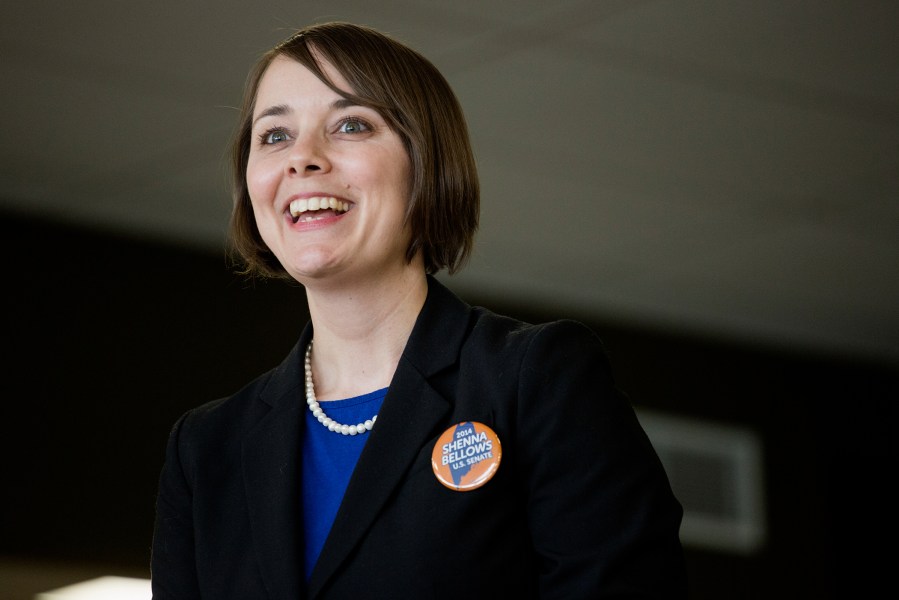
“Shenna Bellows is an impressive candidate and her progressive vision resonates with so many in Maine and across the nation. We are watching this race closely,” Marcy Stech, National Press Secretary of EMILY’s List told msnbc in an email.
Bellows said she recognizes the challenges her campaign faces.
Voters in Maine often cross party lines, meaning she’ll have to attract independents and Libertarians in addition to wooing back a sizable number of Democrats. Collins has been reelected twice by large margins and is admired by many in Washington as one of the last remaining Republican moderates.
In 2008, when Obama defeated Republican John McCain in the Maine presidential contest by a margin of 57-40%, Collins pulled in more than 61 percent of the vote to be easily re-elected. Exit polls showed that a full third of those who voted for Obama voted for Collins. But with controversial Tea Party Gov. Paul LePage up for reelection this year, Democrats in Maine are more energized than they’ve been in other off-year elections. A poll [pdf] done by Maine research firm Pan Atlantic SMS Group late last year found 52.5% of voters said they wouldn’t even consider voting to re-elect LePage, who has become famous for wildly offensive statements. He once told the NAACP to “kiss my butt” after refusing to attend a Martin Luther King, Jr. Day breakfast, joked about bombing the state’s largest newspaper, and, in a state famous for its political moderates, said he wanted to tell President Obama to “go to hell.” With LePage now being challenged by longtime Democratic Rep. Mike Michaud, there’s a lot of motivation among voters. “Add Shenna to the mix, who’s young, got something to say, and has a really enthusiastic following, and that’s infectious” to Maine’s Democrats, Ben Grant, Chairman of the Maine Democratic Party, told msnbc. This year’s caucuses saw record turnout, with party members gathering in town halls and school gyms for a chance to meet Bellows and other members of the ticket. Democrats say that while Collins has been more willing than many Senate Republicans to negotiate “grand bargain” style compromises with Democrats, if the GOP gains control of the Senate in November, she’ll still vote with her party on nearly two out of every three votes. And Collins’ style of bipartisanship, based in compromises like her rejected proposal to end October’s government shutdown, is one Bellows thinks needs to be replaced. “Bipartisanship by which both sides compromise values to benefit large corporations is the worst kind of bipartisanship,” Bellows said in January. She also pointed to Collins’ votes for the Keystone XL pipeline and against the Paycheck Fairness Act that despite her carefully crafted moderate image, Collins isn’t as independent as she seems. Bellows envisions herself crafting anti-surveillance legislations with Paul as well as economic policy with progressive heroine Elizabeth Warren. Despite a historically unproductive year for Congress, it’s not a far-fetched idea. That approach has worked for Kirsten Gillibrand of New York, who secured bipartisan support from Paul and Texas’ Ted Cruz for her legislation to change the way the military prosecutes sexual assault. Bellows describes her strategy for coalition building as “no permanent enemies, no permanent friends.” If government is going to make any progress on critical issues like the environment and civil liberties, “we need more organizers to build more unusual coalitions,” Bellows says.
Meredith Clark
Meredith Clark is a freelance writer and editor. She was previously a senior news producer for "Patriot Act with Hasan Minhaj," a reporter with MSNBC.com, the digital politics and culture editor at Glamour and a senior news and politics editor at Refinery29. She has written for Vulture, Rolling Stone, Self, Marie Claire, Cosmopolitan, The Daily Beast and Bustle. Recommended


