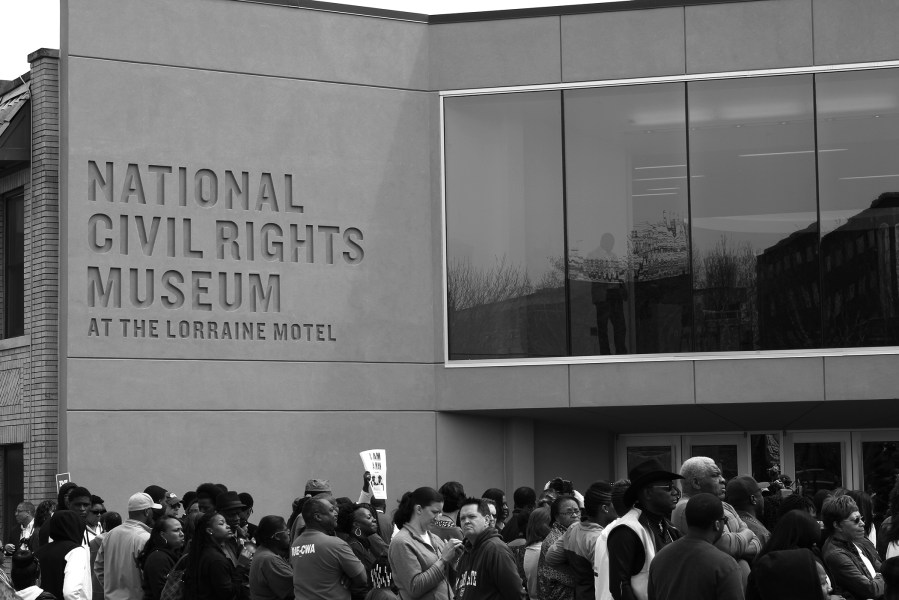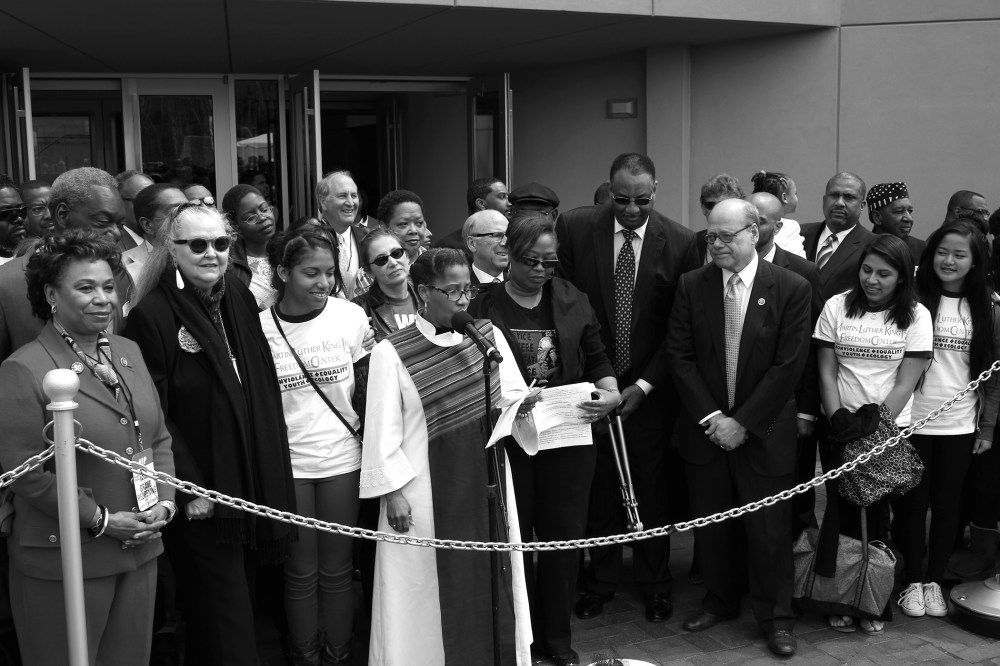
MEMPHIS, Tenn.— When National Civil Rights Museum officials cut through a chain to officially mark the museum’s re-opening here on Saturday, a pastor declared the site “holy ground” and intoned that violence would no longer be victorious.
Doves were released from white baskets with red roses woven into the lids, and the birds flew over the museum, housed in part in Memphis’ old Lorraine Motel, where the Rev. Dr. Martin Luther King was assassinated 46 years ago.
The museum — which opened its doors on Saturday after 18 months and a $28 million reconstruction — details the long journey of civil rights in following a “culture of resistance” forged by African-Americans and freedom fighters over five centuries. In remarkable fashion, the museum highlights both the tragedies and triumphs of history and aims to create new connections to the past for a younger generation of Americans.

Touch screens, along with revamped audio and visual exhibits, allow the voices and images of days past to unfurl seamlessly. The significance of the site is undeniable.
“For a long time this has been sacred ground,” said Marqui Fifer, 40, an assistant middle school principal who brought his two young daughters to the museum’s opening events. “But it’s also a place where life really began for a lot of people. Even though Dr. King died here, his dream still lives.”
Fifer gestured to his girls, Kaylin, 10, and Kela, 6, and said, “they are living in the aftermath of what happened 46 years ago.”
“They can read about what happened in a book, but it’s different to be here and soak it all in,” he added. “I want them to understand that for the rights they have in life, someone had to make a sacrifice. And Dr. King gave the ultimate sacrifice. Not just for blacks but for all Americans.”
Beverly Robertson, the president of the museum, said the re-opening of the space was the beginning of a new era in the civil rights movement.
“It makes me feel as if we are beginning to accomplish the objective of making sure that people of all ages, races, religions, ethnicities, have an opportunity to really understand this history and to understand that their voices are all inside the National Civil Rights Museum,” she said.
While the museum is emotionally and, in some ways, physically anchored to King’s death, it highlights the little-known civil rights events and people who changed the trajectory of the struggle.
A strike by black sanitation workers in 1968 brought King to Memphis in the first place. After two of them, Robert Walker and Echol Cole, were crushed to death in the back of a garbage truck during a rain storm, sanitation workers went on strike demanding better conditions and better pay.
“I feel two ways about all of this,” said Baxter R. Leach, 75, a former Memphis sanitation worker. “He came because of the strike, but he got killed here. That hurts me.”
Alvin Turner, 79, another former sanitation worker, said the museum honors the legacy of King while at the same time highlighting their own fight for justice.
“I wish it would have happened some years ago,” he said. “I’m getting up there in age and can’t move around like I used to. But it really is good, I’m really enjoying this.”
Notable figures in the civil rights struggle, including Black Panther Party co-founder Bobby Seal and Dr. Bernard Lafayette, who was a friend of King’s and serves as the chairman of the board for the Southern Christian Leadership Conference, attended the museum’s reopening.
Lafayette was at the Lorraine the night King was killed. King was shot moments after stepping out of room 306 onto the balcony. Lafayette was staying in a room directly beneath King’s in room 206. “If we want to continue the fights that Dr. King led, then we have to teach a new generation about non-violence,” Lafayette said. California Democratic Rep. Barbara Lee said the “chain cutting” filled her with joy, as her generation is among the last to have experienced legal segregation and all the de-facto ways in which the rights of blacks were denied. She said she attended segregated schools and that her family was not permitted to live where they wanted. “I remember the days in the not-so-distant past when I couldn’t drink out of a public water fountain unless it said colored on it,” Lee said. “So I’m here as part of the movement that challenged America to live up to its creed of liberty and justice for all. But also with a deep sense of humility and gratitude.” While many had come from all over the country and state to be here, the vast majority of attendees were locals, standing among a crowd that swelled to a few hundred. Albert Johnson, 34, sat on a set of bleachers across from the museum. He said he came down to the motel as a kid, before it was turned into a museum in 1991, with family visiting from out of town. And he recalled the annual parade that marched by the site to celebrate King’s birthday. The sanctity of the place offered “a place where you can reflect on everything,” he said. “He was the greatest American to ever live,” Johnson said of King. “We as black Americans have come this far by faith. But when they took him, they took our doctor, our preacher. He was like our voice.” Kenny Richards, 41, said King and so many others who fought for the dignity and respect of blacks “taught us about standing up and being men.”
Trymaine Lee
Trymaine Lee is an NBC News correspondent. Recommended