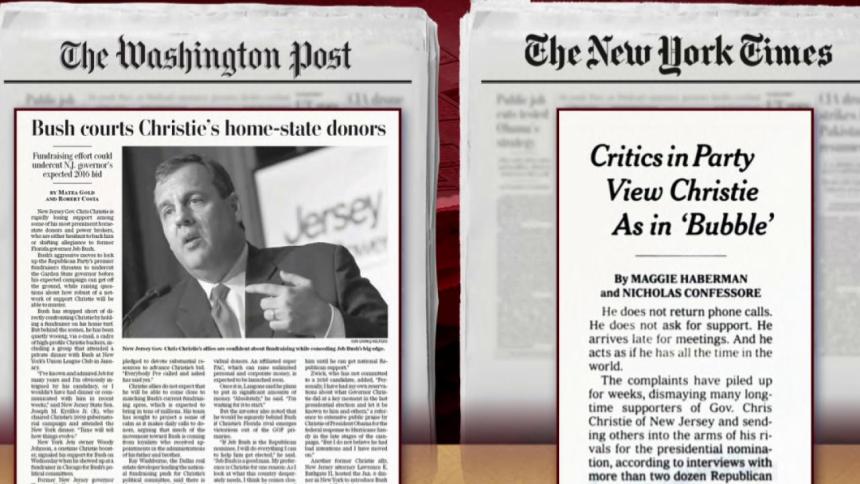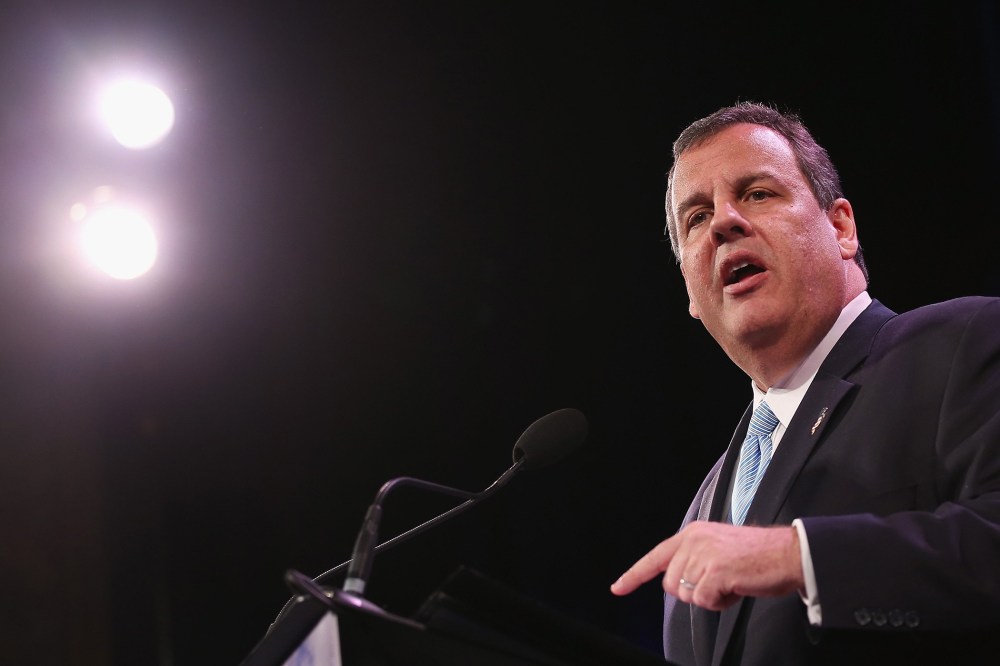
The ominous headlines – three dreadful ones in 48 hours – came fast at the end of the week: From The New York Times, a report that Christie’s “view of his status and pre-eminence within the Republican field is increasingly at odds with the picture outside his inner circle”; then details from the Washington Post of key defections from within Christie’s New Jersey base to Jeb Bush; and finally a Politico survey showing party leaders now downgrading Christie’s prospects of winning the 2016 GOP nod.
Let’s get the usual disclaimers out of the way about how long it is from here to Iowa, how quickly fortunes can change in politics, and how the only poll that counts is on Election Day. There’s truth to all of this, and it should be noted that Christie also managed to pick up some significant out-of-state financial support this week and is apparently now taking steps to rekindle the image that made him famous – as a common-sense reformer doing battle with New Jersey’s rotten and entrenched political old guard.
But there’s also a risk of understating the significance of what’s happening right now. This phase of the campaign is known as the Invisible Primary, when the most influential opinion-shaping forces in the party – donors, elected officials, interest groups – begin taking sides. If history is a guide, then the actual primaries and caucuses that take place a year from now will merely serve as formal ratifications of the decisions that the GOP’s elites are making today. For Christie, that’s the danger of this week’s news: the appearance that he’s being squeezed out of the Invisible Primary.
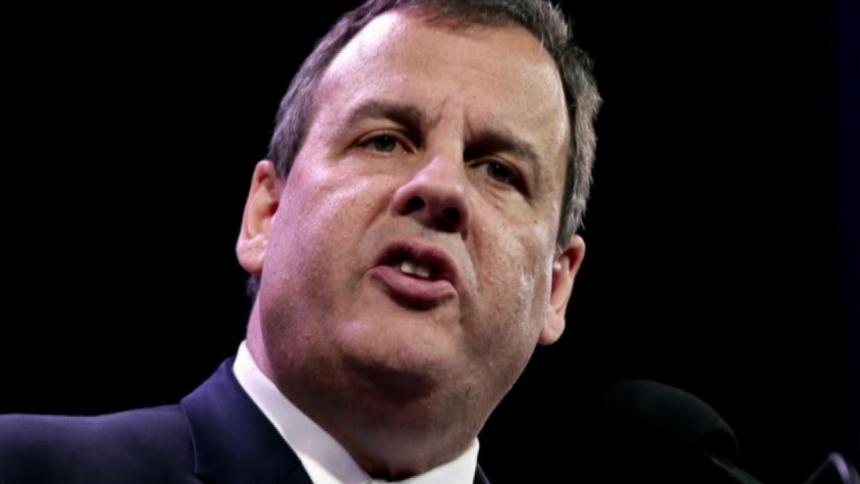
There are multiple reasons for Christie’s struggles, but if there’s a common thread it’s this: The past – both recent and distant – is catching up with him. Decisions, actions, and calculations that helped him to move up the political ladder are now redounding in ways that are harmful to his national ambitions.
Start with what is supposed to be Christie’s trump card on the national stage, his landslide reelection victory in his deep blue state in 2013. The idea was to wow a Republican Party that has won the popular vote in just one of the past five national elections with the promise of a radically expanded ‘16 playing field. And he got the result he was looking for: a 22-point victory over his Democratic opponent.
But look closer at how he achieved it, a story that starts a week before the 2012 election when Superstorm Sandy ravaged the Jersey shore. President Obama, desperately trying to hold off Mitt Romney in the presidential race, flew to the state and was greeted by the governor, who proceeded to lavish him with praise. Obama was only too happy to return the favor in his own public comments. It was a striking, and to many Americans a refreshing, departure from a campaign year that had been defined by hysterical and predictable partisan shrieking – two leaders appearing to rise above politics even as they each profited politically. Days after his New Jersey visit, Obama was reelected, while Christie’s approval rating shot up to nearly 80%.
Granted, you could argue that Christie really was rightly putting politics aside, that he responded to the carnage of Sandy as any man who loves his home state would and should have. But some Republicans detected opportunism and disloyalty in his actions, especially when it was revealed that Christie had turned down a last-minute personal appeal from Romney to headline a rally in the swing state of Pennsylvania – one that was held just 20 minutes from the New Jersey State House. That this refusal came on the heels of a convention keynote speech in which Christie was accused of promoting himself more than his party’s actual candidate only heightened the sense of betrayal among some Republicans.
At the time, Christie could shrug off that ill-will, but now it’s hurting him. Those events from the final days of the 2012 campaign inspired Spencer Zwick, Romney’s finance director in 2012 and now a key Invisible Primary free agent, to tell the Washington Post this week: “Personally, I have had my own reservations about what Governor Christie did at a key moment in the last presidential election and let it be known to him and others.”
Related: A national candidate moving in the wrong direction
Sandy isn’t the only reason Christie got his ’13 landslide. There’s also the alliance he forged with New Jersey’s preeminent Democratic boss, a South Jersey businessman named George Norcross, who in the last generation has transformed his once solidly Republican region of the state into a Democratic stronghold.
The Christie-Norcross relationship is the source of endless rumor and speculation in Trenton. There are those who privately contend that when he was the U.S. Attorney for New Jersey, Christie cut Norcross the break of a lifetime by declining to pursue a corruption case against him – and that Norcross returned the favor by sitting on his hands when Christie challenged Democratic Governor Jon Corzine in 2009. Once Christie was elected, Norcross-aligned Democrats provided pivotal support as the new governor pushed his controversial pension reform plan through the Democratic-controlled state legislature.
But in 2013, Christie was potentially a threat to Norcross because of the possibility that he’d have significant coattails on Election Day, enough to lift Republicans to control of the state Senate, thereby stripping Norcross of one of his biggest Trenton toeholds. Thus were the suspicions of Christie’s fellow Republicans aroused when he demonstrated a clear reluctance to raise money and campaign for down-ballot GOP candidates in districts that were key to Norcross’ fortunes. Fumed one frustrated South Jersey Republican lawmaker after the election: “He cut the deal with George Norcross. That’s why he didn’t raise any money down here.”
Those suspicions exploded when, days after the election, Christie tried to engineer a move to oust the top Republican in the state Senate, Tom Kean Jr., who had devoted serious resources to trying to beat Democrats in Norcross’ backyard. The move failed and Kean survived, but only now is Christie paying a real price for it, with Kean’s father – Tom Kean Sr., the former governor and 9/11 Commission chairman and probably the most respected New Jerseyan on the national political scene – now regularly using his platform to undermine Christie, as he did last week to the Times. Kean Sr.’s criticism has been doubly damaging to Christie because he had long identified the former governor as his political mentor.
2013 was also when access lanes to the George Washington Bridge were allegedly intentionally closed in order to jam traffic, a scheme in which numerous Christie appointees have since been implicated. When “Bridgegate” exploded in the wake of the ’13 election, it spoiled Christie’s victory lap, and the cloud of the resulting federal investigation has hung over his early efforts to win over national GOP big-wigs. That probe is expected to produce indictments (at least six of them, according to one report) in the near future, and while no one thinks Christie will be among those charged the risk of further damage to his national campaign is real. But if all of this has served to soften Christie up, the deeper source of his current woes can be found 16 years ago – in a massive, overpowering machine that he helped to create. It was in 1999 that Christie found himself at the low point of his political career, a man with neither an office nor, it seemed, a future. He’d been an ambitious and talented young pol in the mid-‘90s, elected to county office at 31 years old in 1994. But he was too ambitious, too aggressive, and his brashness offended the locals. A losing campaign for the state legislature was followed by a dead-last finish in his bid for reelection as a Morris County freeholder. He was out of the game, being lapped every day by one rival or another, miles away from political relevance. And that’s when he identified his redemption vehicle. Christie’s best friend and law partner, a New Jersey Republican top operative named Bill Palatucci, was tied in with the Bush family’s political world. George W. Bush was just setting out to run for president and was preparing to mount a blitz attack the field. The goal: lock down a shocking amount of early money, enough to intimidate rivals out of the race and make Bush the presumptive favorite for the nomination. Related: Chris Christie’s path to 2016 may hinge on this state Palatucci brought Christie to meet Bush and the Texas governor’s mansion in January ’99 and soon the two were playing point for Bush’s Garden State fund-raising push. When Bush was finally declared the winner over Al Gore nearly two years later, Palatucci suggested that the new administration name Christie as the U.S. Attorney for New Jersey – a post Christie then skillfully exploited to make himself one of the most visible and popular figures in the state. All these years later, that same Bush machine is again revving its engine, with Jeb Bush now aggressively leveraging that same enviable network of friends, allies and contacts. This “shock-and-awe” strategy is identical to the one that his brother pursued in ’99, and already there are signs that Jeb is raking in serious cash. The pitch is the same one that Palatucci and Christie once bought into: I’m the best chance this party has to win back the White House, so if you want to be in good with the next Republican president, get on board now. Maybe that’s the ultimate irony of Christie’s plight, as he watches some of his cash-rich state’s top donors and top Republican officials defect to Jeb Bush: The same machine that was once his salvation is now threatening to eviscerate the wobbly foundation of his own presidential campaign.
Steve Kornacki
Steve Kornacki, author of "The Red and the Blue: 1990s and the Birth of Political Tribalism," is a national political correspondent for NBC News and MSNBC. Recommended