








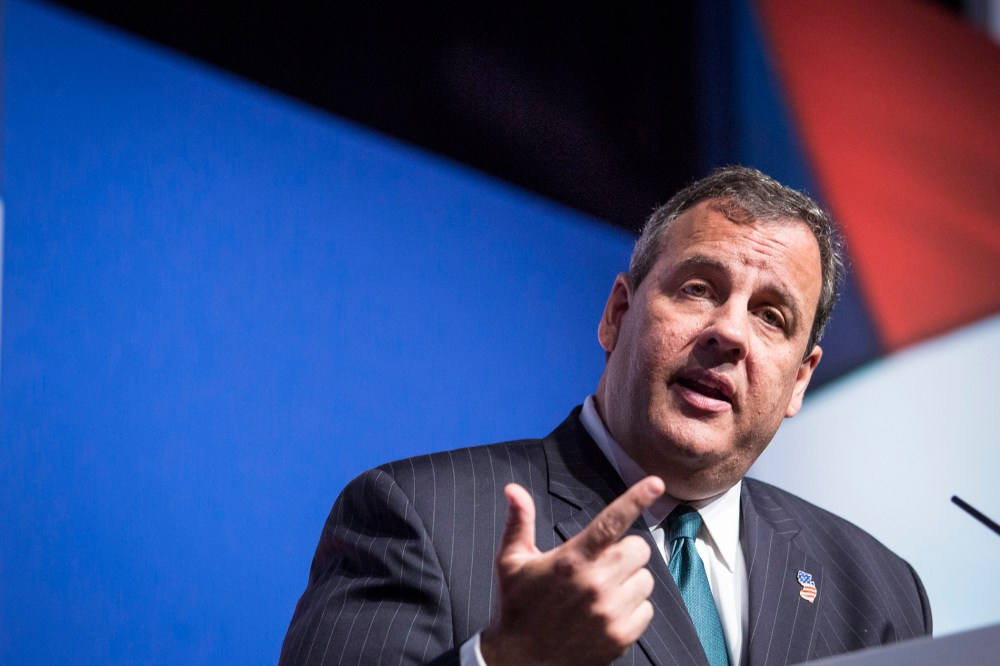
New Jersey Gov. Chris Christie, a Republican not known for his emphasis on social issues, pitched religious conservatives on an expanded definition of “pro-life” politics on Friday that emphasized education and drug treatment as well as abortion.
“You can’t just afford to be pro-life when the human being is in the womb,” Christie said at a conference in Washington. “You have to be pro-life after you leave the womb.”
He was one of a number of top GOP leaders, including Rick Santorum, Rand Paul, and Michelle Bachmann, who delivered remarks at Road to Majority convention, organized by the Ralph Reed-founded Faith and Freedom Coalition in Washington this week. The event is considered a way station for potential presidential candidates, giving them a chance to connect with influential religious conservatives whose endorsements could be crucial in a Republican primary.
Christie sidestepped fiery rhetoric on abortion, but made clear that he had always been willing to “speak very frankly to people about the sanctity of life,” despite being an anti-abortion politician in a liberal state. He mocked Democrats for claiming the GOP was “intolerant” on social issues, accusing the other side of blocking pro-life speakers from its national conventions while Republicans showcased pro-choice leaders like Condoleezza Rice.
The meat of his speech, however, concerned his record on the economy, education, crime, and addiction. He described how his administration is trying to reform drug laws to expand treatment for non-violent addicts instead of jailing them. He told familiar stories about his battles with teachers unions to institute merit pay and expand charter schools.
“We need to stand up for the hurt and the wounded, there needs to be a culture of life that Pope John Paul II talked about,” Christie said. “From the womb until natural death, we need to be there even for those who stumble and fall, to be there to lift them up. To me that’s the true meaning, the complete meaning, of being pro-life.”
Christie also offered a strong denunciation of President Obama’s record on foreign affairs, blaming crises in Syria, Iraq, and Ukraine on his failure to speak “profoundly and inspirationally about what America’s role is” in the world. Beyond that, he offered few direct policy prescriptions for resolving the various conflicts amid an intense debate over how to respond to the rapid rise of a Sunni insurgency in Iraq.
Christie was headed later Friday to New Hampshire, home to the first-in-the-nation presidential primary.
By contrast, Rand Paul, the Kentucky senator who has clashed with the more hawkish Christie on national security in the past, attacked the administration for providing arms to rebels in Syria (a move many Republican hawks favor.) Paul claimed the weapons make their way to Islamic groups who were “intent on killing Christians.”
“The vast majority of Christians in Syria are on the opposite side of the war,” Paul said.
While Christie was considered a potential front runner for the GOP presidential nomination throughout 2013, his popularity has plummeted in national polls since the disclosure that top officials in his administration had closed traffic lanes on the George Washington Bridge in an alleged effort to punish a Democratic mayor for refusing to endorse his campaign.
Christie has denied any involvement, but the issue still hung over him at Friday’s event even months after the story broke. Radio host Michael Medved, the next speaker after Christie, made a joke about attendees being delayed due to bridge closings. Santorum, a former Pennsylvania senator and one of the most prominent religious conservatives in the GOP, used his address to focus more on economic challenges, which he linked to a lack of stable two-parent homes. “The first economy is the home,” he said. “And yet you see many people in our party and our movement who don’t want to fight for the most basic institution that holds the family together and that’s the institution of marriage.” Santorum has argued since 2012 that Mitt Romney lost the presidential race because of the party’s emphasis on corporations and Wall Street over average Americans, a case Santorum laid out in a new book titled “Blue Collar Conservatives.” Recently he came out in support of a minimum wage increase, an issue Democrats have made a centerpiece of their 2014 campaign messages. “We need to have an agenda that speaks across the economic spectrum,” he said. “We need to be the party of the worker, not just the party of business. We need to be the movement that says we want to make things in America again.” Rep. Kevin McCarthy, R-Calif., the newly elected House majority leader, delivered a speech describing how he rose from a small business owner running a deli in his native Bakersfield to eventually representing the area in Congress. “I know we’re frustrated,” he said. “I hear the message, and I want to pledge this one item to you … we will unite, we will have the courage to lead and the wisdom to listen, and we will turn this country back around.”
Benjy Sarlin Recommended


