








ATLANTIC CITY, N.J. — Several casinos here have shuttered or will soon. Others are drab shells of their former selves. Gaming revenue has plummeted. Hotel workers are worried. Atlantic City is in big, big trouble.
And that’s a problem for Chris Christie.
This state’s Republican governor placed a big bet on AC near the start of his tenure in office, unveiling a five-year plan to revive the struggling city which had fallen victim to the proliferation of neighboring states’ casinos and to the economic downturn. But with two casinos having closed their doors in the last week plus another one planning to later this month–and around 6,000 people set to lose their jobs, according to city officials – it’s a bet that Christie is clearly losing.
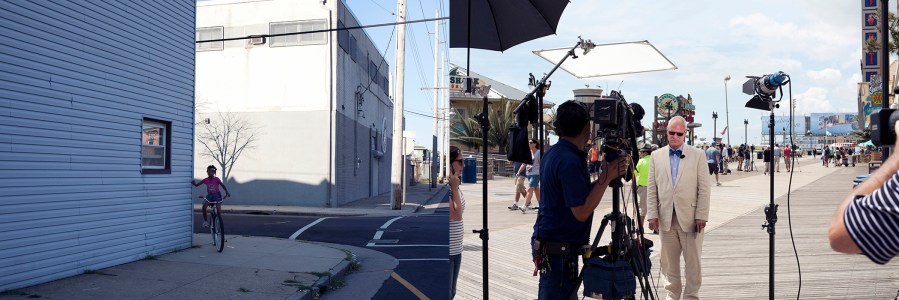
At a recent town hall meeting in nearby Ocean City, worried casino workers begged the governor to come to the rescue. He’ll host a summit Monday with state and local leaders to mull the city’s future. And last week, Mayor Don Guardian announced a job training program for affected city residents—a response that seemed more to evoke the Rust Belt than one of the nation’s wealthiest states.
“The plan certainly hasn’t done what the governor said it would,” said Lorenzo Langford, a Democrat who lost his re-election bid last year as the city’s mayor. “I think that this is going to be his legacy,” Langford said. After the controversy over the closure last year of the George Washington Bridge, Christie can scarcely afford another home-state embarrassment dragging down his prospects for the 2016 Republican presidential contest. And already, his political opponents are pouncing.
%22Many%20hold%20Christie%20responsible%20for%20failing%20to%20come%20up%20with%20a%20coherent%20plan.%22′
Atlantic City was showing signs of decline before Christie took office in 2010. But the following year, the governor committed the state to a five-year plan to revive the iconic city. His administration established a state-run tourism district, shelled out millions in gambling profits to cleanup and promotion, and eased casino regulations.
At the center of the revival strategy was Revel – an ultra-modern, luxurious, $2.6 billion casino that towered above the rest of the city when it opened in April 2012. The long-delayed project was finished only after the state pledged $260 million in tax rebates over the next 20 years to help give the troubled project a nudge. Before its official opening, Christie pointed to the glass-windowed, 6.3-million-square-foot beachfront resort as a signal that Atlantic City was on the rise.
“I believe it’s going to spur more growth and more investment in Atlantic City as more people go down there to enjoy Revel,” he declared. “I’m proud the state has played a part as an equity partner in it to make it happen and create the jobs that were created to build it.”

Two years later, Revel is at death’s door. It filed for bankruptcy protection for the second time in June, and ceased operations last weekend.
“I was in shock and disbelief,” said Ronnie Downing, a 56-year-old kitchen steward at Revel, recounting the moment he found out the hotel would be closing. Working five days a week for $8.65 an hour to support himself and his wife, the Atlantic City resident says he’ll have to scale down on driving to save gas money and potentially cut back on the medication he takes for his high blood pressure.
“I’m disappointed in management and the government,” Downing said. “I know there’s more we could have done. We pulled out of this too early.”
Revel isn’t alone. The Atlantic Club Casino Hotel closed its doors for good in January. Showboat, owned by Caesars Entertainment, closed at the end of August. And Trump Plaza’s last day is Sept. 16.
Money from Atlantic City gaming has declined to $2.8 billion last year from a high of $5 billion in 2006, industry stats show. Analysts say that’s thanks largely to expanding casino operations in neighboring states like Pennsylvania, New York, Delaware and Maryland—as well as the impact of the Great Recession and Hurricane Sandy.
Political observers say Atlantic City’s massive job losses—especially coming after the governor’s bullish talk about the city’s prospects for revival—could weigh down a Christie presidential run.
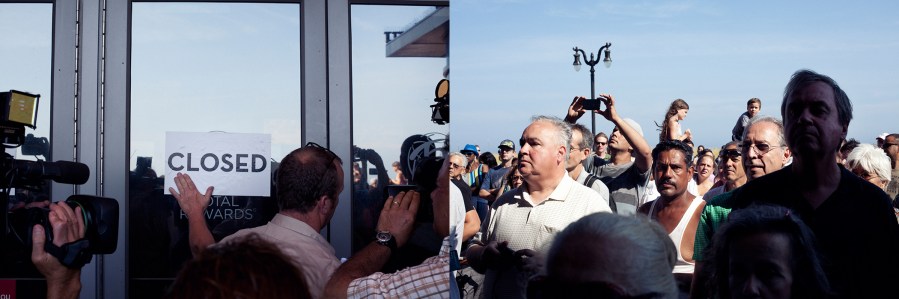
State Sen. Raymond Lesniak, a Democrat, predicted that what’s happening in Atlantic City will “jeopardize” Christie’s presidential ambitions. “I don’t think Christie is to blame for the problems in Atlantic City,” Lesniak said. “But he’s to blame for not solving it and helping to revitalize the economy.”
“Many hold Christie responsible for failing to come up with a coherent plan and preparing for what were clearly going to be economic woes for the city,” said Brigid Harrison, a political science professor at Montclair State University. “I don’t know that the casinos are going to be a huge problem for him. I think the trickier thing would be the slow pace of recovery in general, and this is one component of that. The national economy is going to be an important issue for voters across the country. If you are governor of a state in which you saw better economic recovery, why wouldn’t you use that against Gov. Christie?”
%22I%20know%20there%E2%80%99s%20more%20we%20could%20have%20done.%20We%20pulled%20out%20of%20this%20too%20early.%22′
Christie, whose office didn’t respond to requests for comment for this story, has said he’s doing everything he can to save jobs, but that he can’t mandate that casinos stay open. “I cannot force someone to continue to lose money,” he said at a recent town hall.
The governor left for Mexico Wednesday for what’s being billed as an economic trade mission for the state – but the three-day trip is fueling further speculation he’s seriously considering a 2016 presidential run, trying to beef up his foreign policy credentials and win over potential Hispanic voters. Last week at Revel, the resort was only honoring current reservations. On a recent evening in August—supposedly a busy month—a sign saying the maximum capacity was 13,140 on the main casino floor seemed like a joke, as only around half a dozen tables had players at them. No one was at the kiosk check-in in the cavernous hotel lobby. At Trump, row after row of slot machines sat empty. A “VIP Registration” glass room with leather chairs in the lobby was locked up, the lights turned off. The gift shop’s shelves were empty—not because of gangbusters sales, but because no one had bothered to restock. JekateRina Rimska, a cocktail waitress at Showboat for 13 years, says there’s more the governor could be doing. “I’m absolutely disappointed in Christie,” the 36-year-old single mother said. “He could help extend the closure or help find a reliable buyer.” Rimska said Monday’s summit is too late for Showboat. “What will we do? Where will we go?” she asked. “It seems like I’ll be forced out the region.” There are bright spots. Liza Cartmell, executive director of the Atlantic City Alliance, said non-gaming spending has increased, and that the city’s economy had done surprisingly well over the summer, thanks to some concerts and other events. Still, there are fears that the pending closings of the three casinos will have spillover effects. Ron Dibona, a hotdog and snack vendor who has worked in the city for 25 years, sat underneath a tree near Trump Plaza. “Business was bad this summer already,” said Dibona. “With the closings, it’s gonna hurt us even more.”Recommended


