








TOKYO — Asian stocks fell to a three-month low on Thursday after China opted to keep guiding the yuan sharply lower, deepening concerns about the economy and the potential for competitive devaluations by other countries.
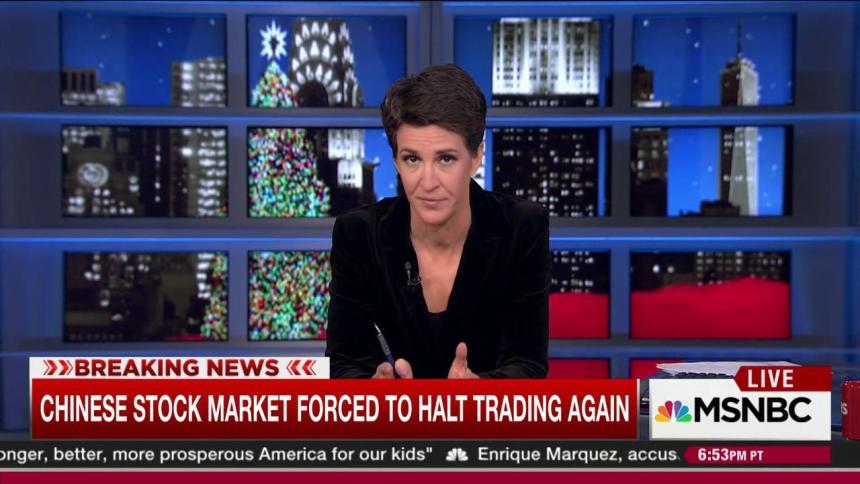
Shanghai shares tanked more than 7 percent and trading was halted as the fall triggered a circuit breaker, despite recent supportive measures announced by Chinese authorities.
MSCI’s broadest index of Asia-Pacific shares outside Japan <.MIAPJ0000PUS> dropped 1.4 percent, hitting its lowest level since late September.
Japan’s Nikkei shed 1.5 percent. Australian shares lost 1.5 percent and South Korea’s KOSPI fell 0.7 percent.
Fears for the health of the Chinese economy, reflected recently in a sharply lower yuan, have become a key topic worrying investors so far in 2016.
Shares in Asia extended losses after the People’s Bank of China (PBOC) set the yuan midpoint rate at 6.5646 per dollar prior to the onshore market open, 0.50 percent weaker than the previous fix 6.5314. It was the biggest fall between daily fixings since August and the eighth day in row for the PBOC to set a lower guidance rate.
Offshore yuan fell to a fresh record low since trading started in 2010 before trimming a chunk of its losses on suspected intervention, but this did little to soothe sentiment.
Financial markets fear the yuan’s rapid depreciation may accelerate, which would mean China’s economy is even weaker than had been imagined, and could therefore spark another wave of competitive devaluations around Asia and in other key economies.
“The Chinese yuan is smack bang at the heart of concerns and much has been made of the comments in the China Securities Journal that the weakness in the CNY is not actually causing instability,” wrote Chris Weston, chief market strategist at IG in Melbourne.
“This is key, and traders feel this portrays more CNY weakness to come and therefore additional strain on the global economy, not to mention corporate China.”
Wall Street shares closed at three-month lows overnight amid the general risk aversion, amplified by a continuing decline in crude oil prices and geopolitical concerns following North Korea’s nuclear test on Wednesday.
U.S. Treasuries gained from a consequent flight to quality. The benchmark 10-year note yield sank 9 basis points to its lowest since mid-December. The yen, another beneficiary in times of perceived global turmoil, also attracted bids. The dollar fell to a four-month low of 117.66 yen. The greenback was also weighed down after the Federal Reserve’s December policy meeting minutes suggested further U.S. rate increases would be gradual because of concerns about persistently low inflation. The euro was up 0.2 percent at $1.0804 with the dollar on the back foot. The Australian dollar, often used as a proxy for China-related trades, fell to a two-month low of $0.7025 . In commodities, Brent crude fell to an 11-year low of $33.41 a barrel after data showed a surprisingly big build-up of U.S. gasoline stocks, adding to fears of a growing global glut. The crude oil market has so far shrugged off rising geopolitical risks such as the tensions between Saudi Arabia and Iran, and North Korea’s nuclear test. Recommended



Reuters