








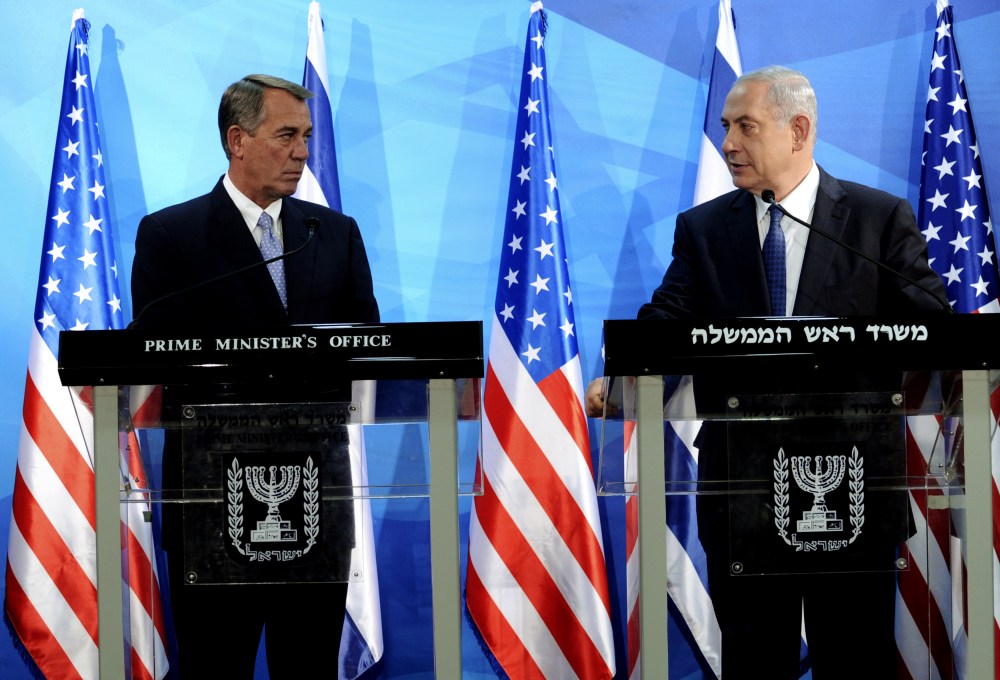
Who would have thought, just a few years ago, that relations between the United States and Israel would hit such an historic rock bottom?
Whether it’s from the assorted tantrums, slights or outright “in-your-face” moments, the clear and present danger of the United States and Israel at odds with one another is troublesome. With the March 17 re-election of Israeli Prime Minister Benjamin Netanyahu behind them and the establishment of a possible Palestinian state thrown into doubt, as well as Netanyahu’s legitimate opposition to the nuclear deal that the Obama administration is negotiating with Iran, now is the time for both the president and the prime minister to act less like playground bullies with each other and more like the leaders we need them to be.
%22Israel%E2%80%99s%20security%20is%20ensured%20not%20only%20by%20our%20military%20and%20intelligence%20support%20but%20also%20by%20our%20diplomatic%20support%20in%20international%20forums.%20What%20happens%20if%20that%20goes%20away%3F%22′
Unfortunately, it doesn’t take much to get a sense of the impact the tensions between these two men is having on the rest of us.
Support for Mr. Netanyahu’s speech before the Congress hit a brick wall with most Democrats. Minority Leader Nancy Pelosi summed it up this way: “As one who values the U.S.-Israel relationship, and loves Israel, I was near tears throughout the Prime Minister’s speech — saddened by the insult to the intelligence of the United States as part of the P5 +1 nations, and saddened by the condescension toward our knowledge of the threat posed by Iran and our broader commitment to preventing nuclear proliferation.”
Similarly strong views emerged regarding the administration after Mr. Netanyahu’s successful re-election: “Mr. Obama’s clumsy and malicious handling of relations with Israel … is but one brick in a wall of failure and infamy,” Peter Wehner wrote in Commentary. “The fact that … Netanyahu emerged victorious in his (election) confrontation with Obama – a confrontation that can be traced to Obama’s hostility not just to Netanyahu but to Israel — is a heartening development in a world that is increasingly chaotic and violent.”
Where does our alliance with Israel find accommodation and cooperation in such rhetoric?
Netanyahu’s speech before the U.S. Congress, his re-election, along with the prime minister’s last-minute campaign declaration that he would oppose a two-state Israeli-Palestinian peace process (not to mention his overt last minute race-baiting voter turnout tactics), undoubtedly sets the tone for relations between our two countries until the end of the president’s term. Unfortunately, while the military and intelligence cooperation continues, the fact that Netanyahu and Obama don’t get along has real consequences.
By all accounts, Mr. Obama desperately wants to revive talks toward a two-state solution – it is his “legacy,” some say. To that end, the administration mustered a bit of its own bluster by calling Mr. Netanyahu’s bluff in making it clear the United States may reconsider protecting Israel from United Nations resolutions critical of Israel or backing a two-state solution.
After the post-election pushback from the White House, the Israeli leader clarified that “I haven’t changed my policy. What has changed is the reality. I don’t want a one-state solution; I want a sustainable, peaceful two-state solution, but for that, circumstances have to change. I was talking about what is achievable and what is not achievable. To make it achievable, then you have to have real negotiations with people who are committed to peace.”
The president, however, isn’t mollified.
Quite frankly, President Obama will never be happy with Mr. Netanyahu’s or any congressional input on his negotiations with Iran. In fact, the administration raising concerns that it may stand with the United Nations has two goals: to teach Netanyahu a lesson and to do an end-run around Congress regarding the Palestinian question. The problem, however, is that Israel’s security is ensured not only by our military and intelligence support but also by our diplomatic support in international forums. What happens if that goes away?
Former U.S. Middle East diplomat Dennis Ross chillingly wrote in his 2004 book, “The Missing Peace,” “Would the Arab world even believe it had to accommodate itself to Israel’s existence, if it had reason to question the staying power of the U.S. commitment to Israel?” Despite the Obama administration’s assurances that a U.S. security commitment will always be there, if Iran and other radical Islamic players in the Mideast see the U.S. publicly turn its back on Israel in the United Nations, then they will have good reason to question America’s long-term commitment to the Jewish state. And act accordingly. Further looming over the deterioration of U.S.-Israeli relations is the specter of the radical Iranian ayatollahs poised to develop nuclear weapons. %22Quite%20frankly%2C%20President%20Obama%20will%20never%20be%20happy%20with%20Mr.%20Netanyahu%E2%80%99s%20or%20any%20congressional%20input%20on%20his%20negotiations%20with%20Iran.%22′ As former U.N. Ambassador John Bolton noted in The New York Times, “Whether diplomacy and sanctions would ever have worked against the hard-liners running Iran is unlikely. But abandoning the red line on weapons-grade fuel drawn originally by the Europeans in 2003, and by the United Nations Security Council in several resolutions, has alarmed the Middle East and effectively handed a permit to Iran’s nuclear weapons establishment.” The domino effect of Mr. Obama’s Iran nuclear policy is profound. Ambassador Bolton states that “[n]eighboring countries are moving forward, driven by fears that Mr. Obama’s diplomacy is fostering a nuclear Iran. Extensive progress in uranium enrichment and plutonium reprocessing reveal its ambitions. Saudi, Egyptian and Turkish interests are complex and conflicting, but faced with Iran’s threat, all have concluded that nuclear weapons are essential.” Consider, too, the factor of U.S. domestic politics. Whatever Secretary of State John Kerry comes back with for a final Iranian deal is going to be under immediate attack by Republicans and some influential Democrats in Congress. There are more Democrats in Congress than one might think who have serious concerns about any deal by which Iran gets to enrich uranium and manufacture plutonium for long-range missiles. Indeed, a growing question for Democrats is whether they will continue to silently support the president’s open contempt for Netanyahu and for the security concerns of the Jewish state, or will they join in applying pressure on the president and his administration to back off of policies that are not advancing either peace or stability in the region — or the long-term national security interests of the United States and Israel. Michael Steele is former Chairman of the Republican National Committee and an MSNBC Political Analyst.
Michael Steele
Michael Steele is a co-host of "The Weeknight," which airs Monday through Friday at 7 p.m. ET on MSNBC. He is a former lieutenant governor of Maryland and a former chairman of the Republican National Committee. Recommended


