








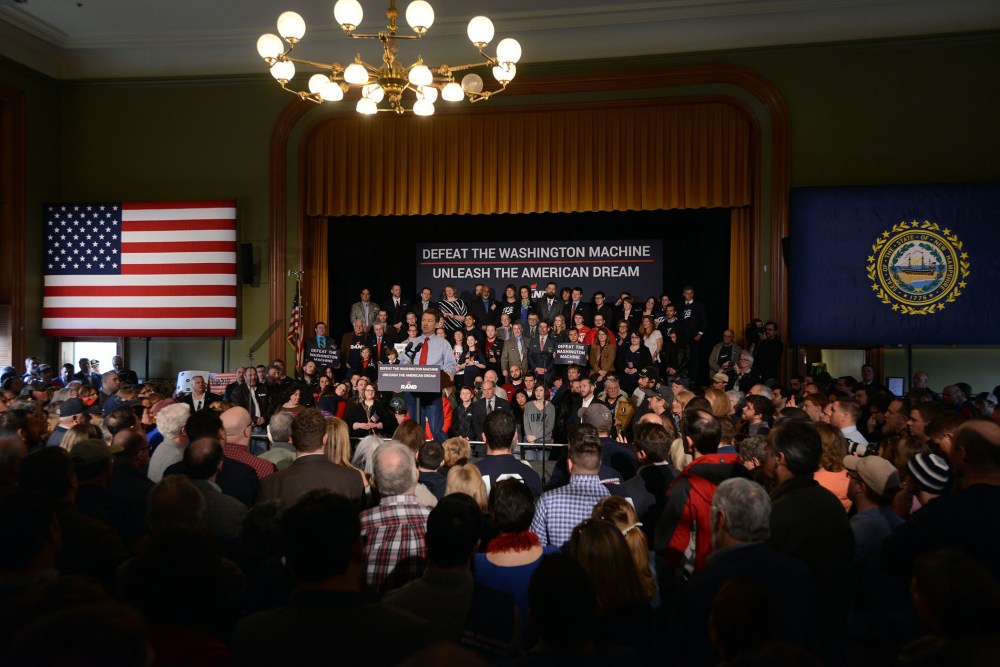
The Republican primary for next year’s presidential election has begun in earnest. More than a dozen candidates have declared, and the crowded field will only grow louder as prospective contenders seeks to distinguish themselves. But beyond the run-of-the-mill buzzwords dominating announcement speeches and fundraising emails, policy ideas inevitably will need to come front and center.
When they do, will Republicans seize the opportunity?
The post-2012 autopsy of the GOP’s losses called for extensive outreach to new and growing constituencies, including women, African-American, Asian, and Hispanic voters. This is crucial to give Republicans any shot at winning back the White House and returning the country to a conservative vision for prosperity. It’s also key to keeping the Senate, especially in the must-win states of Illinois, Florida, Nevada, Wisconsin and Pennsylvania.
RELATED: Jeb Bush and the ghost of W.
Losing minority voters in large numbers in each of those states was a detrimental blow to the Romney campaign in 2012. With turnout in these important constituencies expected to be high in 2016, policies that build upon ties to these critical communities are in desperate need of Republican support.
%22Finding%20a%20little%20compassionate%20conservatism%20in%20today%E2%80%99s%20changing%20political%20landscape%20could%20go%20a%20long%20way.%22′
In 2010 and 2014, Republicans campaigned heavily on the need to repeal Obamacare. Despite the recent ruling by the Supreme Court in King v. Burwell, the law remains flawed and has not lived up to its core promises. As conservative leaders continue to push for its repeal, many are already thinking about next steps for health care policy, both in beginning to draft new initiatives and to identify and better utilize existing programs. Programs that have shown to be effective in the past should be embraced by Republicans, whether up for reelection or not.
For example, in 1992, President George H. W. Bush signed into law the Veterans Health Care Act of 1992 which created, among other things, a program for pharmaceutical pricing known as 340B. The 340B program is simple: in order for pharmaceutical companies to participate in the Medicaid program, they must sell their outpatient drugs to safety-net hospitals, clinics, and other health care providers at discounted prices. It’s a revenue neutral program that doesn’t cost taxpayers anything, all the while expanding access for low income and minority patients in rural and urban areas alike. With health care providers in rural and urban areas being buried by Obamacare’s expensive federal mandates and increasing numbers of Medicare and Medicaid patients at hospitals which are insufficiently reimbursed for their care, their struggles are only increasing.
340B, and other programs like it, are examples of being both morally (bringing needed drugs to the poor) and fiscally (pricing such drugs cheaply) responsible.
In bringing fresh eyes to existing policies like the 340B program, Rep. Paul Ryan, current chair of the House Ways and Means Committee and former vice presidential candidate, has begun to make the moral and fiscal argument for a return to compassionate conservatism—articulating the kind of reforms that enhance oversight, engage those using government services, especially patients, and reach potentially new constituencies. Ryan understands that Congressional action which would effectively raise drug prices on critical-access hospitals would be a mistake. Every time a hospital or clinic closes its doors, ramifications are felt throughout the community, whether it’s in an urban area or a rural one. Jobs are lost, ambulance response times grow longer, and state and local governments have to weigh a bailout against too many other fiscal pressures to count. Adding to these costs, and to the government’s balance sheet, should be avoided like the plague. Other Republican leaders are also focusing much-needed attention on new approaches to addressing old problems. Sen. Rand Paul has identified criminal justice reform as a key part of his efforts to improve the nation’s fiscal health while increasing efforts into minority communities disproportionately affected by our justice system. From mandatory sentencing laws to juvenile offender statutes, minority communities are desperately in need of smart government reforms. Paul’s recognition of this is politically savvy and policy smart. Conservatives should follow the lead of Ryan and Paul and embrace the opportunity to improve their standing among these key constituencies while advancing sound policy. RELATED: Paul vows police reform in 2016 Poll after poll regularly finds that Americans view Congress as out of touch with the average citizen, and for good reason. With both the House and Senate under GOP control, such polls are a major liability that can negatively impact the Republican brand as a whole and individual candidates stumping in their states and districts. As 2016 quickly approaches and campaigns move into overdrive, it’s important for Republicans to focus on the critical issues of our time and honor the roots of the Grand Old Party. But finding a little compassionate conservatism in today’s changing political landscape could also go a long way. Our success in the next election, and beyond, depends on it. Michael Steele is the former Chairman of the RNC and a political analyst at MSNBC.
Michael Steele
Michael Steele is a co-host of "The Weeknight," which airs Monday through Friday at 7 p.m. ET on MSNBC. He is a former lieutenant governor of Maryland and a former chairman of the Republican National Committee. Recommended


