








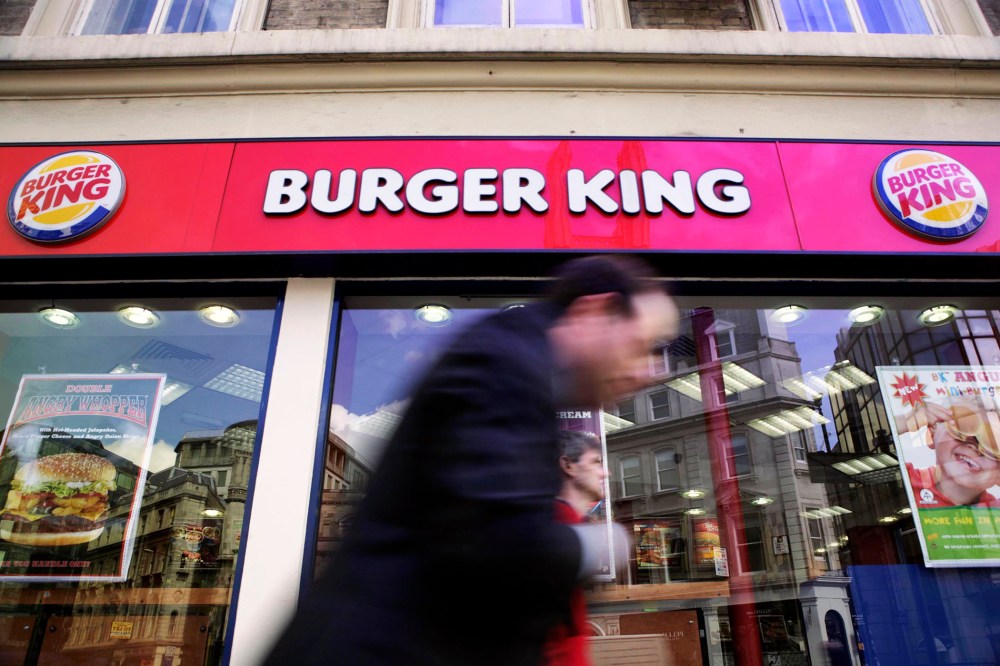
With its acquisition of the Canadian coffee-and-donuts chain Tim Hortons, Burger King is the latest U.S. company to reduce its tax bill by reincorporating abroad, a process known as inversion.
Or is it? Burger King’s executive chairman, Alexandre Behring, told reporters today, “This is not a tax-driven deal. It is fundamentally about growth and creating value through accelerated expansion.”
But even if Burger King has little to gain from reincorporating in Canada — where its effective tax rate will, executives at the company insist, not be much lower than in the U.S. — the company also has little to lose by emigrating.
Burger King is only nominally an American company now. It was bought in 2010 by 3G Capital, a Brazilian-owned private equity firm with offices in New York and Rio de Janeiro; among its four principals is Jorge Paulo Lemann, who ranks 28th on the Forbes 400 list and is probably Brazil’s richest citizen. According to Bloomberg BusinessWeek, Lemann “ate his first Burger King hamburger only after acquiring the company and commented that he found it too big.” (Lemann, the article explained, “prefers a bottle of water and a salad.”)
Burger King had previously been under foreign ownership during the 1990s, when its corporate master was the London-based conglomerate Grand Metropolitan and, subsequently, the London-based liquor company Diageo. Neither company managed Burger King especially well, and in 2002 Diageo unloaded Burger King on TGP Capital, a Texas-based private equity firm, in partnership with Bain Capital and Goldman Sachs. When sales took a hit after the 2008 crash, TGP, Bain, and Goldman sold Burger King to 3G, which took the fast food giant public but retained a 70% share (and will end up with a 51% share after the Tim Hortons merger).
What gives a company its national character? Not who owns it, many would argue, but rather, who works for it. But if that’s the case, then Burger King is already less American than it was four years ago. That’s because 3G did what private equity firms typically do: It slashed costs, mainly by firing people—375 from the Miami headquarters and an additional 275 abroad, according to Bloomberg BusinessWeek. It also “refranchised” by selling off all but 52 of its nearly 1,400 company-owned restaurants, increasing the number of its franchised restaurants to nearly 14,000. One widely-cited benefit to re-franchising was that it enabled Burger King to shift the cost of planned restaurant renovations from the company to its franchisees. This is perhaps the most singularly American thing about Burger King. As I’ve documented elsewhere, U.S. corporations have blazed a trail in recent decades dreaming up seemingly infinite ways to off-load financial obligation to front-line and lower-wage workers, essentially adapting the 19th century institution of sharecropping to the 21st century postindustrial economy. Another American trick is to shift health care and other “living wage” costs onto federal, state, and local governments while sternly lecturing Canada and other advanced industrial democracies about their excessively socialistic ways. According to an October 2013 report by the nonprofit National Employment Law Project, food workers at Burger King restaurants — the overwhelming majority of whom are not employed directly by Burger King — receive about $356 million in public assistance each year. That subsidy will continue after the new merged company is incorporated in Canada. Maybe Burger King’s merger will lower its taxes significantly and thereby raise everyone else’s; maybe the company’s tax savings will, as Behring says, be negligible. But regardless of its nationality, Burger King will continue to play the game of driving profits as high as possible while benefiting as few Americans — or persons of any nationality — as possible. It’s an American habit, and the rest of the world is getting pretty good at it, too.
Timothy Noah Recommended


