








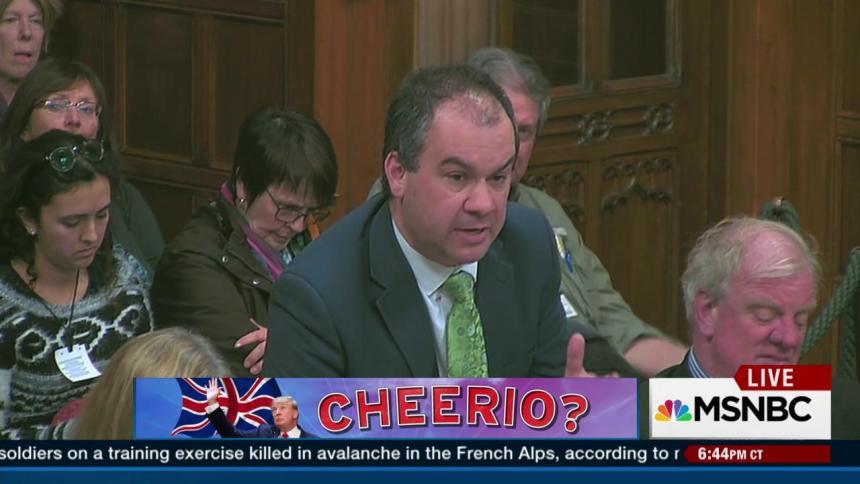
In a robust debate at Westminster Hall on Monday, members of the British Parliament earnestly weighed whether Republican front-runner Donald Trump should be banned from visiting their country,
The widely publicized hearing was the result of both pro and con petitions that drew hundreds of thousands of signatures from British citizens over the past few weeks. The U.K. Home Secretary, who has the actual authority to ban Trump’s entry, has already declined to do so, but also made it clear earlier this month that Prime Minister David Cameron considers the real estate mogul’s rhetoric on issues like immigration “divisive, unhelpful and wrong.”
On Monday, the debate was largely divided between those who felt that banning Trump would be an affront to free speech (even though there was near-universal condemnation of his Muslim travel ban proposal among members of Parliament), those who thought a ban would only bring him more unwarranted publicity (“Why feed this machine?” one lawmaker asked rhetorically), and those who felt that his racially charged rhetoric could actual inspire violent acts of hate. The U.K. has set a precedent of banning certain figures who have been found guilty of inciting racial hatred and terrorist acts, and supporters of the petition to ban Trump have argued that his allegedly anti-immigrant, anti-Muslim comments pose a similar danger.
RELATED: Trump slams UK petition, praises controversial writer’s take on ‘Muslim problems’
“I believe that we should greet the extreme things that this man says with our reasonableness and our own hospitality,” said Paul Flynn of the Labour party in his remarks. He suggested that by banning Trump, his U.K. opponents would only make the Republican presidential candidate into a “martyr.” “We should not build him up with our own attacks,” he added.
Flynn’s more tempered comments were followed by much more colorful critiques of Trump. He was called “the orange prince of self-publicity,” “racist,” “homophobic,” “misogynistic,” “a demagogue” and “an idiot,” by various speakers, many of whom nevertheless raised concerns about the message it would send to a cherished ally should the U.K. ban a potential future American president from their soil. Others argued that “the classic British response of ridicule” should be used to combat Trump’s alleged “hate speech,” not an official rebuke.
Still, despite the unlikely chances of a ban being put in place, several British members of Parliament made impassioned arguments for why Trump presents a unique threat to the safety and security of Muslims in particular in Great Britain. “He’s talking about me, he’s talking about my family, my children,” Tasmina Ahmed-Sheikh, a Muslim member of Parliament for the Scottish National Party, said in an emotional address. Her words were buttressed by Labour lawmaker Jack Dromey who said “ISIS needs Donald Trump and Donald Trump needs ISIS.” “He is free to be a fool. He is not free to be a dangerous fool on our shores,” he said. “I don’t think Donald Trump should be allowed within 1,000 miles of our shores.” Dromey’s remarks and the heated criticism of Trump from other Parliament members, did spark some pushback from lawmakers who lamented the nation’s preoccupation with political correctness. (“People are fed up of being told what they can or can’t think,” Conservative party member Philip Davies claimed.) Meanwhile, others said, by attacking Trump in a such a public forum, they were “playing into his hands.” Trump was busy campaigning at Liberty University in Virginia while the petition debate was ongoing, but his company did say it was an “absurd” waste of Parliamentary time in a statement released on Monday. But British lawmakers, by and large, take Trump and his ascendancy very seriously because as Muslim member of Parliament Tulip Siddiq of the Labour party argued, “He is interviewing for the most important job in the world. His words are not comical.”
Adam Howard Recommended


