








States from Rhode Island to Louisiana took steps this week toward making voting easier. In Washington, a new bill that would automatically register citizens to vote when they turn 18 is gaining traction among Democrats. And Ohio’s top voting official blocked a Democratic lawmaker on Twitter amid a spat over efforts to increase access to the ballot in the nation’s most pivotal swing state.
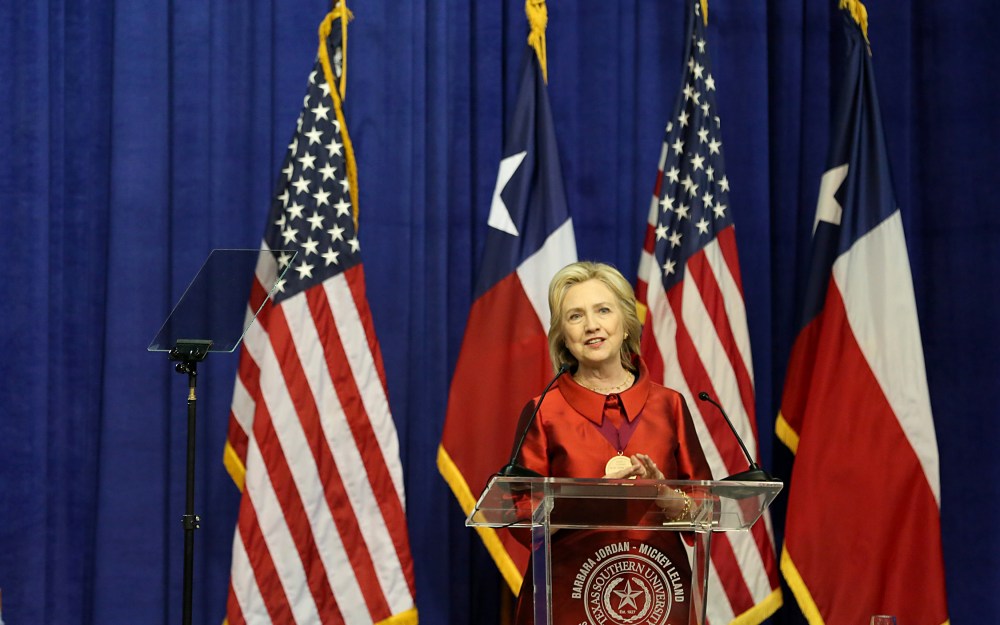
It’s more evidence that Hillary Clinton’s major speech on voting last Thursday helped move along a conversation — already underway, to be sure — about how to to expand access to the ballot, especially by modernizing voter registration systems. It’s a conversation that threatens to put Republicans on the defensive after years of playing offense on the issue with a wave of restrictive voting laws.
RELATED: Hillary Clinton lays out sweeping voting rights vision
In her speech in Houston last Thursday, Clinton laid out an expansive and positive agenda to boost voting participation. The centerpiece was automatic voter registration, in which any citizen who has contact with the DMV is automatically registered unless he or she chooses to opt out—putting the responsibility for registering on the government rather than the individual. But Clinton also talked up online voter registration, a nationwide standard of at least 20 days of early voting, a full restoration of the Voting Rights Act, and a loosening of felon disenfranchisement laws, among other ideas.
In March, Oregon became the first state in the nation to pass automatic voter registration. Since then, 14 other states plus the District of Columbia—including deep red ones like Texas and Georgia—have introduced automatic registration bills, according to a tally by the Brennan Center for Justice. And three states plus D.C. have this year passed online voter registration, bringing the total number of jurisdictions that offer it to 27.
%22Why%20is%20it%20that%20one%20political%20party%20is%20not%20supporting%20this%20effort%2C%20and%20one%20is%3F%E2%80%9D’
In just the week since Clinton spoke, Ohio and Rhode Island have both moved forward with online voter registration bills, and Louisiana passed a bill to study automatic voter registration. If it weren’t for the fact that most state legislatures have already adjourned for the session, the number of states moving forward with expansive legislation would likely be larger.
“Many, many states are moving in the direction toward a more modern voter registration system,” said Wendy Weiser, the director of the Democracy Program at the Brennan Center. “I’m really glad that this issue is now at a national stage, that we sort of set our sights toward the end goal of a real modern system that registers every eligible voter, that’s accurate, that’s updated, and where the government takes responsibility.”
U.S. Rep. David Cicilline on Wednesday introduced a federal automatic voter registration bill modeled on Oregon’s. The measure already has around 50 Democratic co-sponsors, including powerful figures like DNC Chair Debbie Wasserman Schultz, former Democratic Congressional Campaign Committee Chairman Steve Israel, and civil rights icon Rep. John Lewis.
Cicilline’s bill was in the works before Clinton’s speech, but he said it could still get a boost from her high-profile embrace of the idea.
“Hopefully the secretary’s comments will bring some more attention to this issue, and help us build momentum,” Cicilline said. I think we have a responsibility to do everything we can to remove as many obstacles as possible to voting.”
RELATED: The voting conversation has shifted. That’s good news for Dems.
The bill is unlikely to go anywhere in a Republican Congress that won’t even restore the Voting Rights Act. But Cicilline suggested his legislation could nonetheless provoke a useful and clarifying debate about whether Republicans actually want to make voting easier.
“I think if there’s substantial resistance from the leadership in the House, it will invite a real conversation,” he said. “You know: Why is it that one political party is not supporting this effort, and one is?”
But Ohio might be ground zero for how Clinton’s ambitious plan may already be boosting those looking to make voting easier.
On Wednesday afternoon, State Rep. Kathleen Clyde, a Democrat, was notified on Twitter that she’d been blocked by an account in the name of Secretary of State Jon Husted. The move came after Husted, a Republican, responded defiantly to Clinton’s criticism of Ohio’s voting policies, among other states, in her speech. Husted, rebutting Clinton, called the state “the gold standard” for election administration. That led to a series of tweets by Clyde Wednesday mocking the “gold standard” claim. Clyde accused Husted of improperly purging the vote rolls, and failing to mail absentee ballots to around 1 million eligible voters just because they hadn’t voted recently. And she noted, accurately, that Husted has waged a years-long campaign to reduce early voting. %E2%80%9CThis%20is%20the%20type%20of%20thing%20that%20we%20should%20get%20up%20and%20running%20well%20before%20the%20presidential%20election%20in%20Ohio.%E2%80%9D’ Husted and Clyde also have been sparring over how and whether to advance some of the expansive voting policies Clinton proposed. Though he’s gained a national reputation as an advocate of restrictive voting policies, Husted has long been an advocate of online registration, and he testified Wednesday in support of a Republican-sponsored online registration bill, calling it “a common sense reform that is long overdue.” The bill is expected to pass the Senate, but its prospects in the House are far less clear. But in a letter sent the same day, Clyde wrote that Husted doesn’t need new legislation to implement online registration. She said it’s already in place, but it currently only accepts registration updates, not new registrations. All that’s needed to change that is for Husted to “switch on” full online registration. “He’s been talking about this for years. How about some action?” said Clyde in an interview. “This is the type of thing that we should get up and running well before the presidential election in Ohio.” Husted has said he needs further legislative authority, and election law experts in Ohio say the question is debatable. In the letter, Clyde also urged Husted to support a bill she introduced earlier this year that would establish automatic voter registration. Husted’s office has opposed that measure, misleadingly suggesting — despite the opt-out provision — that it would require people to be on the rolls even if they didn’t want to be. A Husted spokesman didn’t respond to a request for comment about blocking Clyde on Twitter, or about the secretary of state’s positions on online or automatic voter registration.
Zachary Roth Recommended


