








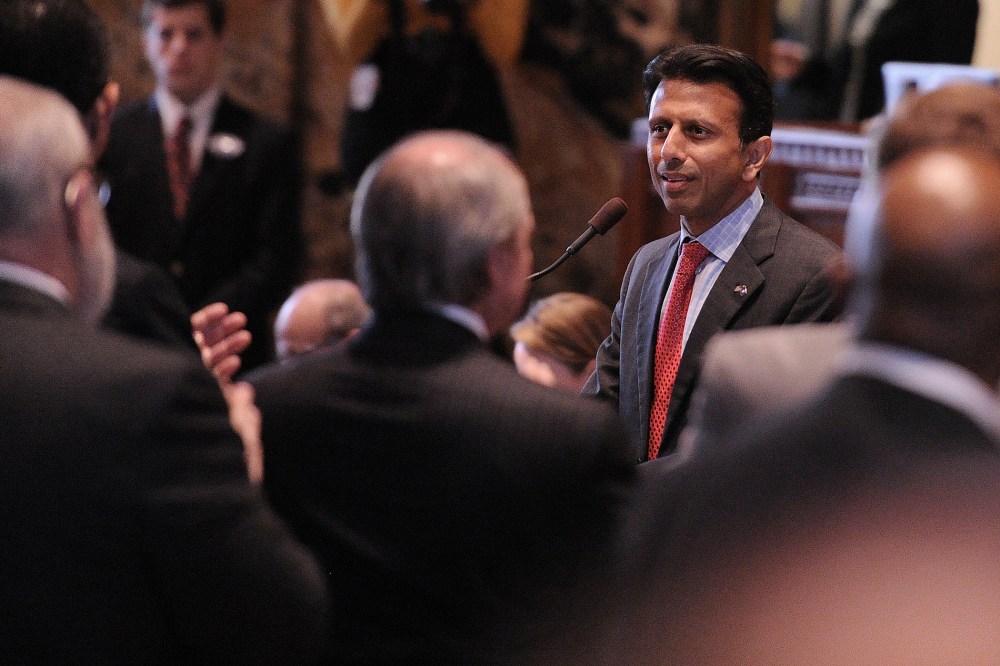
With an eye to 2016, Louisiana Gov. Bobby Jindal unveiled a new health care plan Wednesday and urged his fellow Republicans to play a more constructive role on the issue, even as the GOP wages all-out war on Obamacare.
“I think there are too many Republicans in this town thinking that we should just run against Obamacare, we shouldn’t say anything else more specific until November because that’s a winning strategy,” he told reporters at a breakfast held by the Christian Science Monitor. “There may be short term tactical reasons that makes sense for a lot of people, but I think that’s wrong.”
Jindal, who is weighing a potential presidential bid, picked a momentous occasion to drop his proposal. Less than 24 hours earlier, the White House announced that over 7 million people had signed up for private insurance through the Affordable Care Act, roughly in line with initial estimates. Millions more have joined Medicaid under the law’s expanded formula for coverage.
The news is especially relevant in Jindal’s Louisiana, which has been one of the fiercest battlegrounds over the law.
On the Republican side, Jindal’s approval ratings have sagged over the last year. Democrats believe the decline is at least partially due to his decision to turn down the Medicaid expansion, a portion of Obamacare that’s scored strong support in polls even as the same respondents dislike the law overall.
That theory will get a major test in 2014. Democratic Senator Mary Landrieu is staking her re-election hopes on the notion that voters want changes to Obamacare, but are loath to turn down federal Medicaid dollars and abandon the law’s more popular benefits once they actually take effect.
“It is time for Republicans to stop the drumbeat of repeal and join us to make the Affordable Care Act work better,” Landrieu said in a statement on Tuesday after the White House announcement. “I will not allow private health coverage to be taken away from these 50,000 hard-working Louisianians.”
Jindal dismissed the notion that enrollment numbers “under the threat of an IRS mandate” were a White House victory or that repeal was no longer viable now that the law was more entrenched.
“The left likes to say you cant repeal this law,” he said. “I think that’s ridiculous. This is a country that’s done tremendous things.”
But underneath his bravado, Jindal’s new plan nodded towards the changing political environment as Obamacare’s implementation continues apace.
If the administration keeps hitting its targets, a Republican president trying to repeal the law will have to reckon with 36 million Americans covered through the exhanges or Medicaid by 2017. Eliminating the law would threaten to abruptly pull insurance away from tens of millions, an unappetizing prospect for a party that’s spent months telling Americans how angry they should be about false claims of “If you like your plan, you can keep it.”
Much of Jindal’s plan is in line with previous conservative health care proposals: things like block granting Medicaid, turning Medicare into a voucher program in which seniors can purchase private plans, allowing insurance companies to sell plans across state lines, and limiting malpractice lawsuits. A more controversial element, though still familiar from a variety of GOP plans, is to slash tax breaks for employer health care plans and use the savings to provide a deduction for individuals to buy insurance. The standout, however, is that Jindal proposes committing substantial federal dollars to address Americans with pre-existing conditions, many of whom could not obtain affordable or reliable coverage under the old system. Under Obamacare, the costs of covering these consumers are spread out across the insurance market by mandating all Americans purchase insurance. Jindal does away with the federal mandate and proposes instead a $100 billion fund, separate from the Medicaid block grants, for state health care programs that can demonstrate they would lower premiums and cover patients regardless of their health status. “What is interesting is that he is willing to admit that it will take real money,” MIT economics professor Jon Gruber, who helped craft the Affordable Care Act, told msnbc. “[It’s] not enough, but at least it is owning that this is an expensive undertaking.” Many of the Republican plans up to this point have been wary of directly funding any expansion of coverage; Majority Leader Eric Cantor couldn’t even secure party support for a modest $3.7 billion plan to fund high-risk polls for people with pre-existing conditions. This dynamic has made it almost impossible for House GOP leaders to unite their caucus around an alternative to Obamacare that’s both ideologically acceptable and politically viable. Jindal’s plan is still very rough: the governor says it’s revenue neutral, but there are no dollar figures attached to its various components. His fund also might just spawn dozens of mini-Obamacares at the state level — since guaranteeing access to insurance without a mandate is tough — but at least Jindal could claim it wasn’t his decision. Nonetheless, Jindal’s latest proposal is significant in the way it anticipates the difficulties going forward with the same old message. “Repeal and (sorta, maybe, kinda) replace” doesn’t have the same ring it used to back when the law’s core benefits were projections on a budget report instead of actual voters with health insurance.
Benjy Sarlin Recommended


