








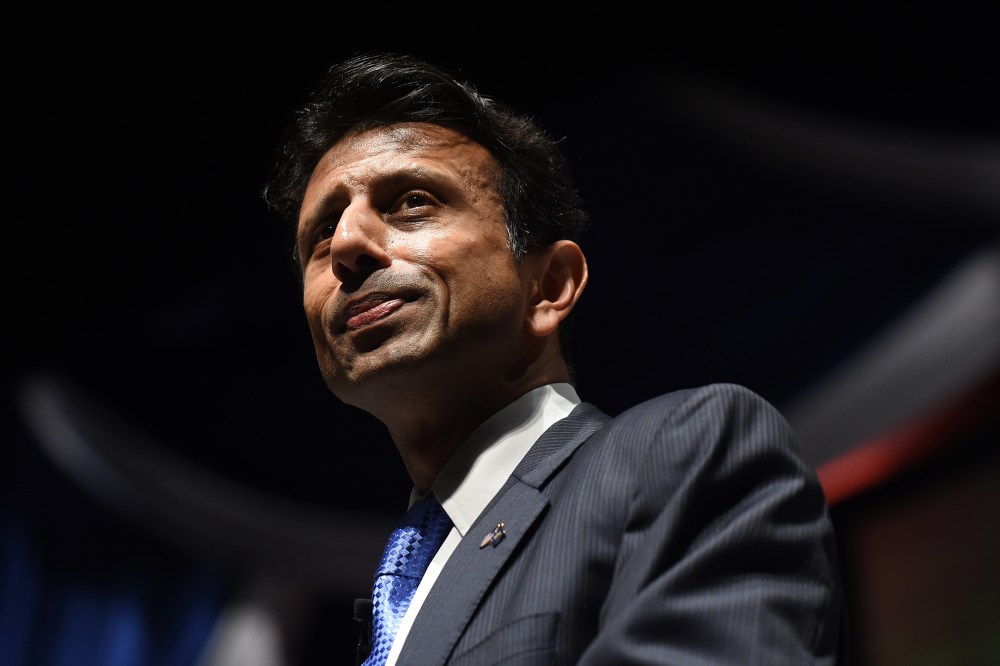
Louisiana Governor Bobby Jindal accused rival Jeb Bush on Wednesday of backing “amnesty” in the former Florida governor’s interview with msnbc’s Jose Diaz-Balart — even though Jindal’s own rhetoric on the issue sounds nearly identical.
“During a recent Spanish-language interview with Telemundo, Jeb Bush called for amnesty for those who are in our country illegally,” Jindal wrote in a fundraising email to supporters. ”I wish I could say I’m surprised. But Jeb Bush has been clear and consistent about his belief that Republicans have to be willing to ‘lose the primary to win the general.’ We just disagree about that.”
The e-mail goes on to say the government “should not and must not reward those who came to this country illegally.”
RELATED: Did Bobby Jindal squander a potential presidential moment?
It’s not clear where the two differ on the topic, however — both have called for legal status for undocumented immigrants and Jindal has explicitly called for a path to citizenship, something Bush backed in the past but now says he doesn’t support.
Welcome to the messy world of Republican immigration politics, where nothing is what it seems.
Let’s take a look at an English translation of Bush’s remarks on immigration in the MSNBC/Telemundo interview:
DIAZ-BALART: How do we resolve the problem of 11 million undocumented and what do you think is the formula for the border to be secured and deal with those people who are here and contribute to the economy with their hard work?
BUSH: Look, first of all, to arrive here legally has to be easier than to arrive here illegally. So one must have a commitment with a border, and just as important, there’s 40 percent of the undocumented that arrived here legally, that have a legal visa and they overstayed And they don’t go back. We must have a plan to solve that. It’s not the most complicated thing in our country, we can do it. We can accomplish it. But for the 11 million people, I believe that they come from out of the shadows they get a work permit, they pay taxes naturally, they pay small fine they, learn English. They don’t get benefits from the federal government, but they come out of the shadows. And they obtain a legal status after some time. I believe that’s the place where one could obtain consensus to solve this problem.
Here’s how Jindal laid out his views on immigration in 2013 in a detailed op-ed in the National Review:
Once the border is secure, and not before, we should provide an opportunity for those who came here illegally seeking to work for a better life to gain legal status rather quickly, if and only if they are willing to do all that is required. We should deport immediately those who engage in criminal activity. We should bar those seeking public assistance from receiving welfare or unemployment benefits for a substantial period of time. After fulfilling other logical and reasonable requirements, we should offer legal status to those currently here illegally so they can work and pay taxes via a guest-worker visa.
…
As for a pathway to citizenship: For folks who came here illegally but are willing to gain proficiency in English, pay a fine, and demonstrate a willingness to assimilate, we should require them to work here and pay taxes for a substantial period of time after obtaining legal status before they have the opportunity to begin the process of applying for U.S. citizenship.
So to reiterate: Bush said he wanted to bolster border security, crack down on visa overstays and grant legal status to undocumented immigrants who “get a work permit,” “pay taxes,” “pay a small fine” and “learn English” and “don’t get benefits from the federal government” for “some time” afterwards.
Jindal, by contrast, wrote that he wanted to bolster border security and offer undocumented immigrants a chance to “gain legal status rather quickly” if they “don’t engage in criminal activity” and forgo federal benefits. They could then become citizens if they “are willing to gain proficiency in English, pay a fine, and demonstrate a willingness to assimilate” and “work here and pay taxes for a substantial period of time after obtaining legal status.”
RELATED: Jeb Bush takes campaign to Spanish media There’s some room for differences. As a spokeswoman for Jindal’s campaign noted to msnbc, his op-ed insists border security must be accomplished before legalization takes place; Bush has been less clear on whether the two can be tackled simultaneously and the timing is a significant issue in the reform debate. Jindal explicitly called for a path to citizenship in his op-ed; Bush came out against a path to citizenship in his campaign after previously supporting the idea, but indicated in his interview with Diaz-Balart interview that some immigrants might become naturalized if they don’t “cut in front of the line.” For the most part, however, their position on what to do with undocumented immigrants currently in the country is extremely similar, right down to the nitty gritty details of what requirements they would have to meet to obtain legal status. Asked by msnbc to define Bush’s “amnesty” violation and clarify whether Jindal’s 2013 position had changed, Jindal campaign spokeswoman Shannon Dirmann indicated Bush had erred even by discussing legalization rather than only pursuing border security measures. “Jeb and others have consistently put the cart before the horse here by advocating for amnesty for illegals,” Jindal spokeswoman Shannon Dirmann told msnbc in an e-mail after being asked to define how Bush’s “amnesty” differed from Jindal’s 2013 position. “That is a mistake and would make our illegal immigration problem worse than it already is.” “We’ve always said that border security must be our only focus,” Dirmann added. “And border security must be verified by border state governors, not some bureaucrats from the federal government. Once that is done, I’m confident the American people will find consensus to deal with the people here illegally. But we must not, under any circumstances, do anything before or until the border is secure. ” If Bush’s crime is prematurely “advocating for amnesty,” however, then Jindal’s point-by-point proposal for a path to legal status and then citizenship would seem to qualify too. Dirmann told msnbc that Jindal’s National Review op-ed “was written in order to help rally conservatives to oppose the Gang of 8 comprehensive amnesty bill” that the Senate had passed. Jindal’s e-mail is the latest demonstration of just how meaningless the “amnesty” epithet is in divining a candidate’s platform. To anti-immigration activists, “amnesty is any policy that allows undocumented immigrants to remain in the country under any circumstances, period. To immigration reform activists courting conservative support, “amnesty” is any policy that allows undocumented immigrants to remain in the country without meeting certain requirements or paying a penalty first – much like what Bush and Jindal outlined. Politically, it’s a way to appeal to angry conservatives without committing to any specific policy position, which is what Jindal is doing. Whatever your position on the issue, if a politician answers your question on the topic at a town hall with hand waving about “amnesty” be ready to follow up and demand specifics.
Benjy Sarlin Recommended


