








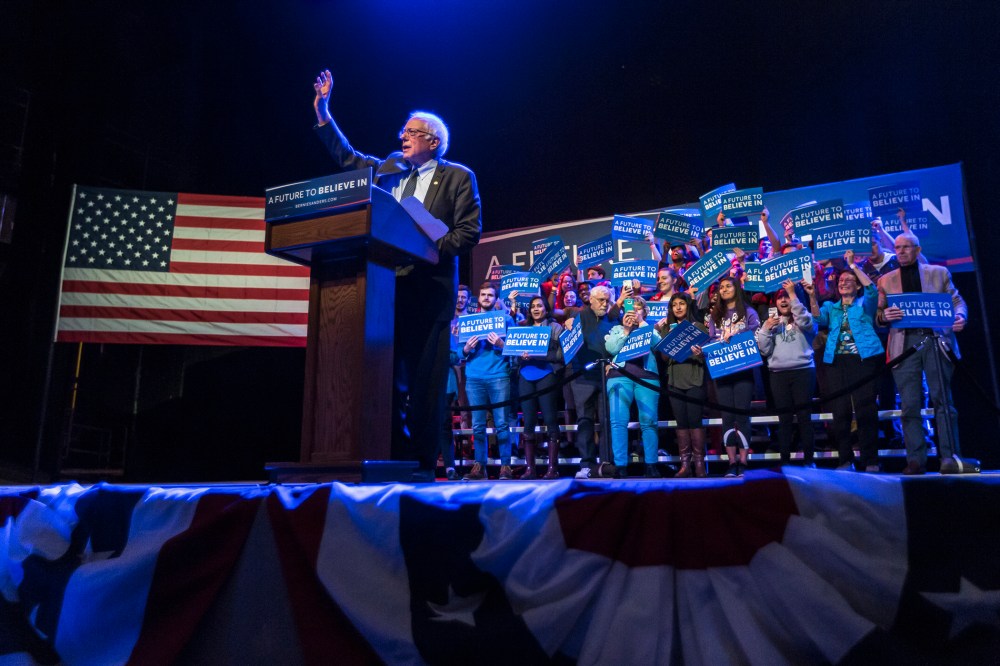
By staying in Democratic primary despite the odds, Bernie Sanders is following in the footsteps of an unlikely role model: Hillary Clinton.
Just like Sanders is pledging to do now, Clinton in 2008 hung on until June, long after the delegate math showed her locked in a trajectory that fell short of the nomination. As Barack Obama’s patience wore thin, Clinton supporters hailed wins in March and April and May and even June as proof they still had a shot.
Now the tables have turned, and it’s Clinton dealing with an opponent whom some allies think has overstayed his welcome.
Sanders aides and allies point to Clinton’s persistence as justification for their own. “Just like it made no sense for then-Sen. Clinton to get out until she did, it makes no sense for Bernie to get out now,” said Neil Sroka of Democracy for America, a liberal group that backs Sanders.
RELATED: Clinton, Sanders tag-team Trump
Clinton has not asked Sanders to step aside and aides say she never will. She needs his support to help unite the Democratic Party in November, and has instead opted to ignore Sanders. “I’m the person who went all the way to the end in June in 2008. So, why would I expect anybody running against me to give up or quit?” Clinton told MSNBC’s Rachel Maddow Tuesday.
But she and her supporters have flashed glimpses of impatience at times, making some of the same arguments Obama’s team made towards the end of 2008. “The sooner I could become your nominee, the more I could begin to turn attention our to the Republicans,” Clinton said in Detroit earlier this month.
Former Clinton and Obama aides, who witnessed the grueling spring offensive firsthand, are having some some deja vu. But they are also quick to point to some major differences.
“I’m totally sympathetic to people who work on something 24/7 for over a year. It is really hard fought. You win a bunch of races you were not expected to win,” said Neera Tanden, a former top aide to Clinton’s 2008 campaign.
Tanden recalled how every day, Obama advisors would go out and make the case that the delegate math was insurmountable for Clinton. And every day, Clinton aides would find new ways to chart an increasingly improbable path to victory.
“It’s literally the same debate” as now, Tanden said. “But having said all of that, we didn’t win.”
Tanden also noted that Clinton’s delegate gap then was never as large as Sanders’ is now, and that she was tied and times even ahead of Obama in the popular vote. Clinton today has received 2.5 million more votes than Sanders.
Clinton has been on both sides of the underdog-frontrunner divide. “Every campaign that’s behind tries to demonstrate that they have a shot,” said Democratic strategist HIlary Rosen, who supported Clinton then and now.
Today, it’s Sanders’ campaign making dubious arguments about winning over superdelegates. Eight years ago, just days before Clinton conceded, she was calling super delegates to ask them to “keep an open mind until the convention.”
Today, it’s Bernie Sanders who is demanding another debate with Clinton. Her campaign has dismissed that as a “stunt” from a campaign “struggling a bit for attention,” and been noncommittal about whether the fortuner will participate. In 2008, it was Barack Obama dodging Hillary Clinton’s challenge to debate Obama “anytime, anywhere.”
“Between my opponent and his camp and some in the media, there has been this urgency to end this. And historically, that makes no sense,” Clinton said in a video tweeted by the Sanders campaign this week of a editorial board interview from late May of 2008.
Clinton stuck it through the very end of the primary calendar, June 3, and even pulled out a 10-point victory in South Dakota on the last day of voting. That same day, Obama clinched the nomination by hitting his “magic number” of delegates.
A month earlier, NBC’s Tim Russert famously delivered some real talk. “Absent a complete collapse in the Obama campaign or an act of God, this race is over,” Russert said on MSNBC. RELATED: Sanders raises $39.6M in March, leads Clinton “The only pressure that’s being exerted on us is coming from the media covering the campaign,” Clinton’s press secretary Phil Singer snapped back Today, Clinton’s allies are concerned about what they see as Sanders’ negative tone towards Clinton, worried it could damage her in a general election. Clinton chose to back off from sharp critiques in 2008 towards the end, they say. “When the math was the math, we as a campaign made the decision to move to focus on a positive image of hillary. We chose the path of moving off any sharp critiques,” said Tanden. Still, Clinton did not shy away from jumping on the Jeremiah Wright controversy in late March ahead of the Pennsylvania primary. During a debate in mid-April, Clinton questioned Obama’s relationship with Bill Ayers and Louis Farrakhan, suggesting Obama gave “some kind of seal of approval” to the controversial figures by associating himself with them. “These are problems. And they raise questions in people’s minds. And, so, this is a legitimate area, as everything is, when we run for office,” she said. Clinton had some big wins late in the calendar. She took Ohio on March 4, and Pennsylvania on April 22, leading her supporters to argue that Clinton would make a stronger general election candidate than Obama since both were key swing states. And string of wins in May, including a whopping 41-point victory in West Virginia, were used to argue that Obama couldn’t appeal to working class white voters. But ultimately, she got behind Obama and wholeheartedly campaigned for him, before going on to serve in her administration, as she often recalls on the stump. Some Democrats are worried Sanders is not preparing himself to the same. “It’s clear the Sanders campaign wants to rack up as many delegates as possible to play an influential role at the Convention,” said former Obama 2008 spokesperson Ben LaBolt. “That’s their right — but it becomes problematic for the party if Trump starts to take daily shots at Clinton and she is forced to remain focused on the primary long after Republicans have engaged in the general.” That may be true, and it may also be something the former spokesperson could have said about Clinton eight years ago.
Alex Seitz-Wald Recommended


