









Dr. Ben Carson defended a prior call to combine and “redistribute” education funds in order to eliminate inequality between rich and poor school districts on Tuesday, but his campaign clarified afterwards that Carson would not intrude on local control of education.
The exchange stemmed from comments Carson made in 2014 to Politico Magazine in which he condemned gaps in school spending at the local level.
“If you happen to be in an affluent community, there’s a lot more money for the schools, better facilities, everything. All that does is perpetuate the situation,” Carson said at the time. “Wouldn’t it make more sense to put the money in a pot and redistribute it throughout the country so that public schools are equal, whether you’re in a poor area or a wealthy area?”
RELATED: Trump on Carson: A lot of things will come out
Asked by CNN’s Jake Tapper on Tuesday whether those quotes went against Carson’s frequent condemnations of “redistribution,” the candidate defended his remarks.
“It’s the government having a responsibility to educate everyone and looking at the best system to do that,” Carson said. “I think that’s very different than a situation where someone is working hard, is making a lot of money, providing a lot of jobs, and contributing to the fabric of America, then us going along, and saying he’s got too much and this guy, he doesn’t have a lot, let’s give it to that guy.”
Carson’s comments were surprising because K-12 schools are overwhelmingly funded by local property taxes and state dollars rather than by the federal government, which covers only 10.8% of school costs according to the Department of Education. Critics of the system argue that local funding of education funding fosters inequality and segregation, especially given that minority communities tend to live in districts with weaker tax bases. Parents in more upscale school districts have historically resisted efforts to flatten funding disparities, however, such as distributing school funding evenly across a state or transferring students from schools in poor neighborhoods to richer ones.
Tapper challenged Carson on this point, asking whether his plan still qualified as redistribution given that education is primarily “funded from local taxes” that reflect each community’s wealth.
“It’s not the same principle at stake,” Carson said. “We are talking about the entire nation, and we are talking about what makes [it] competitive as a nation and the great divide between the haves and have-nots is education.”
Carson added that his plan was “very different than redistributing because you believe in it as a social thing.”
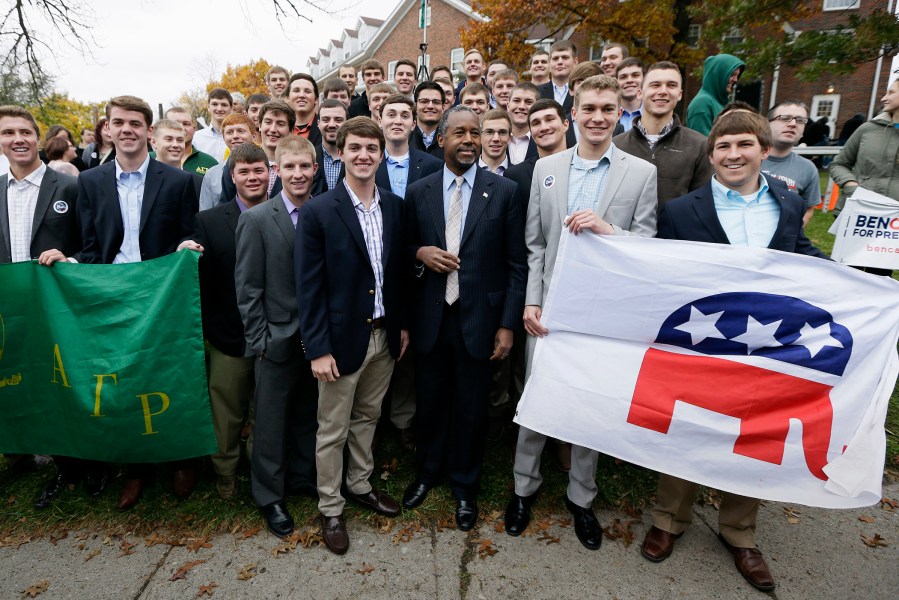
While Carson’s 2014 remarks appeared to endorse the argument that an “affluent” community should not receive more school funding based on their tax base, campaign spokesman Doug Watts told msnbc that Carson would not interfere with the existing system of local taxes. Carson issued a similar denial after his interview on Facebook.
“Dr. Carson [does not] support the national pooling of property tax receipts,” Carson spokesman Watts said in an email. ”That is a falsehood.” Instead, Watts said that Carson would pool federal education funding to bolster Title I, a Department of Education program that distributes money to support urban and rural schools with impoverished student bodies. Watts declined to elaborate further, saying he did not want to get ahead of an upcoming policy paper that would fill in more details. “[K]eep in mind this was a story done a year ago, and they didn’t complete his thoughts, literally took it way out of context and did not publish his complete comments,” he added in a follow-up email. Many conservative activists are strongly opposed to a larger federal role in education and their cause has gained significant momentum within the party in recent years. Some presidential candidates, including Sen. Rand Paul and former Arkansas Gov. Mike Huckabee, have proposed abolishing the Department of Education entirely. In recent years, the grassroots right has been galvanized in particular by opposition to Common Core standards, which the federal government has encouraged states to voluntarily adopt by offering grant money through its Race To The Top program as an incentive. After initially drawing bipartisan support, the idea has since become politically toxic on the right. Former Florida Gov. Jeb Bush, an early proponent of Common Core, frequently is asked to explain his support for the standards on the campaign trail, where he’s stressed that he’s against any federal education mandates. Carson himself is a strong critic of Common Care. “Our education system must be run by involved parents and engaged teachers and principals,” reads Carson’s campaign website. “Any attempt by faceless federal bureaucrats to take over our local schools must be defeated.”
Benjy Sarlin Recommended


