Voting rights advocates are girding for a series of crucial battles that will play out over the next twelve months in Congress, in the courts, and in state legislatures. Victories could go a long way to reversing the setbacks of the last year. Defeats could help cement a new era in which voting is more difficult, especially for racial minorities, students, and the poor.
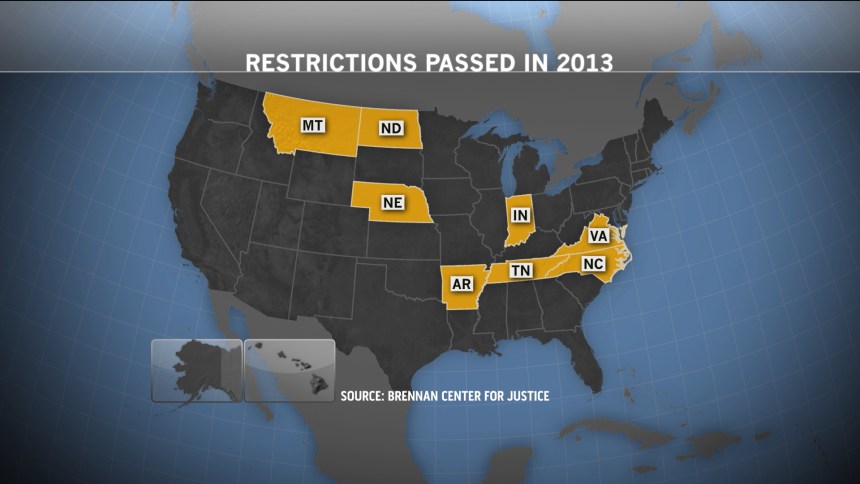
Despite some scattered efforts by states to improve voting access, the right to vote took a big step backwards last year. Republican legislatures in states across the country continued to advance restrictive voting laws, while a major Supreme Court ruling, Shelby County v. Holder, badly weakened the Voting Rights Act (VRA).
Wendy Weiser, who runs the Democracy program at the Brenan Center for Justice, called Shelby “the single biggest blow to voting rights in decades.”
Congress:
Perhaps the key voting rights showdown of 2014 will take place on Capitol Hill, as the push to update and strengthen the VRA gathers momentum.
The Shelby ruling, which freed areas with a history of discrimination from federal oversight, “leaves a big hole in our voting rights law that Congress will have to fill at some point,” said Dan Tokaji, an election law professor at Ohio State University.
There’s disagreement about just how it should do that. Some want an improved VRA to mimic the existing law by continuing to center on barring racial discrimination in voting. That might be the best way to crack down on the kind of under-the-radar schemes to reduce minority voting power that we’ve seen lately on the local level in places like Beaumont, Texas, and Augusta, Georgia.
“Eighty-five percent of objections under Section 5 were to local-level changes,” said Spencer Overton, a law professor at George Washington University. “From a pure policy standpoint, being accurate about the problem, these local jurisdicitons present significant problems.”
Others, including Tokaji, argue the fix should also—or instead—approach the issue more broadly, perhaps by trying to codify standards that guarantee the right to vote for all. That approach would acknowledge that tactics like voter ID laws are often as much about partisanship as race.
But the debate may be irrelevant. Despite cautious optimism from some voting rights advocates, passing anything looks to be an uphill battle, given Republican obstructionism.
“I’m not optimistic about any legislation getting through the current Congress,” Tokaji said.
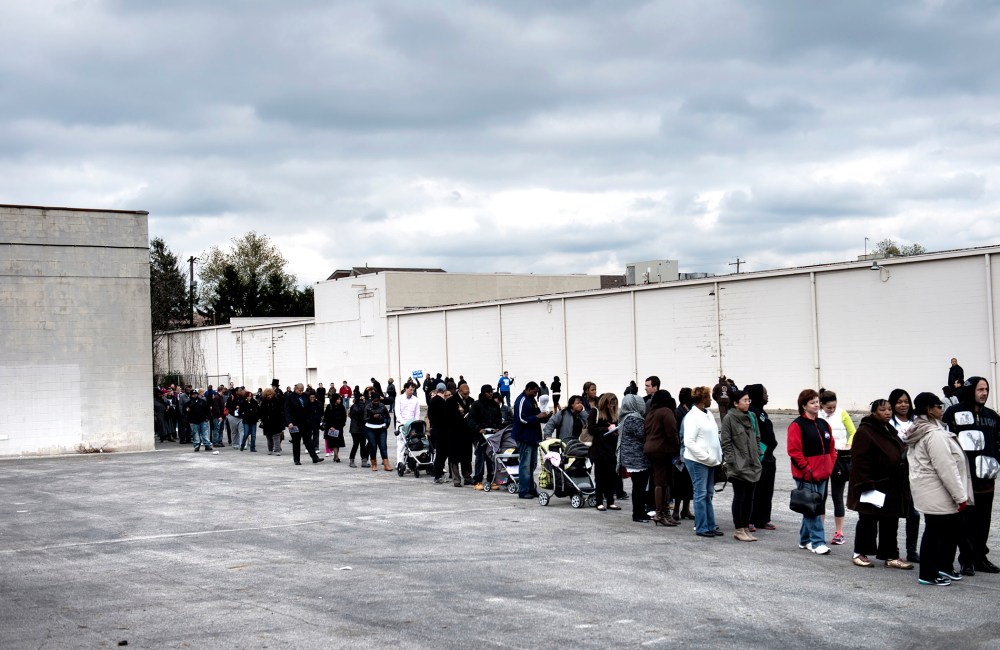
It may be more likely that Congress will act on a different opportunity: taking up the recommendations of President Obama’s bipartisan commission on voting, which early next month will unveil its report on how to fix long lines at the polls and modernize the voting system. The proposals are likely to focus on relatively non-controversial ideas, like getting better technical tools and expertise to local election administrators. But election experts say steps like that could lead to much smoother elections, after some voters waited eight hours or more in Florida last year.
The Courts:
Other crucial skirmishes will be fought in the courts. Voter ID laws are being challenged in Wisconsin and Texas, and the outcome of those cases will offer a key signal of whether and when, Section 2 of the VRA—the major pillar of the law left in tact after Shelby—can be used to stop voter ID and other restrictive measures. North Carolina’s sweeping voting law, also being challenged under Section 2, won’t go to trial until 2015, though it could be blocked from going into effect for the 2014 midterms.
“It’ll really send a signal as to how strong the protection of Section 2 really is going to be against discriminatory voting changes,” said Weiser, referring to all three cases.
In advance of these cases, the Justice Department is adding muscle to its voting rights arm. The White House announced in November that it will nominate Debo Adegbile, a highly regarded former top lawyer for the NAACP Legal Defense Fund, to serve as Assistant Attorney General for Civil Rights, a post that includes oversight of DoJ’s voting section. And it reportedly will appoint Pamela Karlan, a Stanford University law professor and prominent voting rights advocate, as Deputy Assistant Attorney General in charge of the voting section. In Wisconsin, where a ruling is expected in January, lawyers for the civil rights groups challenging the law are said to be optimistic. Whatever the outcome, the case is likely to be appealed. That could offer one prominent judge the chance for a high-profile do-over. Judge Richard Posner, who sits on the federal appeals court that would hear the case, drew headlines in October when he admitted that he erred by approving an Indiana voter ID law in 2008, saying he was unaware at the time of evidence that such laws discriminate against minorities (Posner later attempted a partial walk-back.) Another upcoming case has received less attention but could have an even greater impact. Kansas and Arizona are suing the federal government for the right to require people to provide proof of citizenship when they register to vote. A win for the states could not only make it much harder to register voters in those places—after all, few people carry their birth certificate when they leave home. It would also do major damage to Congress’s authority to establish minimum national standards for voting—a power that’s crucial for any effort to improve elections. “It is critical that we don’t undermine Congress’s power to do that, which we need to actually move our system into the 21st century,” Weiser said. “So that’s a real legally significant case.” State Legislatures: Republican-controlled states are poised to continue the push for regressive voting laws. Next month, perennial swing state Ohio will likely pass measures that cut back on early voting, end same-day registration, and make it harder to vote absentee. That’s a recipe for longer lines at the polls, threatening a re-run of 2004, when some Ohioans waited over 10 hours to vote. A voter ID bill is also said to be in the works, though its chances of passage are far less certain. In Missouri, three separate photo ID bills have been “pre-filed.” Restrictive voting bills also are likely to be introduced in Michigan and Colorado. And Iowa’s Republican Secretary of State, Matt Schultz, has pushed voter ID legislation there, though Democratic Senate leaders look unlikely to bring it to a vote. But there are also efforts to expand access to the ballot, according to a roundup by the Brennan Center. In Kentucky, three bills have been pre-filed that would restore voting rights to those with past criminal convictions. A similar one was pre-filed in Virginia. And in Florida, which in recent years has cracked down on voter registration activities, two measures would move in the opposite direction, making it easier for eligible citizens to register to vote. Still despite those more positive moves, voting rights rights expect to play whack-a-mole as new threats pop up around the country. “Unfortunately the push to restrict voting continues,” Weiser sais. “We need to keep pushing back against these unfair efforts to restrict the franchise.”
Zachary Roth Recommended