








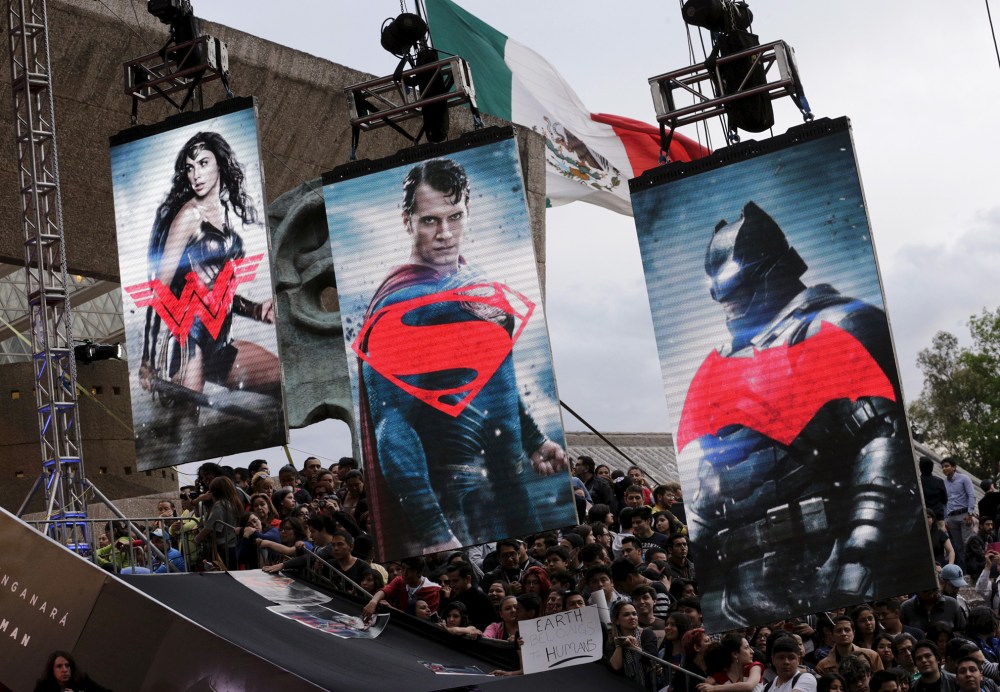
The term fascist has been thrown around a lot recently. Amid the rise of Donald Trump’s unconventional (and many have argued xenophobic and even racist) brand of neo-nationalism, it has become something of a catch-all, though many historians believe it doesn’t apply in his case.
Ironically, in recent years, the term has been applied liberally to two of popular culture’s most enduring fictional characters: Superman and Batman, both of whom are featured in a highly anticipated new film opening on Friday.
“Batman v. Superman: Dawn of Justice” marks the first time these two icons will appear in a movie together, and while the pairing has been met with a mix of fan excitement and tepid critical reviews, it has also revived a familiar debate: Are both characters inherently fascist?
“The word really does suffer from what’s called inflation. It’s become widely used as a way of delegitimizing something,” said Professor Roger Griffin of Oxford Brookes University in the U.K., an expert in modern history and the author of “The Nature of Fascism,” in an interview with MSNBC Friday. “Basically any sense of oppression or fanaticism you don’t agree with can be dismissed as fascism.”
RELATED: New Batman comic shows caped crusader fighting police brutality
According to Griffin, this kind of loose use of the term goes back as far as the 1920s, when Marxists used it to define anyone who opposed their ideology. Griffin laments the fact that today, largely outside of academia, the term has been wildly misinterpreted. For instance, he believes that Trump represents radical right-wing populism, not fascism. Trump may espouse extreme rhetoric, but he has no desire to dismantle the government should he win the presidency.
“Facsism is revolutionary … it wants to destroy any sort of representative state,” Griffin said.
Ironically, both DC Comics characters — which debuted in the late 1930s — had long represented wholesome, all-American values. When the late Christopher Reeve first played Superman in the late ’70s he said he stood for “truth, justice and the American way,” without a trace of irony. And while Batman’s origin story was considerably more grisly (the man behind the mask, Bruce Wayne, becomes a crime-fighting vigilante after witnessing the murder of his parents), he was not a figure of controversy.
That began to change as the films (and comic books) featuring the characters eventually reached for a more realistic tone and exploited the darker shadings of their personas. Audiences have seen so many iterations of both superheroes over the years, with many versions veering wildly into campy self-parody, but the incarnations in the last decade barely resemble their squeaky-clean images from years prior.
Both characters now stretch the concept of “hero.” They are far more violent and arguably emotionally unstable, plus they have entered a far more politically charged atmosphere where audiences project their own anxieties about the war on terror and threats both real and imagined onto films that were once dismissed as light entertainment.
“Starting in 2016, those things that we found as subtext in these stories no longer have much power because those dog whistles have all become foghorns in the political arena,” cartoonist and “Understanding Comics: The Invisible Art” author Scott McCloud told MSNBC on Friday, which may account for the newfound gravity that these projects have taken on.
The fascist label began to be thrown at Batman when the character was revitalized in three critically acclaimed blockbuster films directed by British auteur Christopher Nolan. When the second film in the trilogy arrived — 2008’s “The Dark Knight” — in an election year no less, critics couldn’t help but draw parallels between the paranoid world of Gotham and the waning days of the Bush administration.
Nolan’s films were the first to raise questions about the moral ambiguity of the Bruce Wayne character. At one point he confronts copy cat vigilantes who question how he justifies his one-man gestapo force and he replies, “I’m not wearing hockey pads.” Later, he employs an NSA-on-steroids surveillance system to trace the whereabouts of the villainous joker. This strategy provokes a stern rebuke from his trusted ally Lucius Fox (played by an avuncular Morgan Freeman) but Batman uses it anyway, albeit only to eschew it once the bad guys are beaten.
The Batman character on paper does appear to have all the hallmarks of a would-be fascist dictator. He single-handedly deems traditional law enforcement ineffective and takes the law into his own hands from a position of privilege (in the fictional world of comic books, Wayne has far deeper pockets than Trump). He believes he knows what is best for civilization and only he is equipped to make his ideal a reality. Usually, there are figures around Batman (most often his trusted voice of conscience, his butler Alfred) who question to wisdom of his crusade, which creates much of the tension behind his complex psyche.
The third film in Nolan’s trilogy, “The Dark Knight Rises,” muddied perceptions even further, when it appeared to evoke the Occupy Wall Street movement while portraying it as chaotic horde inspired by a Machiavellian bad guy, Bane. By the film’s climax, Bane has been installed as an ersatz leader with kangaroo courts in place to exact vengeance on the upper classes. Once again, only Batman can restore order — but that order is defined on his terms alone.
Still, some have argued that the criticism of those films and Batman are overheated. After all, despite his immense wealth, Wayne/Batman has dedicated his life to helping others. And as Chris Yogerst pointed out in a 2013 column for The Atlantic, “Like many others, Batman works to be an example of helping others while respecting the autonomy of society and individuals.” Although, as some critics point out, the films rarely portray the individuals who are benefiting from his efforts.
Griffin argues that Batman’s vigilantism itself is the opposite of fascism. “Fascists hated vigilantes and people taking the law into their own hands, not obeying orders. [Batman] is an anarchist,” he said, adding that if anything his mantra of “fighting evil though anarchic violence could very loosely reminiscent of early Nazism.”
Until recently, Superman was almost cuddly by comparison. The character was originally conceived as Jewish (his dark hair and his Hebrew sounding birthname Kal-El, were intentional). His exploits were instinctively anti-fascist (he fought them in World War II and was even used in an effort to expose the evils of the Ku Klux Klan via a radio show in the 1940s). But under director Zack Snyder’s stewardship, first in 2013’s “Man of Steel” and now in “Batman v. Superman,” the character has committed murder while allowing what appears to be thousands of innocent people die. Superman has become largely humorless and seems to lean more heavily on a messianic posture. “Superman embodies a sort of Aryan god as conceptualized by a Nazi on acid,” said Griffin, but he points out that “neither Hitler nor Mussolini were God-like or Aryan heroes.” This is a character who once turned the world around to save his own girlfriend, but in the shadow of our current political climate, Superman’s tendency to bend fate to his will has not sat well with some audiences. The new film, at least according to early reviews, amps up the religious symbolism and self-righteous displays of power. In “Batman v. Superman,” the dark knight apparently goes even deeper down the rabbit hole of judge-jury-executioner, branding his prey with his own bat signal. And the Chicago Tribune‘s Michael Phillips writes that in the new movie, Superman has not only grown more narcissistic, “he seems to have crossed an invisible line of smugness, from which it is difficult to return.” RELATED: The GOP presidential field as cartoon characters Griffin believes that the term fascist could only apply to these characters in the context of a feminist interpretation of the word, because they represent a kind of macho aesthetic of hyper-masculine dominance. He thinks the more fascinating phenomenon at play with these characters and the international preoccupation with the comic book genre as whole, is the evolution of what he refers to as the “heroic double,” or “people creating a fantasy alter ego of themselves.” A grim example of this can be seen in ISIS recruits, who take on a new persona when they join the terrorist organization, living double lives in many cases. And the mythological allure of cosmic powers buried within us (a popular trope in the Marvel universe, as well) that have previously gone unrealized, has a strong appeal that can be ambivalent or dangerous, depending on who embraces it. According to McCloud, some comic book artists have “ironically” played with the problematic nature of the Superman and Batman characters while some have “bought into the strongman image.” Still, he believes by-and-large that the comic book world is on the “progressive end of the spectrum” politically and that the public’s impulse “will very quickly choose sides against the real world fascism.” McCloud believes that it is the “pure power fantasy that has been driving the superhero phenomenon in movies,” not a more insidious ideological bent in audiences or the film’s themselves. He also thinks that the dichotomy between these two classic characters could have been ripe for cinematic exploration. “Superman was naturally optimistic. The idea that he would have faith in the human race puts him very much in the opposite camp of Batman,” said McCloud. “The two characters have value as counterpoints to one another.” But it appears that this film’s true crime is that it misses the opportunity to explore the “yin and yang” of the characters which McCloud describes, with critics singling out everything from its bombastic soundtrack to its propensity to lay Easter eggs for future films for ridicule. As Brian Roan, writes in his review for The Film Stage: “In total, ‘Batman v. Superman’ is a movie that seems to exist only because of the pure inevitability of its own creation, not because anyone involved in said creation seemed to have something to say through it.” In other words, a Trojan horse for fascism it is not.
Adam Howard Recommended



