








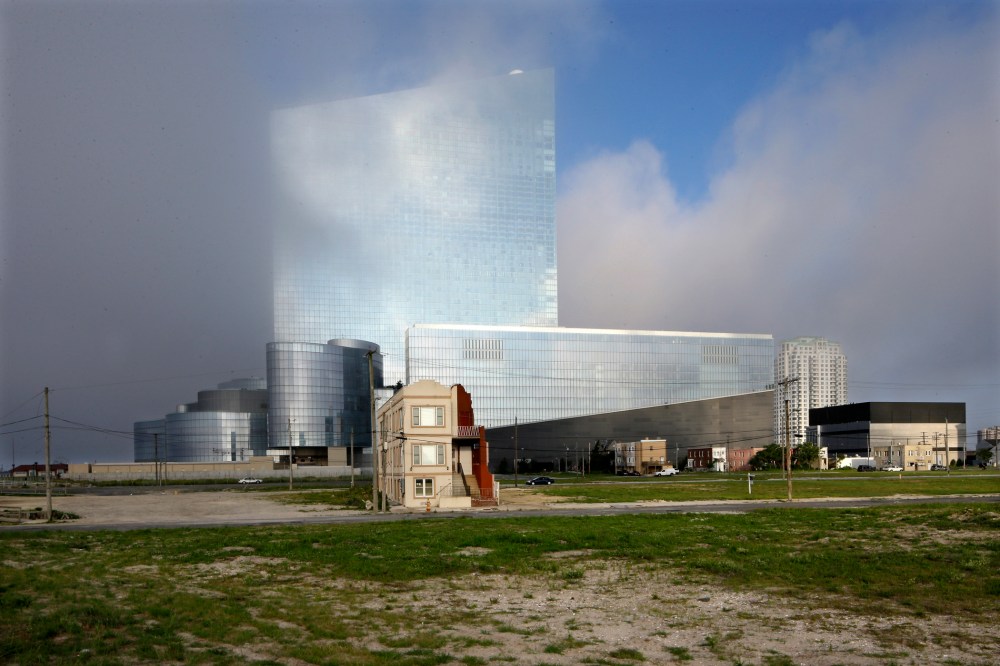
When her hometown first legalized casino gambling in 1976, Atlantic City native Turiyah Abdur-Raheem had her doubts.
“I wasn’t here then, I was still away at college, but I was concerned about my family and friends who still lived here,” said Raheem. “I think my biggest concern was whether or not people in the community were going to really benefit; or was it going to still be a situation where these casinos and other casino-related businesses were going to thrive, and the community was going to suffer.”
That was nearly four decades ago. For three of those decades, Raheem lived elsewhere. When she returned to her hometown in 2008, what she found was “heartbreaking,” she says.
%22It%20benefits%20one%20side%20of%20the%20city%20and%20not%20the%20other.%20It%20doesn%27t%20trickle%20down.%22′
“I was hearing more and more stories about hopelessness, about people not being able to be hired,” said Raheem, the author of a recent book about growing up in “the other Atlantic City.” “Last hired, first fired. Whereas we always had jobs as teenagers, the teenagers here were not being hired. Other teenagers were able to come in and get work, and our teenagers were not.”
For Abdur-Raheem and some other residents of Atlantic City, impending casino closures are just another bump in the community’s long, fraught relationship with legalized gaming. They see an industry that has grown fat in their backyard, while sharing little of the profit. In 2010, Atlantic City casinos took in $3.6 billion; meanwhile, the city’s median household income between 2008 and 2012 was just under $30,000.
Yet the gaming industry nationwide is on the ascent, even as three major Atlantic City casinos threaten to close within the next few weeks. Roughly two decades ago, casinos could only be found in six states; as of last year, 22 states have commercial casinos, according to an American Gaming Association (AGA) survey [PDF]. That same survey found that casinos raked in $37.34 billion nationwide in 2012. Only in 2007, the year before the financial collapse, did the industry collect more in revenue.
The question facing Atlantic City, and a growing number of other communities around the United States, is where all that revenue goes. While industry spokespeople argue that commercial casinos do wonders for a local economy, not all Atlantic City residents agree.
“It benefits one side of the city and not the other. It doesn’t trickle down,” said Atlantic City councilman-at-large Moisse Delgado. “Tourism dollars are good for the industry. It’s not as much for the municipality and its residents.”
A significant chunk of the city’s revenue does come from casinos. According to Atlantic City’s 2013 audit report [PDF], local government collects about 65% of its taxes from the gaming industry. While in earlier times that might have allowed the city to share in the industry’s prosperity, today it means the municipality has no safety net when casino revenues decline. Earlier this month, Atlantic City Revenue and Finance director Michael Stinson told Reuters that impending casino closures could wipe out as much as half of the city’s tax base.
Adding to the city’s financial woes, its unemployment rate is markedly higher than the national average, and wages tend to be lower. Delgado alleges that’s because “front of the house” casino jobs — relatively high-paying jobs that require a greater degree of customer interface, such as tending bar or manning the blackjack tables — usually go to people who don’t live within city limits.
“People who have those jobs don’t live on this island,” he said. “They live in farther towns. They live 60 minutes away, two hours away. They don’t call it home, they don’t see it as home, they don’t invest in home.”
People who live in the city — most of whom are either African American or Latino — do the back of the house jobs, such as cleaning rooms and doing line cook work, said Delgado. But Joe Kelly, president of the Greater Atlantic City Chamber of Commerce, argued casinos “have done a wonderful job in creating employment opportunities.”
“I don’t think that’s consistent with what I’ve seen,” he said of Delgado’s concerns. “I’ve seen a number of professionals come through the local market that have gone on to take leadership roles in the casinos that were local citizens.” For industry leaders and experts, the watchword in Atlantic City is “diversification.” The local Chamber of Commerce is trying to resuscitate business in Atlantic City by expanding tourism and hospitality services beyond just gambling. If that effort is successful, the city will come to more closely resemble Las Vegas, where gambling now accounts for just about 36% of revenue in the main tourism center known as the Las Vegas Strip. Dining, musical entertainment and retail have come to occupy a larger chunk of that city’s income. Industry analysts believe that developing those industries in Atlantic City would help to distinguish it from the myriad other Mid-Atlantic towns that now host casinos. “It’s a tourism destination,” said Sara Rayme, senior vice president of public affairs for the AGA. “As more markets have come online, clearly it’s up to the policy makers in tandem with the operators to make sure their business models are evolving and changing with what’s going on around them.” %22As%20an%20Atlantic%20City%20native%2C%20I%20can%20see%20it%E2%80%99s%20definitely%20been%20a%20boon.%22′ Rayme also believes that casinos have been good to Atlantic City overall, saying “gaming has been incredibly successful in Atlantic City for the past 30 years.” The AGA estimates that Atlantic City casinos have “directly supported 1.4 million jobs” and “generated $9.3 billion in tax revenue,” according to a fact sheet [PDF] shared by Rayme. David Schwartz, the director of the University of Nevada, Las Vegas’ Center for Gaming Research, said “the city was completely moribund” before legalized gambling. “As an Atlantic City native, I can see it’s definitely been a boon,” he said. “Created a lot of jobs, brought in a lot of development.” The Federal Reserve of Philadelphia has expressed a little more ambivalence regarding the industry’s effects. In a recent survey [PDF] of the available literature regarding gambling’s economic impact, the Philadelphia Fed found that casino revenue can do some good for state tax revenues and generate jobs; however, the same report offered a grim prognosis for Atlantic City’s gambling industry. Another report focusing on Atlantic City in particular [PDF] noted that the local gaming industry “has typically provided jobs for more than 10,000 city residents,” but added that “many of the problems that gambling was supposed to alleviate remain severe.” The paradox of Atlantic City, they write, is that it is “a place where plentiful jobs are juxtaposed with high levels of poverty and unemployment.” The way forward is not yet clear.
Ned Resnikoff is an urban policy analyst, researcher, writer, and editor. His byline has appeared in a variety of publications, including the New York Times, San Francisco Chronicle, Dissent, and The Nation. He writes the newsletter Public Comment, which can be found at publiccomment.blog. Recommended


