








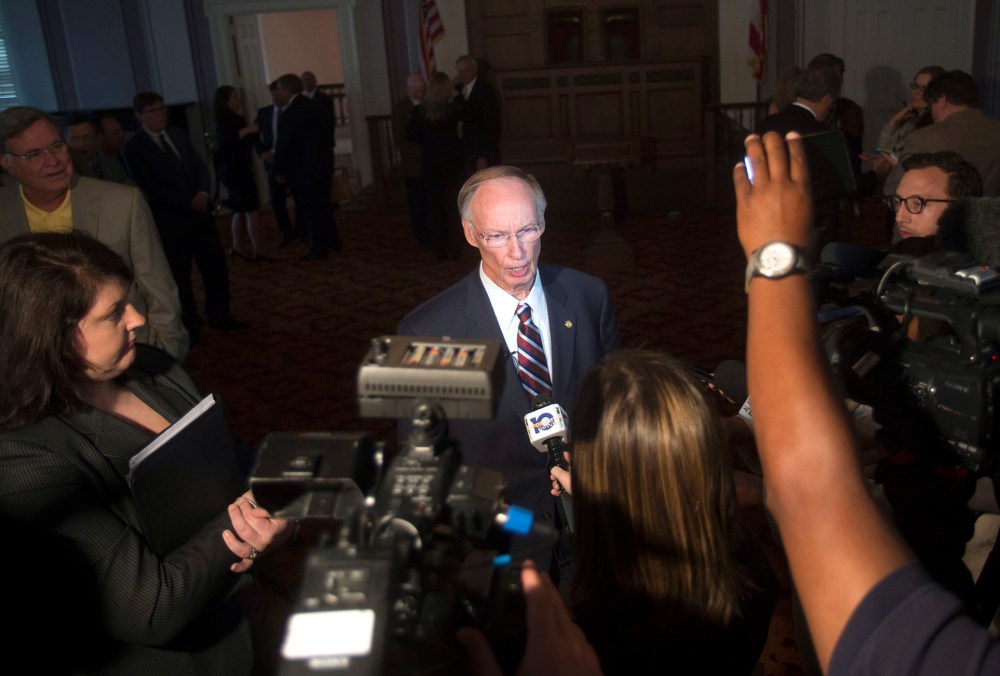
Alabama Gov. Robert Bentley responded Wednesday to a lawsuit challenging his state’s voter ID law by claiming that the state already came to an agreement with the federal government that addresses concerns about the law.
But Bentley’s claim is flatly false: Alabama’s deal with the Feds had nothing to do with the ID law.
Another top Alabama official, Secretary of State John Merrill, issued a misleading response of his own to the lawsuit, claiming that the ID law hasn’t stopped anyone from voting, despite clear evidence to the contrary.
But Bentley’s response is the more egregiously false. As such, it raises questions about the state’s commitment to act in good faith as it handles a months-long controversy over its strict voting policies.
RELATED: New lawsuit challenges Alabama voter ID law
On Wednesday, the NAACP Legal Defense Fund filed a lawsuit against Alabama’s voter ID law, claiming that it discriminates against blacks and Hispanics in violation of the Voting Rights Act. In response, Bentley, a Republican who was among the state officials named as a defendant, issued a statement that read in part: “The State of Alabama signed an agreement approximately three weeks ago with the Department of Justice to address some concerns related to Alabama’s photo id law.”
“I am proud of Alabama’s efforts to reach a sensible solution with the Dept. of Justice,” Bentley added.
Those statements appear designed to give the impression that the issues raised in the lawsuit have already been addressed.
In fact, no such agreement between Alabama and the Justice Department on voter ID exists. Rather, the two came to a deal last month to ensure that the state is in compliance with a federal law known as Motor Voter, which requires states to offer voter registration opportunities at their DMVs and public assistance agencies. Alabama agreed to take various steps to make it easier to register at the DMV.
You can read the agreement here. It has nothing to do with obtaining an ID to vote, or with the state’s ID law, which requires people to show one of several types of photo ID when they vote.
“Alabama’s recent settlement with the Department of Justice doesn’t address the state’s photo ID law,” Lisa Danetz, the legal director for Demos, which before the deal played a leading role in raising concerns about Alabama’s compliance with Motor Voter, confirmed. “Instead, it relates to the federal requirement that the state must provide voter registration during driver’s license transactions.”
Joyce Vance, the U.S. Attorney for the northern district of Alabama, told the Birmingham News the same thing.
“That was a completely and distinct different matter. It had nothing to do with the Voter ID act,” Vance said. “It was silent as to the ID act.”
Vance also said she was reading the voter ID lawsuit “with great interest,” though she wouldn’t say whether DoJ would join it. The Justice Department has worked with voting rights groups to challenge Texas’s voter ID law and North Carolina’s sweeping and restrictive voting law.
Asked about Bentley’s claim that the deal had addressed voter ID, Yasamie August, the governor’s press secretary, forwarded a link to the Motor Voter settlement. Asked again whether that agreement related to the ID law, August did not respond. Another defendant in the suit, Secretary of State Merrill, a Republican, was also misleading in his response, though perhaps less blatantly so. “As of today, there have been no credible reports of a lack of ability for someone to cast their vote because of this law,” Merrill’s response read in part. In fact, as the NAACP LDF lawsuit notes: “At least 629 provisional and absentee ballots (66 provisional and 563 absentee) cast in the 2014 primary and general elections by voters without the required photo ID were not counted because the voters failed to ‘cure’ their ballots pursuant to the Photo ID Law’s inadequate fail-safe procedures.” Asked about the uncounted absentee ballots, Kayla Farnon, Merrill’s press secretary, appeared to confirm the point that the ID law was responsible for those votes not counting. “Any absentee ballots that were not counted were not counted due to the fact that they did not include a photo ID in compliance with the law,” she wrote. Alabama has been on the hot-seat for months over its restrictive voting policies. Wednesday’s lawsuit was prompted in part by the state’s move several months ago to close several DMV offices in predominantly black counties. Those closures deeply angered Democrats and civil rights groups, who say shuttering the offices will make it even harder for local residents to get the ID required by the law. Rep. Terri Sewell (D-Ala.), who represents a district that includes Selma, has called for a federal investigation of the closures. Here are the full responses from Bentley and Merrill, respectively, to the lawsuit: Voting rights are important to every citizen, and it is imperative that every Alabamian who is eligible to vote have the ability to vote. A photo id protects the process of voting and ensures fair elections are held. The State of Alabama signed an agreement approximately three weeks ago with the Department of Justice to address some concerns related to Alabama’s photo id law. I am proud of Alabama’s efforts to reach a sensible solution with the Dept. of Justice and for our state’s progress to ensure all eligible citizens have access to a free photo id to vote. We have not been served with the complaint and will do a legal review of it once it is officially received by the Governor’s Office. ………………………………….. The lawsuit filed today claims that the photo ID requirement is an impediment to voting in our state. Empirical data would indicate that the photo ID requirement is in no way a barrier or obstacle to voting,” said Secretary Merrill. “The photo ID requirement was designed to preserve the credibility and the integrity of the electoral process. I voted for and was a co-sponsor of House Bill 19 that became Act Number 2011-673 in 2011, and I will defend the rights and freedoms of all our eligible citizens to register to vote, obtain a qualified photo voter ID, and participate in the electoral process! In the office of the Secretary of State, we want to make it real easy to vote and real hard to cheat. As of today, there have been no credible reports of a lack of ability for someone to cast their vote because of this law. We are going to continue to register all eligible Alabamians to vote, we are going to abide by the photo ID law passed by the Alabama Legislature, and we are going to issue qualified government photo IDs to preserve voting integrity as long as I have the privilege to serve our citizens in this capacity!” privilege to serve our citizens in this capacity!
Zachary Roth Recommended


