








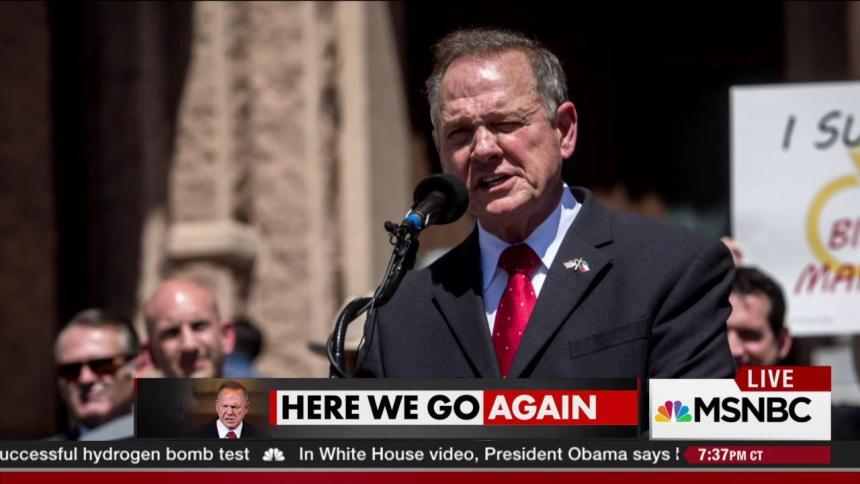
The chief justice of Alabama’s Supreme Court on Wednesday ordered probate judges to stop issuing marriage licenses to same-sex couples, defying a six-month-old Supreme Court decision that made marriage equality the law of the land.
In his order, Roy Moore — the Republican chief justice who made headlines last year for similarly standing in the way of same-sex nuptials in Alabama — said that the U.S. Supreme Court’s June decision only struck down the four same-sex marriage bans that were specifically challenged in the landmark case of Obergefell v. Hodges. That lawsuit was a consolidated challenge to bans in Kentucky, Michigan, Ohio and Tennessee — not Alabama.
Therefore, Moore wrote, Alabama probate judges still have a “ministerial duty” to comply with an order issued by the state Supreme Court last March to deny same-sex couples marriage licenses.
RELATED: The sign that anti-abortion clinics say tramples their religious liberty
There exists “an elementary principle of federal jurisdiction,” Moore wrote: “[A] judgment only binds the parties to the case before the court.”
“Until further decision by the Alabama Supreme Court, the existing orders of the Alabama Supreme Court that Alabama probate judges have a ministerial duty not to issue any marriage license contrary to the Alabama Sanctity of Marriage Amendment or the Alabama Marriage Protection Act remain in full force and effect,” Moore wrote.
Wednesday’s order seemingly sets up a major conflict for Alabama’s 67 probate judges — that is, whether they should follow the direction of Moore in his official capacity as administrative head of the state’s unified judicial system, or whether they’re bound by a federal court order to no longer enforce the state’s same-sex marriage ban.
According to Chris Stoll, senior attorney at the National Center for Lesbian Rights (NCLR), the choice is clear.
“In terms of what the probate judges ought to be doing, there really is no conflict. They should be following the federal court order,” Stoll told MSNBC. “The state order from Roy Moore has no legal effect.”
Nevertheless, it’s a tough position that these judges have been in before.
Last January, U.S. District Judge Callie V.S. Granade, a President George W. Bush appointee, struck down Alabama’s same-sex marriage ban, staying the effects of her ruling until Feb. 9. Both the 11th Circuit Court of Appeals and the U.S. Supreme Court denied the state’s request for a longer stay, which should have cleared the way for gay and lesbian couples to begin marrying in the state. But Moore sent out a letter ordering probate judges to continue denying same-sex couples marriage licenses. No probate judge, he argued, was listed as a defendant in the lawsuits that led to Granade’s original ruling. Therefore, no probate judges were obligated to follow it.
To clear up the confusion, Granade held another hearing in February and issued another order specifically requiring Mobile County’s probate judge to begin licensing marriages between couples of the same sex. Many other probate judges followed suit. But some were still confused by whether to listen to Moore or to Granade. RELATED: Oregon bakers pay damages for refusing service to a same-sex couple In March, the Alabama Supreme Court added even more uncertainty to the mix when it ordered all probate judges to stop issuing marriage licenses to same-sex couples. That directive was in response to a request from two conservative groups — the Alabama Citizens Action Program and the Alabama Policy Institute — as well as Elmore County Probate Judge John Enslen. Soon after, marriage equality in Alabama ground to a halt. But the situation flipped again in May, when Granade issued yet another order requiring all probate judges to no longer enforce the state’s same-sex marriage ban. Five months later, the 11th Circuit Court of Appeals said that the U.S. Supreme Court’s decision in Obergefell nullified the instruction from the Alabama Supreme Court. Given those two federal orders, Stoll said, there’s no way the Alabama Supreme Court’s March order still stands, regardless of Moore’s belief that it would need to be “reversed by orderly and proper proceedings.” “I can’t speak to what probate judges are going to do,” Stoll said. “But if they fail to comply with Judge Granade’s injunction, they’re exposing themselves to risk of contempt sanctions.” As demonstrated by Kentucky Clerk Kim Davis, who was found in contempt of court and jailed last summer for refusing to issue marriage licenses to same-sex couples, those sanctions could be severe.
Emma Margolin
Emma Margolin is a reporter at MSNBC.com. Recommended


