








This article originally appeared on TheGrio.com.
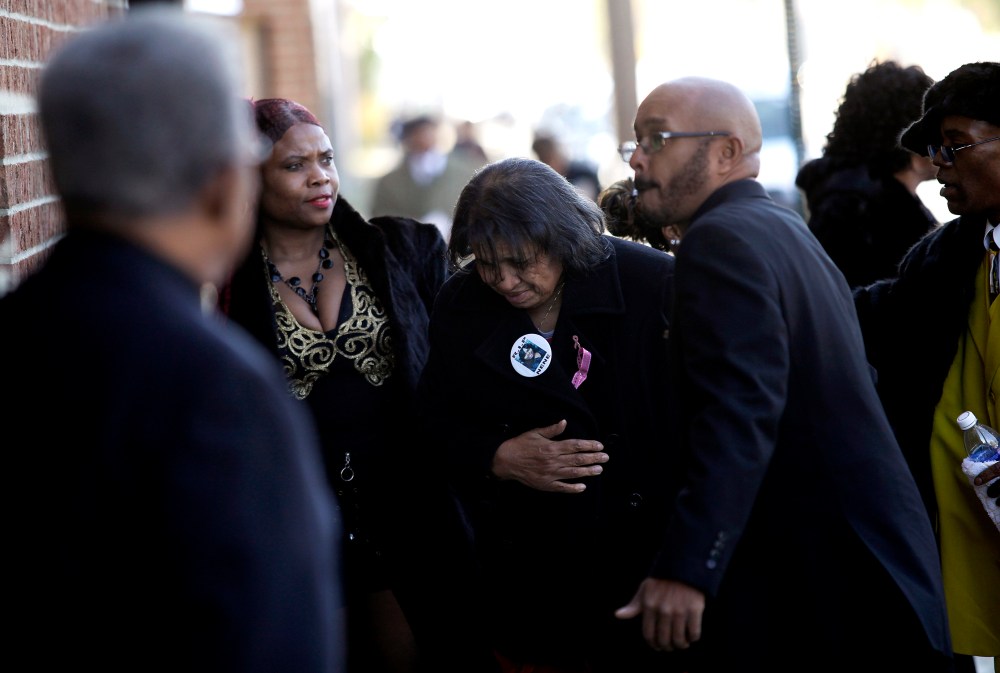
Detroit-based activists and community members gathered in front of the Police Station of nearby suburb Dearborn Heights Thursday evening demanding justice for a 19-year-old black woman from Detroit who was shot and killed by an unidentified Dearborn Heights resident in the early hours of last Saturday.
Renisha McBride was shot and killed by a middle-aged Dearborn Heights male resident after knocking on his door seeking help. Her car had entered into an accident, police confirmed, and her phone had run out of battery, family said.
The shooter, who remains uncharged, told police he thought she was breaking into his home and that his shotgun accidentally misfired. McBride was standing on his porch and was shot in the front of her face, near her mouth, police said.
Police were brought to the scene following a 911 call, but would not confirm whether the call came from within the shooter’s home or whether the call was made by neighbors.
A predominantly African-American crowd of demonstrators gathering in front of the police station called the shooting a clear case of racial profiling, echoing previous declarations to the press by the victim’s aunt.
“It makes no sense to me. There is no scenario that will help me to understand why this young lady had to be shot. I don’t understand it. It’s almost like it’s a hate crime or something,” Mary Waters, a former state representative and Detroit resident said.
The Dearborn Heights Police Department has released very little information about the circumstances of the shooting, stating that they are waiting for the prosecutor’s office to officially charge the shooter.
Dearborn Heights Police Captain Jeffrey Seipenko, who is in charge of the station’s investigative services division, said the original evidence package was sent to the office of Wayne State Prosecutor, Kym Worthy, earlier in the week, but that a request for the administration of further forensic tests was sent back. Once tests were completed, Seipenko said, evidence would be resubmitted to Worthy’s office for a decision on charges.
But according to Detroit-native and filmmaker Dream Hampton, who helped organize the protest, Dearborn Heights police has a long history of racism and “protecting their own.”
While the race of the shooter is unknown, 86-percent of Dearborn Heights residents are white, a number which strongly contrasts with Detroit where 82-percent of residents are black.
Iyatunde Folayan said she completely avoided coming in to Dearborn Heights. “As black people – you know where you should and should not go, where you’re safe and where you’re not safe,” she said.
Folayan remembered being in Detroit in 1986 when Dearborn Heights voters approved a city ordinance designed at keeping non-residents out of local parks.
“This is a sundown town,” she said referring to segregated American towns where people of color were historically told to leave by sundown.
Captain Seipenko disagrees with the accusations laid at his city’s door by demonstrators and McBride family members concerning the racial profiling of the victim and the different treatment of this case because of race.
“As far as I am concerned we don’t have a [problem]. Dearborn is a very mixed community, you know – white, black, Arab – for years, it’s been that way. So I am a little confused as to where that is coming from.” Driving around the streets where Renisha McBride was seemingly left stranded and asking for help last Saturday reveals blocks of fully occupied single-family homes, with fresh licks of paint. Neighbors are shocked by the news, with residents of over 30 years saying they have never heard of any similar incidents. Kimberley Ann Lockett, an undertaker who lives in a trailer home close to the shooting scene, said she heard a gunshot last Saturday morning, but had not known its origin until Thursday when local newspapers reported the story. For protesters back at the rally, Renisha McBride’s story is one that is all too familiar. Participants drew parallels with the deaths of other black teenagers such as Trayvon Martin and Emmett Till. Both Martin, who was fatally shot in 2012, and Till, whose body was shot and mutilated in 1955, were unarmed at the time of their death. Neither of their shooters faced prison sentences. Michigan currently has a “Stand Your Ground” rule named the Self-Defense Act, in law since 2006. The act allows for the use of deadly force against another individual when an individual “honestly and reasonably believes” such use is necessary to prevent imminent death, great bodily harm, sexual assault or to defend himself or herself against the “imminent unlawful use of force by another individual.” “This is about being black in America. I’m here tonight because black life matters,” Yusef Shakur, a Detroit-based author and community activist who also helped organize the gathering, said. “We’re here for justice. Black people deserve the same treatment as white people.” Shakur lamented what he felt was a double standard, stating police would have reacted more swiftly and firmly if the shooter had been black, like him. “Violence is not just a black thing or a Detroit thing. It’s also a white thing.”
Rose Hackman Recommended


