








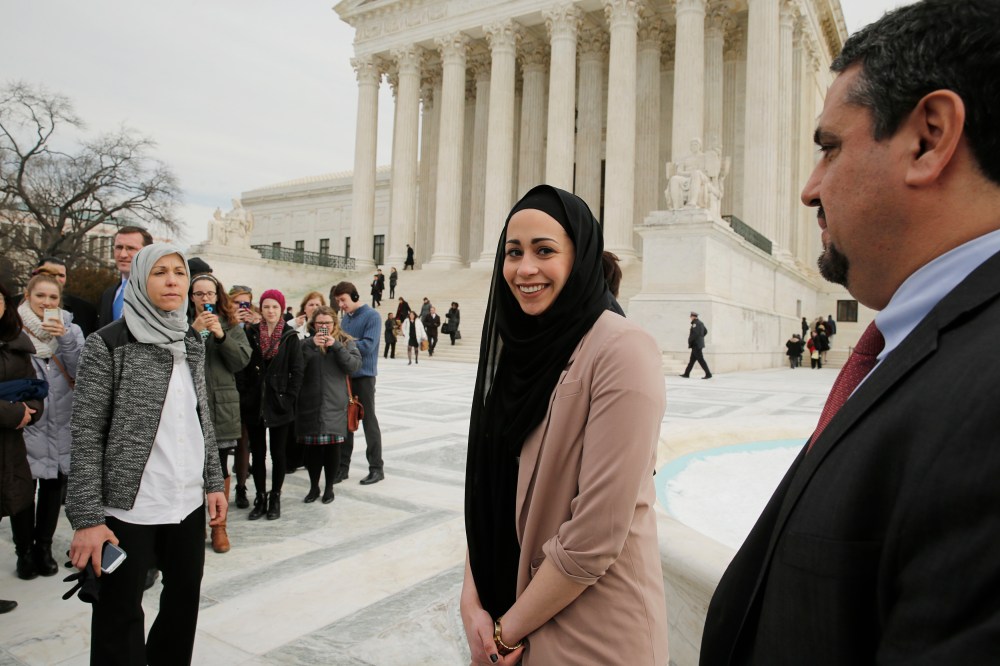
Abercrombie & Fitch likely broke the law when it refused to hire a Muslim teenager because she wore a headscarf, eight justices of the Supreme Court ruled Monday in an opinion by Justice Antonin Scalia. The mall retailer had claimed it was only applying its supposedly neutral “Look Policy” prohibiting caps, and that its conduct was legal because the job applicant, Samantha Elauf, didn’t explicitly ask for an accommodation.
But the court found that under Title VII of the Civil Rights Act, the burden is on the employer not to discriminate in hiring. “An applicant need only show that his need for an accommodation was a motivating factor in the employer’s decision,” wrote Scalia for the majority.
Justice Clarence Thomas dissented, arguing that because no caps were allowed at all, and not just religious head-coverings, the store chain should have prevailed. “It did not treat religious practices less favorably than similar secular practices,” Thomas wrote, “but instead remained neutral with regard to religious practices.” Justice Samuel Alito wrote a separate concurrence saying that beyond the facts of this case — in which Abercrombie appeared to know Elauf wore a scarf for religious reasons — he thinks employers can’t be liable for discrimination unless they know for sure that the employee or applicant is acting out of their religious faith.
Related: SCOTUS makes major ruling
The case, EEOC v. Abercrombie & Fitch Stores, marks the second time this term most of the Supreme Court has come together for a religious accommodation case involving a Muslim plaintiff. In Holt v. Hobbs, decided in January, the court unanimously found that Arkansas prison officials had violated a different federal law when they refused to allow a Muslim prisoner to grow a short beard. Hobby Lobby v. Burwell, a religious freedom case decided 5-4 at the end of last term, was more bitterly divided over the question of how to balance demands for religious accommodation with other interests. In that case, in which the narrow majority ruled companies could opt out of covering contraception on their insurance plans because of the owners’ beliefs, the question was whether corporations could even have religious beliefs, and how the court would weigh the impact on Hobby Lobby’s female employees.
By contrast, Elauf’s case is relatively straightforward, with the burden mainly falling on Abercrombie as the case returns to a lower court. Elauf had been rated qualified to work at Abercrombie & Fitch, but her application was downgraded because managers thought her religious attire would violate their policies. The 10th Circuit Court of Appeals had claimed that Elauf should have told Abercrombie she needed a religious accommodation to work there, even though she did not know the headscarf violated the policy or that it was the reason she wasn’t hired. The Supreme Court today overruled that opinion.
Abercrombie long referred to its sales floor employees as “models,” and said that allowing an employee to wear a headscarf “inaccurately represents the brand, causes consumer confusion, fails to perform an essential function of the position and ultimately damages the brand.” In 2013, Abercrombie settled two other cases of young Muslim women who were fired or not hired for similar reasons. Mike Jeffries, its longtime chief executive, notoriously said in 2006, “We go after the attractive all-American kid with a great attitude and a lot of friends. A lot of people don’t belong [in our clothes], and they can’t belong. Are we exclusionary? Absolutely. Those companies that are in trouble are trying to target everybody: young, old, fat, skinny.” Jeffries left the company in December. Related: SCOTUS voting case could have major ramifications In a statement, Abercrombie & Fitch said, “We will determine our next steps in the litigation, which the Supreme Court remanded for further consideration. A&F remains focused on ensuring the company has an open-minded and tolerant workplace environment for all current and future store associates. We have made significant enhancements to our store associate policies, including the replacement of the ‘look policy’ with a new dress code that allows associates to be more individualistic; changed our hiring practices to not consider attractiveness; and changed store associates’ titles from ‘Model’ to ‘Brand Representative’ to align with their new customer focus.” The federal Equal Employment Opportunity Commission, which represented Elauf, cheered the decision. “At its root, this case is about defending the quintessentially American principles of religious freedom and tolerance,” said EEOC General Counsel David Lopez in a statement. “This decision is a victory for our increasingly diverse society and we applaud Samantha Elauf’s courage and tenacity in pursuing this matter.”
Irin Carmon Recommended


