








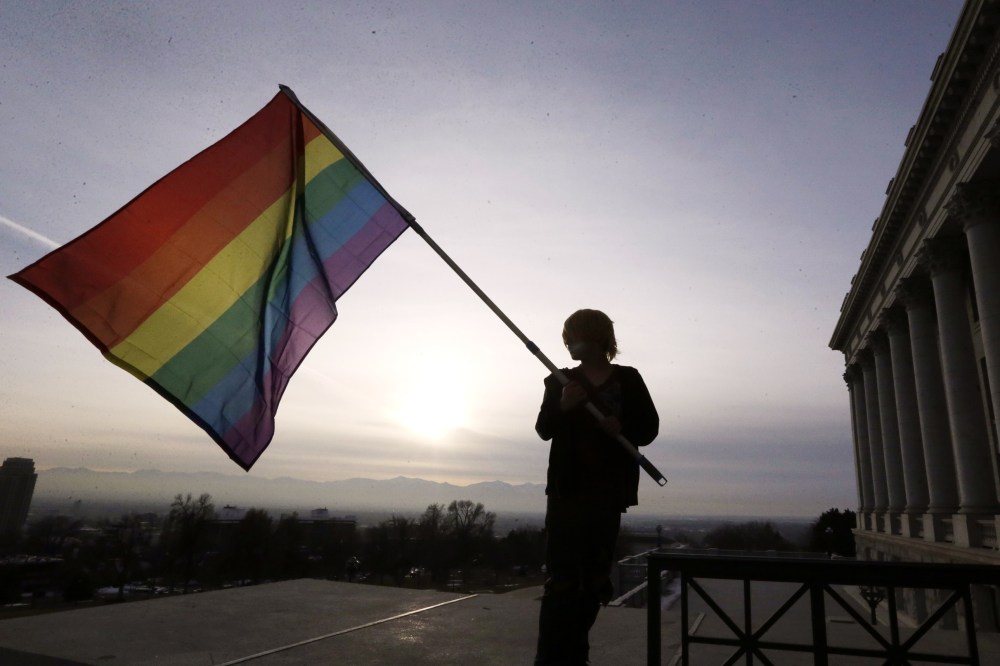
President Obama delivered a big win for the LGBT community when he signed an executive order last week barring federal contractors from discriminating on the basis of sexual orientation or gender identity. And he went further still, refusing to grant any exemption for religious organizations who do business with the government despite calls from more than a dozen high-profile faith leaders — some his own allies — to create such a carve-out. Under Obama’s order, all federal contractors, religious or otherwise, will be prohibited from firing, refusing to hire, or discriminating in any other way against LGBT employees
Needless to say, members of the religious right haven’t been too pleased. Here’s a look at some of their assertions.
1. President Obama is infringing on religious liberty.
By far the most popular charge against Obama’s executive order was that it would trample on their First Amendment guarantees to religious liberty.
“In the name of forbidding discrimination, this order implements discrimination,” said two chairmen of the United States Conference of Catholic Bishops (USCCB) in a statement. “With the stroke of a pen, it lends the economic power of the federal government to a deeply flawed understanding of human sexuality, to which faithful Catholics and many other people of faith will not assent. As a result, the order will exclude federal contractors precisely on the basis of their religious beliefs.”
Peter Sprigg, senior fellow for policy studies at the Family Research Council, voiced a similar complaint.
“If religious organizations cannot require that their employees conduct themselves in ways consistent with the teachings of their faith – then, essentially, those organizations are unable to operate in accordance with their faith,” Sprigg told Fox News’ Todd Starnes. For his part, Starnes wrote that Obama’s executive action was another example of “the federal government bullying religious groups that hold viewpoints it deems inappropriate.”
%22LGBT%20people%20experience%20treatment%20in%20the%20workplace%20that%20they%20might%20not%20even%20think%20of%20as%20discrimination.%22′
The National Organization for Marriage (NOM) and the Heritage Foundation made similar claims.
The accusations are heavy, and if true, could spell constitutional troubles for the Obama administration ahead. But do they hold up?
Kara Loewentheil, director of Columbia Law School’s Public Rights/Private Conscience Project, says the answer is unequivocally no.
“As a legal matter and as a general matter, it is not part of free exercise of religious liberty to fire someone because they’re gay,” Loewentheil told msnbc. “The idea that LGBT discrimination is acceptable if it’s religiously motivated I think is misplaced.”
If religious groups object to the nondiscrimination requirements, they have neither a right nor an obligation to enter into a government contract, Lowentheil added.
“Generally, for a religious liberty claim the government has to be requiring you to do something you don’t want to do,” she said. “There’s no requirement that they participate in this contract.”
But Eugene Volokh, a religious freedom law professor at UCLA, says the answer is more complicated, especially since the executive order covers employers with federal contracts or subcontracts greater than $10,000 — no easy sum to part with should a religious organization decide to cut ties with the government.
“The order would in certain situations require organizations to choose whether to continue participating in these broad federal contracting programs, which are tremendously important in this economy, or to comply with their understanding of religious beliefs,” Volokh told msnbc. “I think there will be some litigation.”
2. LGBT workplace discrimination isn’t a problem.
The editors at National Review have criticized Obama’s order as one addressing “a small and shrinking problem of discrimination.”
“Sensible employers will almost never consider sexual orientation or gender identity when making hiring decisions,” they wrote. “Changing social attitudes and the pressure of market competition must be working to make such discrimination ever less of a pressing social problem.”
It’s a familiar argument. Last year, Republican House Speaker John Boehner dismissed nationwide protections for LGBT workers as “unnecessary.” He later declared outright that the Employment Non-Discrimination Act (ENDA), a bill to implement such protections, had zero chance of passing the House.
Supporters of so-called religious freedom measures have also cast LGBT discrimination as a minor issue, frequently defending the right of religious businesses to turn away LGBT customers on the grounds that they could take simply take their business elsewhere. A truly prejudiced business, they argue, will eventually be punished by the free market.
A majority of Fortune 500 companies already bar discrimination based on sexual orientation or gender identity. Why? Because firing an employee simply for being gay or transgender creates a number of consequences, including a substandard workforce, poor productivity, and high litigation costs. In other words, LGBT discrimination is simply bad for business.
But that doesn’t mean it never happens.
“In every survey that gets done on a regular basis where LGBT people are asked if they face discrimination, we find out that they have,” said Lee Badgett, senior scholar at the WIlliams Institute and an economics professor at the University of Massachusetts, Amherst.
It is legal in 29 states to fire someone for being gay, and three more where it’s legal to fire someone for being transgender. Yet discrimination manifests in other forms. A recent Pew Research Center survey found that about 20% of LGBT adults reported experiencing unfair treatment from an employer. While that percentage may sound low to some, a separate study from the Williams Institute found that rate of discrimination complaints was very similar to the rate among women and people of color.
“LGBT people experience treatment in the workplace that they might not even think of as discrimination,” Badgett added. “There’s pressure on people to not come out, pressure on people to not include pictures of partners on their desks, they may not be allowed or encouraged to bring their partners to events.”
Even in companies that do have stated values of inclusion and equality, many LGBT employees purposely downplay aspects of their identity — a practice identified as “covering” in a recent study from the Deloitte University Leadership Center for Inclusion. In that survey, 83% of LGBT respondents reported covering in the workplace, a higher percentage than among any other group.
In short, there is very little evidence to suggest that LGBT workplace discrimination is a thing of the past.
3. Obama’s executive order will lead to other actions against religious organizations.
Even if this particular executive order ends up being rather benign for religious employers, some critics warn of a slippery slope.
“The problem with this executive order is that it paves the way for the next one – which could withhold the tax-exempt status or broadcast licenses for religious organizations,” Pastor Robert Jeffress of the First Baptist Church in Dallas, Texas, told Fox News.
Jenny Yang, vice president of advocacy and policy for World Relief, a federal grantee, made a similar prediction.
“Our main concern is its implication on religious freedom down the line, where future executive orders could also include not just federal contractors but grantees as well,” she said.
While past precedent isn’t always a reliable indicator of what’s to come, those fretting over future executive orders can at least take solace in the amount of time it took Obama to sign this one. Up until recently, LGBT advocates claimed he’d been dragging his feet on workplace protections. After all, Obama pledged to take executive action on LGBT nondiscrimination practices in the 2008 presidential campaign and it took him six years to follow through. At this rate, it’s unlikely he’ll be signing any more LGBT-related executive orders. The demise of Don’t Ask, Don’t Tell also offers a lesson. Obama signed off on ending the military’s former ban on openly gay service members in 2010 – a move that also elicited a fair share of doomsday scenarios that never came to be. “As someone who is intimately familiar with the repeal of Don’t Ask, Don’t Tell, I can tell you there were a lot of people who unleashed a parade of horribles,” said Winnie Stachelberg, of the Center for American Progress. “People said the military wouldn’t be able to recruit or retain, they said no one would serve, they said it would be the undoing of the most powerful military in the world … All of those wild claims have not come true.” Others see more legitimacy in the concern over future orders. “The ‘slippery slope’ arguments are made because they’re pretty sensible,” said Volokh. “You could imagine a compromise [with religious organizations] being brokered, but you could also imagine this being the latest step in the continued marginalization of groups that hold traditional values.” In his order, Obama did not go so far as to repeal an existing provision signed by President George W. Bush that allows religious groups to make hiring decisions based on a job candidate’s faith. Some viewed the move as a sign of respect for religious groups. “This Administration has been quietly attentive to religious liberty issues, and may quietly use the religious liberty protections it left in place,” said University of Virginia law professor Douglas Laycock via email. %22As%20a%20legal%20matter%20and%20as%20a%20general%20matter%2C%20it%20is%20not%20part%20of%20free%20exercise%20of%20religious%20liberty%20to%20fire%20someone%20because%20they%E2%80%99re%20gay.%22′ 4. The Obama administration is meddling in business interests with this order. During an appearance on on EWTN’s “News Nightly,” Alison Howard from Concerned Women for America mounted a kind of libertarian attack against Obama’s order. “It’s sad that we can’t come together and work toward really great and big things that we could be doing — taking the heavy hand of government off of businesses, allowing people to run their businesses according to their deeply held religious convictions,” she said. This argument is surprising in that it suggests barring LGBT discrimination will somehow hurt the business interests of federal contractors, when — as stated earlier — the opposite is true. “This order is in alignment with business interests. If it weren’t, President Obama wouldn’t have signed it,” said Stachelberg. In a recent poll from the Center for American Progress, 63% of small business owners said they supported ENDA, which if passed would apply the executive order’s LGBT protections to every employer in the country, not just those in business with the government. Though ENDA does include a broad religious exemption, only 7% of the small businesses surveyed that did not have inclusive nondiscrimination policies cited religious or moral beliefs as the reason. Additionally, as Stachelberg noted, before an executive order of this kind is signed, there has to be an “economy and efficiency” test to ensure that it won’t place a burden on businesses. 5. The order wrongfully equates being gay or transgender with characteristics outside a person’s control, like race. Until Obama’s order, federal contractors were already prohibited from discriminating on the basis of race, color, religion, sex, or national origin — but not sexual orientation or gender identity. Aside from religion, all those traits are outside of a person’s control — no one can choose to be white, for example. While science suggests the same is true for sexual orientation and gender identity — i.e. neither is a choice – many religious conservatives insist otherwise. Obama’s executive order presented yet another opportunity to do so. “This action is wrong on the merits, because it accepts the premise that distinctions based on actual conduct — such as homosexual behavior and cross-dressing — should be treated the same way as distinctions based on immutable and innocuous characteristics like race,” said Family Research Council President Tony Perkins. In another statement, Traditional Values Coalition President Andrea Lafferty referred to the order’s beneficiaries as “gays, transgenders, and she-males.” The assertion that sexual orientation or gender identity is somehow alterable and/or harmful has been the driving force behind the anti-gay movement for decades. It’s the foundation for the argument that being gay is something a person does — not who a person is — and can therefore be regulated or treated. It also happens to be completely inaccurate. “It’s true that we don’t know what causes homosexuality. But the idea that somehow parents did this to you, or you can change it has not been borne out at all,” said Dr. Jack Drescher, a psychiatrist who served as a member of the American Psychiatric Association Workgroup on Sexual and Gender Identity Disorders. In June, the U.S. Supreme Court cleared the way for California to enforce its ban on psychological counseling aimed at turning gay kids straight — a medically discredited process known as conversion therapy. New Jersey last year became the second state in the nation to ban conversion therapy among minors, and 8 other legislatures plus the District of Columbia have similar bans pending. Still, the practice remains legal in a majority of the states. Earlier this year, the Texas GOP went so far as to endorse conversion therapy in its party platform as a legitimate and effective “treatment for those patients seeking healing and wholeness from their homosexual lifestyle.” In general, however, national acceptance of gay and lesbian individuals is growing at a rapid clip, particularly when it comes to the right to marry someone of the same sex. Transgender individuals are gaining ground too when it comes to understanding within the medical community, as well as in their fight to acquire full civil rights at school and in the workplace. In the most recent version of the Diagnostic and Statistical Manual of Mental Disorders (DSM-5,) “gender identity disorder” is nowhere to be found.
Emma Margolin
Emma Margolin is a reporter at MSNBC.com. Recommended


