








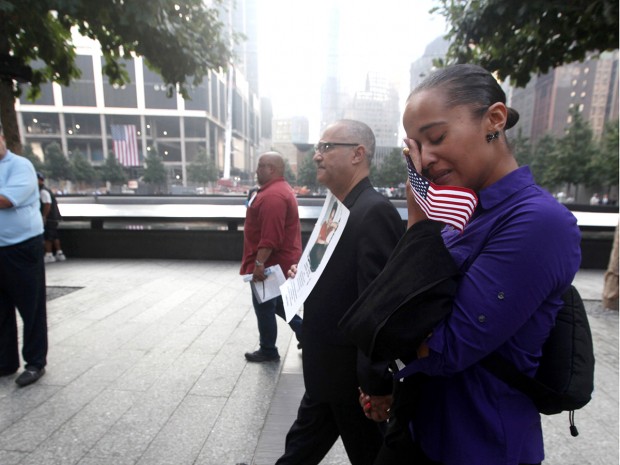
As Americans marked the 12th anniversary of the Sept. 11 terrorist attacks when hijacked planes crashed into the World Trade Center towers in New York, the Pentagon, and a field in Pennsylvania, the reminders of that day were everywhere, from the debate on Syria to the now annual 8:46 a.m. moment of silence recognizing the nearly 3,000 deaths.
President Barack Obama and Vice President Joe Biden, joined by their wives, led a moment of silence at 8:46 a.m. The president then spoke again from the Pentagon.
“Our hearts still ache for the futures snatched away, the lives that might have been, the parents who would’ve known the joy of being grandparents, the fathers and mothers who would’ve known the pride of a child’s graduation, the sons and daughters who would’ve grown,” the president said. Later in the day, Obama will participate in a day of service to commemorate those who died in the attacks.
Just the night before, Obama appeared before the American public in a televised address in which he once again made the case for a U.S. military strike on the Syrian regime of President Bashar al-Assad, while also acknowledging Americans’ reluctance after nearly a decade of war that followed the 9/11 attacks on U.S. soil. He quoted from letters he’d received from the public who called on him to avoid another war, and said, “I’ve spent four and a half years working to end wars, not start them.”
More than 2.5 million Americans served in the twin wars of Iraq and Afghanistan as the country chased Osama bin Laden (and eventually killed) and weapons of mass destruction. Now, war-weary, the country strongly opposes a military intervention in Syria, according to the latest NBC News poll, despite the White House charge that Assad used chemical weapons to kill more than 1400 people.
The wars cost trillions, adding to the country’s deficit and debt (the U.S. has not seen a budget surplus since 2001; it now has 16.7. trillion in debt.) Intelligence and surveillance efforts have ballooned as the PATRIOT Act gave the federal government unprecedented rights to monitor its people, authorizing, as the country recently learned, wide-scale monitoring of phone and internet communication records.
In New York City the names of the nearly 3,000 killed will be read, with six moments of silences marking the major blows of the morning.
The legacy of 9/11 is felt on a daily basis in New York City—public safety messages appeal to all citizens to vigilantly watch their streets, subways, and neighborhoods, pleading with them to ‘see something, say something.’
Under the leadership of Mayor Michael Bloomberg, who was elected just weeks after the attacks, massive surveillance efforts, including as many as 6,000 surveillance cameras, watch the city. Civil liberties groups allege such widespread surveillance—including the ones by “smart cameras”—violate privacy on a wide scale. Another police initiative, the city’s stop-and-frisk policy, became a national issue when critics alleged the policing practice violate civil liberties, while police counter that it is necessary to keep the city safe.
In the president’s remarks, he remembered the diplomats killed in the attacks on the Benghazi consulate in Libya, who died a year ago on the 9/11 anniversary. At the Department of Justice, Attorney General Eric Holder named the victims of the attacks in Benghazi, Libya, and paid tribute to all those who serve in the continuing war on terror. “We pay tribute to each of them, and to many others who have given their lives in the service of their country since 9/11–from the soldiers, sailors, airmen, and Marines who have fought on the battlefields of Iraq and Afghanistan; to patriots like Glen Doherty, Tyrone Woods, Sean Smith, and Ambassador Chris Stevens, who were taken from us just one year ago, in Libya,” he said. In his opening remarks at the Capitol, House Speaker Rep. John Boehner read a biblical passage and reminded Americans to “never forget,” the Washington Times reported. “This moment is for us to pray for the families of the departed,” Boehner said. “To ask God to renew our strength and replenish our grace so that we may press on and serve without growing weary, and walk without growing faint, towards that more perfect union of our founders’ dreams.” (Morning Joe broadcast from the World Trade Center on Wednesday, where we spoke with firefighter John Morabito who was one of the first-responders. Watch the interview below.)
Jane Timm Recommended


