









The country’s health care spending occurred at the slowest rates ever recorded in history during a recent consecutive four-year period, according to a report published Monday.
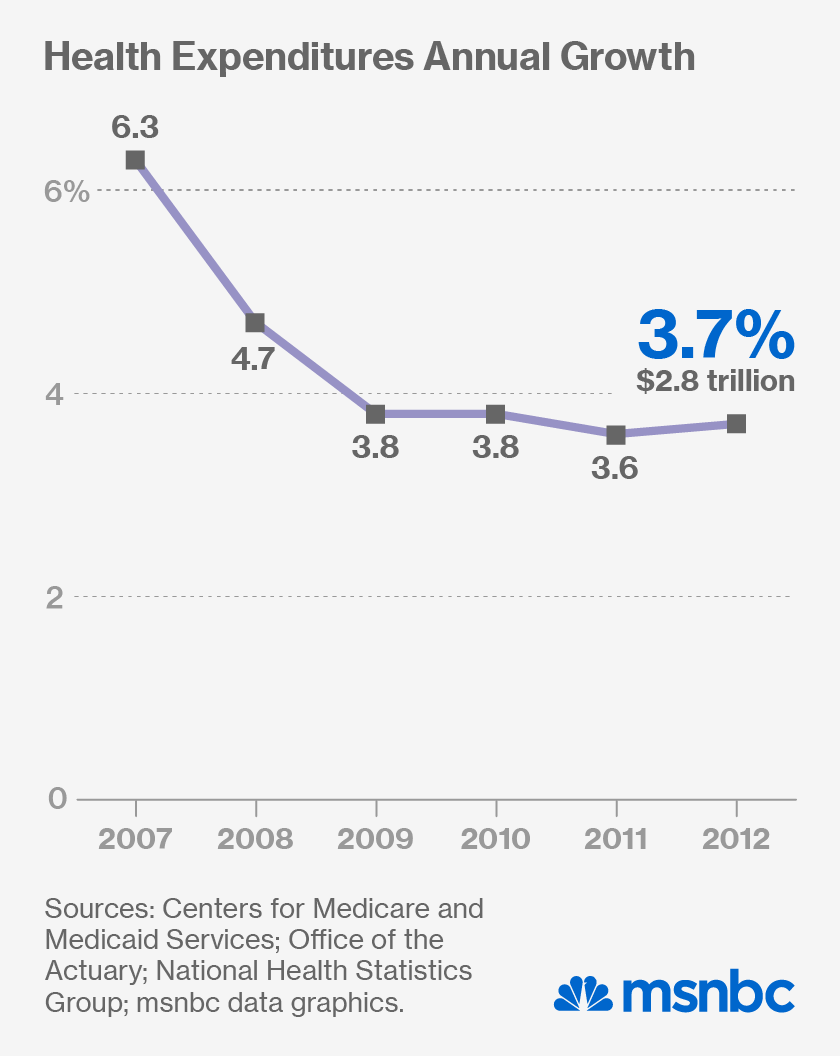
U.S. health care spending grew to $2.8 trillion in 2012, a low 3.7% growth rate similar to the level of annual percents between 2009 and 2012, according to the new analysis released by the Office of the Actuary at the Centers for Medicare and Medicaid Services (CMS). That is $8,915 in national health expenditures per person.
“We carefully analyzed our data courses throughout the year, so really nothing surprised us,” said Anne Martin, an economist and lead author of the report, during a press conference call on Monday afternoon. “It wasn’t just one prominent trend that affected growth; it was more of a mixed bag of results.”
The country’s health spending has been relatively stable since 2009, with the annual growth rate remaining between 3.6% and 3.8%.
The share of Gross Domestic Product devoted to health care spending fell from 17.3% in 2011 to 17.2% in 2012. The period between 1996 and 1997 was the last time the share declined relative to GDP, author Aaron Catlin said on the call.
Since 1969, annual health spending had increased about 2.3% more than GDP growth.
What explains this new stability in spending? Writing in the journal Health Affairs, the CMS analysts acknowledged that it “primarily reflects the lagged impacts of the recent severe economic recession,” which cut into health-care coverage along with employment and income.
Opponents of health care reform pounced on that simple observation as an admission of defeat. “This report shows that the Administration’s promise that Obamacare would rein in the skyrocketing health-care costs is false,” Utah Senator Orrin Hatch in a statement.
In truth, it’s far too soon to judge the impact of the Affordable Care Act. It includes many provisions to control costs and improve quality, but many of them are just now taking effect. The new analysis credits Obamacare for slowing Medicare spending, which the government actually controls. As the White House noted in a Monday-night blog post, “the Affordable Care Act’s policies to discourage readmissions and manage care transitions have contributed to 130,000 fewer readmissions to hospitals for Medicare beneficiaries from January 2012 through August 2013.”
Personal health care goods and services grew more quickly because of faster growth in hospital, physician, and clinical services, and accounted for 85% of the total national spending. But upward mobility in those services was reduced by slower growth in the prices of retail prescription drugs and nursing care facilities.
Although the Affordable Care Act, effective since 2010, had minimal impact on total national costs, spending increased at a faster rate for Medicaid and out-of-pocket purchases. Rates increased at a slower pace for private health insurance–which also remained near historic lows–and Medicare. The ACA prevents insurance companies from discriminating against customers with pre-existing conditions and placing lifetime caps on coverage. It allows young people to remain on their parents’ coverage plans until the age of 26. National health expenditures occasionally have minimal revisions each year based on updated data sources. CMS will release projections for the next decade later this year. The report has a 53-year history. Some analysts credit the new findings to the country’s recovery from the economic recession, while others believe it is a result of recent health care reform. But current spending is higher than it should be, and continued efforts to maintain cost control are necessary to bring spending to the same level as the economy, according to a report published on Dec. 25, 2013 by the Commonwealth Fund, which aims to promote a high-performing health care system. Related: Obamacare to save family $18,900 The now-infamous HealthCare.gov launched last year on Oct. 1 to serve millions of Americans shopping for health insurance. Now, more than 2 million people have signed up for private health plans–and another 4 million registered for Medicaid–ahead of the 2014 open enrollment season that ends on March 31.
Michele Richinick Recommended


