Too much debt is too much debt–no matter who is charging the country’s credit card, said Douglas Holtz-Eakin on Morning Joe.
Holtz-Eakin is the former director of the Congressional Budget Office and former chief economic adviser to Sen. John McCain’s presidential campaign and presently serves as the head of American Action Forum. He argued on Wednesday that history proves that too high debt makes for too low growth, regardless of what the debt was used to fund.
“All you’ve got to do is look at the historical record and countries get too much debt grow slower than countries who look the same, and have the same approach to economic policy, but have less debt,” Holtz-Eakin said.
NOW host Alex Wagner pointed to Holtz-Eakin’s own party, asking “where was this rhetoric when we were getting involved with two wars and paying for them on a credit card and also having major tax cuts put in place? The Iraq war was the first war where we haven’t had a war tax–where was this fiscal responsibility a decade ago?”
“Missing,” Holtz-Eakin responded. “I said famously in budget circles–you know, a big crowd–I said in 2003 that the party’s over, people get it, we’re not going to spend any more money and 10 years later, I was dead wrong…We lost our rudder somewhere.”
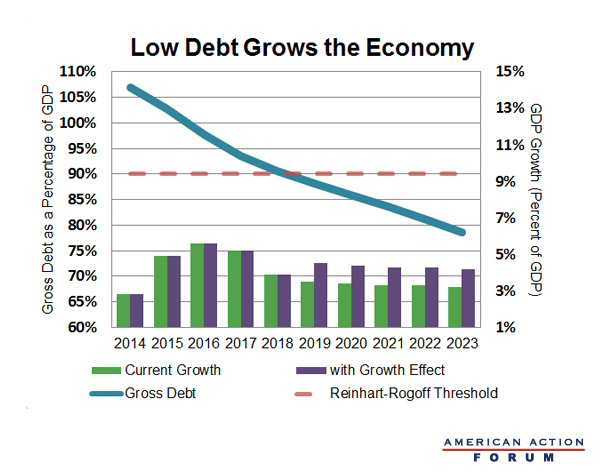
Holtz-Eakin pointed to a detailed study by the AAF that found, after studying 44 different countries over the last two centuries, that when gross debt rises above 90% of GDP (a tipping point identified by economists Carmen Reinhart and Kenneth Rogoff), growth slows. Current policy keeps gross debt above 90% till 2023, which Holtz-Eakin said will slow economic growth year after year.
Reducing the debt, however, would do the opposite, according to Holtz-Eakin:
On the other side of the spectrum, many economists argue that the more effective way to spur growth, at least in the short term, is through economic stimulus—that is, tax cuts and government spending. Most agree that the deficit should be reduced over the long term, but say that doing so too quickly and sharply could send us back into another recession. Holtz-Eakin doesn’t discount that growth can alleviate the debt problems, but notes that that growth, particularly hampered growth, won’t be enough in his mind to fix the problem too much debt creates and the problem can’t be pushed off for as long as economists like Paul Krugman advocates. “I’ve been saying the same thing for ten years since I was at the CBO: If you look at the numbers, spending grows at the rates where you cannot tax your way out of it, you cannot grow your way out of it,” he said. “The only thing you can do is get your arms around those programs and what’s it’s come down to the recognition that we have to do something about Medicare, we have to do something about Medicaid.” He said the debate in Congress shouldn’t center around whether or not to reform entitlements, but how to reform them. “There should be a fight about how to save it, but there shouldn’t be a fight about whether to save it and that’s what debt deniers are doing,” he said.
Jane Timm Recommended