








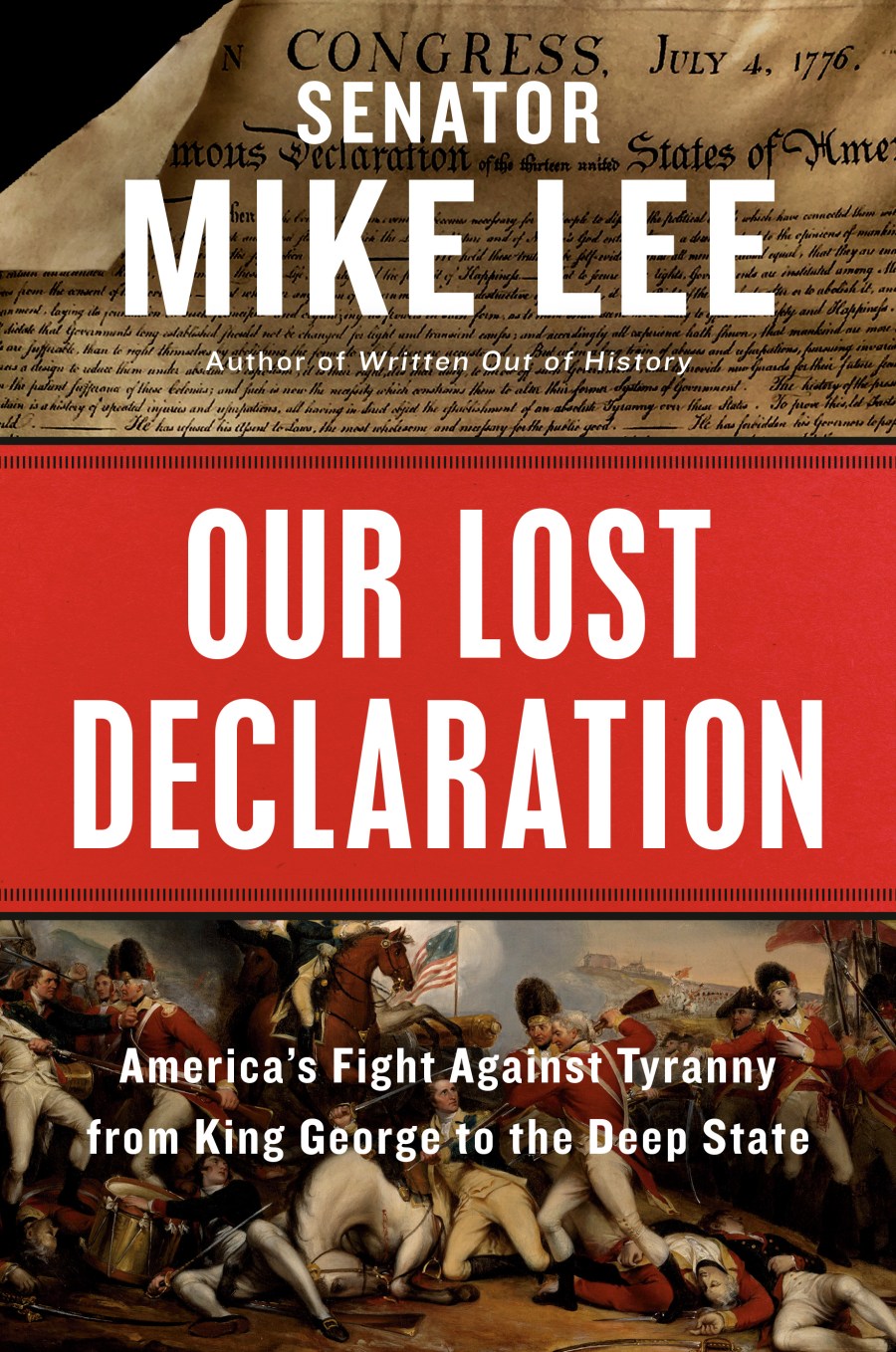
Since the days when early humans first organized themselves into groups for mutual protection and assistance, human societies have imposed rules intended to keep order. As societies evolved, those rules were written down and became systems of laws. A society’s values are reflected in the system of laws it adopts to protect the rights of its people, and especially how much value that society places on each individual human soul. Sometimes these values are defined in the affirmative—when a society shows what it believes. Our American society does this in the Declaration of Independence. The Continental Congress, which approved this document, was issuing the manifesto of a new society free of British rule, one founded on a revolutionary combination of ideas.
The document leads off by explaining the truths the Congress’s members held to be self-evident: that people have certain rights; that government’s job is to protect these rights and remain answerable to the people in doing so; and that if government fails at this job the people can adjust it as they see fit. These simple statements in the Declaration’s preamble contain thousands of years of human wisdom, distilled and interpreted in the mind of an authentic American genius.
Sometimes, however, just as much can be learned about a society by the values they define in the negative—that is, when they explain what they are definitively against.
The Declaration does this, too, in the litany of grievances against King George III. This is why that section of the Declaration deserves consideration on its own, despite not being as rhetorically memorable as the passages that open and close the document. This is one of the imbalances that I have tried to correct in this book.
Most—but I fear increasingly few—Americans can recite the part of the Declaration that shows what America stands for, but fewer are familiar with the Founders’ explanation, in the same document, of what America stands against. American society remains committed to the principles of equality and liberty outlined in the Declaration’s first lines. But the grievances listed later should remind us of what we fought against, and what we must not allow ourselves to become.
As we near the first-quarter mark of the twenty-first century, the steady growth of the administrative state under presidents of both political parties has made the central government based in Washington an all- too- common intruder into the lives of most Americans. In many ways, these lessons of the eighteenth century have never been more relevant.
We must remember that the Declaration of Independence is not just a manifesto for natural human rights, but it is a manifesto against a strong central government that would infringe upon those rights. It is against “swarms of officers” that “harass” the people. It is against the unchecked growth of executive power. It is against an administrative state.
The tragedy of American legislative bodies (federal and state) in the twentieth and into the twenty-first century is one of slow and steady unilateral disarmament. Bit by bit, state legislatures have become more comfortable giving up more and more of their power to the federal government. Likewise, the Congress in Washington has turned over much of its power to unelected, unaccountable bureaucrats housed within the executive branch. In many areas where Congress once reigned supreme, it has now been reduced to a token “oversight” role at best.
The steady usurpation of legislative authority by the executive branch, and of state authority by federal authority, is a creeping phenomenon that is in some ways nearly as menacing to American liberty as a royal colonial governor who woke up on the wrong side of his feather bed. And the greatest indignity is that this is a problem largely of our own making. Over the last eight decades, the people’s elected representatives have made countless choices that have steadily diminished their own power, and with it that of the people they represent. In many respects, they have done so for a simple, understandable, but indefensible reason: Delegating to others the difficult and contentious task of making law has a tendency to make reelection easier.
What is needed is an innovative, perhaps even a radical reimagining of the relationship between Congress and the executive branch, and between state governments and the federal government. This would be a system in which Congress actually exercises the power and authority it is supposed to, rather than delegating that power to a vast web of government agencies. In such a system, any powers not delegated to the federal government to the Constitution would actually be reserved for the state governments or the people, as the Tenth Amendment promises.
Although it might seem radical to us to put more power back in the hands of legislatures, that’s only because we’ve had blinders on for too long. The Founders’ original vision, forged in part by watching their elected legislatures in the colonies get trampled on and dissolved at will by the King’s appointed governors, was one that vested as much power as possible in the place where it was closest to the people— the chamber of their elected representatives. And in a republic like ours, isn’t that where most of the power should belong?
No other conclusion can be drawn from the colonists’ response to the heavy- handed actions of King George III’s government. The seeds of revolution were planted when that government, whose ruler combined a devoted British patriotism with a German absolutist idea of monarchy, decided to squeeze its American colonies tighter and tighter.
Those seeds took root when His Majesty’s royal governors shut down the colonial legislatures where the people had their only say in government. They grew whenever a citizen was dragged before one of His Majesty’s courts without benefit of a jury of his peers—a right any British subject should have enjoyed— or when the courts were shut down altogether due to conflicts with the King’s law. They flourished despite the pressure of unfair trade restrictions, attempts to control the free market for products like tea. And finally they bore the fruit of revolution.
Of course, it took the work of several skilled hands to bring that fruit to bear. Thomas Paine’s rhetoric lit the fire that would fuel the engines of independence. Edmund Randolph defied his loyalist father and fought with George Washington, then joined his fellow Virginians to lead the charge for breaking all ties with Britain. John Adams used his legal skill to remind the royal courts what justice really meant, and later added his expertise to the drafting of the Declaration. Benjamin Franklin, despite being stricken with gout, helped with the editing—and used his trademark wit to console the main author as the full Congress argued over the draft. It was Thomas Jefferson, of course, whom Franklin consoled— the man who staved off his headaches long enough to focus on the important task at hand, and shake loose from the shelves of his meticulously organized mental library the ancient and modern ideas he would use to explain the Americans’ unprecedented act to an astounded world.
These men were not perfect, and neither was the system they created. They were keenly aware that as they signed their names to a statement that “all men are created equal,” this was far from the reality for many of their fellow men and women. And for many Americans, it took far too long for this reality to come to pass. Millions of African Americans lived, worked, and died never knowing freedom simply because of the color of their skin, and their descendants in large swaths of the country were forced into second-c lass citizenry until the latter half of the twentieth century. Millions of Americans were not able to exercise that most precious of the rights of citizenship— the vote—until that same century due to their race or gender. There were the Mormons who were forced out of their communities by government forces because of their religion, and the Japanese Americans who spent years behind barbed wire on American soil because they happened to look like the enemy (even as their sons fought under the Stars and Stripes).
For many in marginalized communities in America to this day, the fight for real equality goes on. But what makes that fight so righteous is that we still look to the words of the Declaration for inspiration. When Jefferson and his colleagues signed their names to that document, they were making a bet on an idea. It’s a bet that every succeeding generation of Americans has done its best to make good on.
Sometimes making good on it means expending blood and treasure. In the midst of the greatest struggle we have yet faced to preserve our founding ideals, one of America’s greatest leaders turned to the Declaration of Independence for strength. Abraham Lincoln, despite his deep knowledge of and respect for the law rooted in the Constitution, viewed the Declaration as a perfect expression of our founding principles. He felt there was no firmer bedrock on which our nation could stand than the simple truth that “all men are created equal.” Indeed, Lincoln observed that he “never had a feeling politically that did not spring from the sentiments embodied in the Declaration of Independence.” 1 In 1854, during his famous series of debates with Stephen Douglas, Lincoln called that concept “the leading principle, the sheet anchor of American republicanism.” And he used it to attack the institution of slavery, arguing that if slaves were indeed human, they too had the right to govern themselves according to the Declaration. “If the negro is a man,” said Lincoln, “why then my ancient faith teaches me that ‘all men are created equal’; and that there can be no moral right in connection with one man’s making a slave of another.” That, according to Lincoln, was “despotism”— the very charge Jefferson leveled at King George. 2 Four years later, he told an audience in Chicago that what binds us all together as Americans, whether our families had been here since the founding or came in the latest wave of immigration, was that we could all rally behind the “father of all moral principle”—that doctrine of equality expressed in the Declaration. “That is the electric cord in that Declaration,” he said, “that links the hearts of patriotic and liberty- loving men together, that will link those patriotic hearts as long as the love of freedom exists in the minds of men throughout the world.” 3 It is recorded that applause erupted after this line—and it is easy to see why. In February 1861, as he prepared to take over the presidency of a country inching toward war over the question of slavery, Lincoln spent George Washington’s birthday in Philadelphia. In a short impromptu speech on the steps of Independence Hall, Lincoln considered the question of what had kept the country united in the decades since its founding. He concluded that the great unifying force was “that sentiment in the Declaration of Independence which gave liberty, not alone to the people of this country, but, I hope, to the world, for all future time.” 4 And in November 1863, as the war to make all Americans free raged around him, Lincoln addressed those gathered to dedicate a cemetery at the site of the recent Battle of Gettysburg. “Four score and seven years ago,” he told those assembled, “our fathers brought forth, on this continent, a new nation, conceived in liberty, and dedicated to the proposition that all men are created equal.” There was his “ancient faith” again. But now he cast the current struggle in no uncertain terms as an effort to reclaim our founding principles. “Now we are engaged in a great civil war,” he said, “testing whether that nation, or any nation so conceived, and so dedicated, can long endure.” It was a test that, by God’s grace, we passed. Just as our nation has not always expressed perfectly that ideal of liberty among our fellow men, Lincoln’s additional hope that this liberty be expanded across the entire world has sadly remained unfulfilled. But Lincoln understood then what we must understand now— that the Declaration of Independence must be a guiding light, always moving ahead of us, urging us onward, urging us to ever more perfectly follow the principles it sets out. A century after Lincoln spoke those immortal words at Gettysburg, someone else stood in front of a colossal marble statue of Lincoln and made a proclamation that was no less immortal. “Even though we face the difficulties of today and tomorrow,” Dr. Martin Luther King Jr. assured the throngs stretched out before him, “I still have a dream. It is a dream deeply rooted in the American dream.” And then he told us what the American dream meant to him. “I have a dream,” he said, “that one day this nation will rise up and live out the true meaning of its creed: ‘We hold these truths to be self- evident, that all men are created equal.’ ” The crowd cheered. Dr. King recognized our nation’s creed in Jefferson’s words, and he was urging us to better live up to it. This is our task as Americans today, and it will be the task for every future generation. Armed with a greater understanding of the Declaration’s principles and how it came to be, we will surely be able to fulfill it.
Morning staff Recommended


