








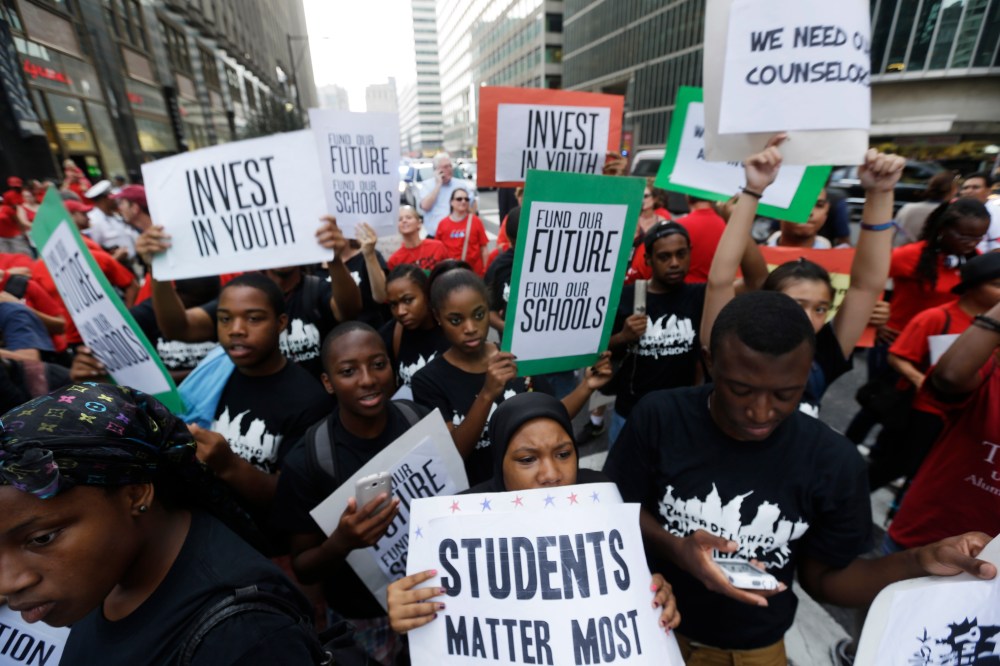
With just days before the start of classes for Philadelphia public school students, elementary school counselor Nikkie Wong Phing is on edge. It’s not the typical anticipation that comes with the start of a new school year, of greeting returning students after a long summer break or coaxing new ones down unfamiliar halls.
“It’s a mix of everything,” Wong Phing said. “But it’s mostly anxiety.”
Over the summer the School District of Philadelphia shuttered 23 schools and laid off nearly 4,000 teachers and other support staff, including every school counselor in the district, 270 in all. Last month the city borrowed $50 million to help the beleaguered district open on time and with the barest essentials. The 11th hour influx allowed the district to rehire about 1,000 laid-off employees, including about 126 school counselors.
Wong Phing was re-hired. But the start of the school year brings no optimism, she said.
Thousands of transferring students from closed schools will be crowding into new receiving schools. And where school counselors were besieged by a daily onslaught of students in need in the best of times, this year they will be doing their jobs with fewer than half the colleagues they had a year ago but with more students to serve.
According to the Philadelphia Federation of Teachers, no school with fewer than 600 students will be assigned a counselor. Only one counselor will be assigned to a school with 600 or more students. And only those schools with more than 1,500 students will receive more than one counselor.
In Philadelphia, like many major urban cities, a vast number of students are impoverished. They arrive in school hobbled by everything that often accompanies poverty: violent communities, unstable homes and food insecurity. Counselors have often been the most reliable line of defense between students and the worlds around them. The counselors handled bullying and harassment. They help soothe the emotional fallout from suicides or homicides. They are college and career counselors and they manage individualized programs for special education and special needs students.
And yet, about 60% of all schools in Philadelphia public schools will not have a counselor this school year.
Over the summer one of Wong Phing’s students drowned. Three of the boy’s siblings will be returning to the school with heavy hearts. A few weeks ago another student’s mother died of a drug overdose.
“Any given day something could happen. You could have a child in crisis or a parent needs help accessing services, and now you’re going to just have to pray that something happens on a day that a counselor is there,” Wong Phing told MSNBC on Friday.
Sharron Snyder, 18, a rising senior at Benjamin Franklin High School, said she’s afraid that when she starts school on Monday, the counselors she spent so much time talking with last year, about college and life, won’t be there.
“They played an important role in my life,” said Snyder. “This is my senior year. It’s supposed to be the best year. But if my counselor won’t be there, who is going to help me with my college applications and financial aid? I really want to get a scholarship to a good school, I’m afraid I won’t have anyone to help me get that.”
Snyder’s school, Benjamin Franklin, is absorbing two other high schools, University City High School in West Philadelphia and Robert Vaux High School in Northwest Philadelphia. Snyder said she’s concerned about tension and drama among the new classmates.
“It makes me nervous because I don’t want to be in school with a lot of fights,” she said. “I am worried about my safety. They’re not going to want to be at Franklin, they want to be at their own school.”
If tensions do bubble over, Snyder asks, who will be there to help students get through it?
Superintendent William Hite Jr. told The Notebook, a website chronicling the Philadelphia school crisis, that “most high schools will have a counselor.”
“Some of the smaller ones do not, but will have counseling services,” Hite said, according to the website.
“Students are going to walk into uncertainty, guaranteed uncertainty,” said Hiram Rivera, executive director of the Philadelphia Student Union, a youth advocate organization. “No one really knows what to expect. The money that was raised [by the city] was not enough to bring back all the staff that is required to deliver the services that the students need and deserve.”
Budget cuts have been so deep that many schools will be operating not only without counselors but without regular nurses or assistant principals. The district’s secretaries and many other support staff that help run the day to day operations of a school have also been laid-off. Some have been rehired, but the confusion has caused chaos in schools preparing to reopen, administrators and teachers told MSNBC. Desk and door keys can’t be located. Computer passwords are missing. In some schools, student registration has swelled to the point where there aren’t enough desks. In one school, the number of students assigned to a particular Algebra class has grown so large that the class will be moved from a traditional classroom to an auditorium, one teacher said. The district is currently in a battle with teachers over pay and a new contract. The teachers contract expired last weekend. The school district is trying to squeeze concessions from the Philadelphia Federation of Teachers totaling $103 million, including salary cuts of up to 13%, in order to close a $304 million deficit. The teachers union has balked at salary cuts, saying the city’s teachers already make less than teachers in surrounding school districts. Meanwhile, advocate groups and parents are preparing for action over concerns that the lack of counselors hurts the most vulnerable students. Parents of children with special needs and advocates met this week with legal advisers to discuss what recourse might be available if they have difficulty receiving services that the state requires the school district to provide to special needs students. “We want parents to know how to file a complaint immediately,” Helen Gym, a public school parent and co-founder of Parents United for Public Education, told the Philadelphia Inquirer. “We want them to demand that their children get the service required under the law.” Sabra Townsend, the mother of a 9th Grader with special needs whose school was recently closed, told MSNBC that she is angry and frustrated. Townsend said her son’s former school counselor was responsible for handling her son’s independent education plan (IEP), which includes navigating class assignments, placements and fulfilling various administrative requirements. “Of course it’s stressful,” she said. “It’s stressful because I really don’t know what the program is going to be, who will handle his IEP, his legal documents or what’s going to happen once he gets the classroom. It’s just a mess and nobody seems to have any answers for me.” Wong Phing, the elementary school counselor, said the she’s not sure how things are going to play out this year. While she’s happy she was re-hired, her feelings are tempered by the fact that so many of her former colleagues haven’t been so fortunate. And she said knows the children are going to suffer as fewer adults in the building will have less of themselves to give. “I think that it just speaks very little of society but also what we have going on in Philadelphia. We are talking about the most vulnerable kids. Most of them are poor and most of them are African-American and Latino,” Wong Phing said. “I wish I could feel a little optimistic. I can see that parents and the community are starting to become more organized against all of this, that part feels kind of positive. But I think it’s going to be a really tough year. I just don’t see things just miraculously going back to the way they were or getting better.”
Trymaine Lee
Trymaine Lee is an NBC News correspondent. Recommended


