








President Obama this morning hosted a Fourth of July naturalization ceremony for active duty U.S. servicemen and women at the White House, greeting those assembled, “I could not be prouder to be among the first to greet you as, ‘my fellow Americans.’” I was born here in the States, so I didn’t have to take the test which these new Americans had to pass. Judging by a recent Xavier University survey, I wonder if we natural-born ‘Murricans had to take a test to retain that automatic citizenship, we might have some trouble:
Whereas 97.5 percent of immigrants achieved a passing grade of 60 percent, only 65 percent of citizens born here passed. If the passing grade had been 70, the Xavier researchers reported, only 50 percent of the natives would have passed.
You can take some of the test here; I highly recommend it. It stands to reason that on a day during which we celebrate our country’s independence by blowing up pretty bombs and eating tubed meat, we also take time to put that independence in context, receive a reminder about the freedoms some of our ancestors won that day, and recognize how we’re putting those freedoms into practice.
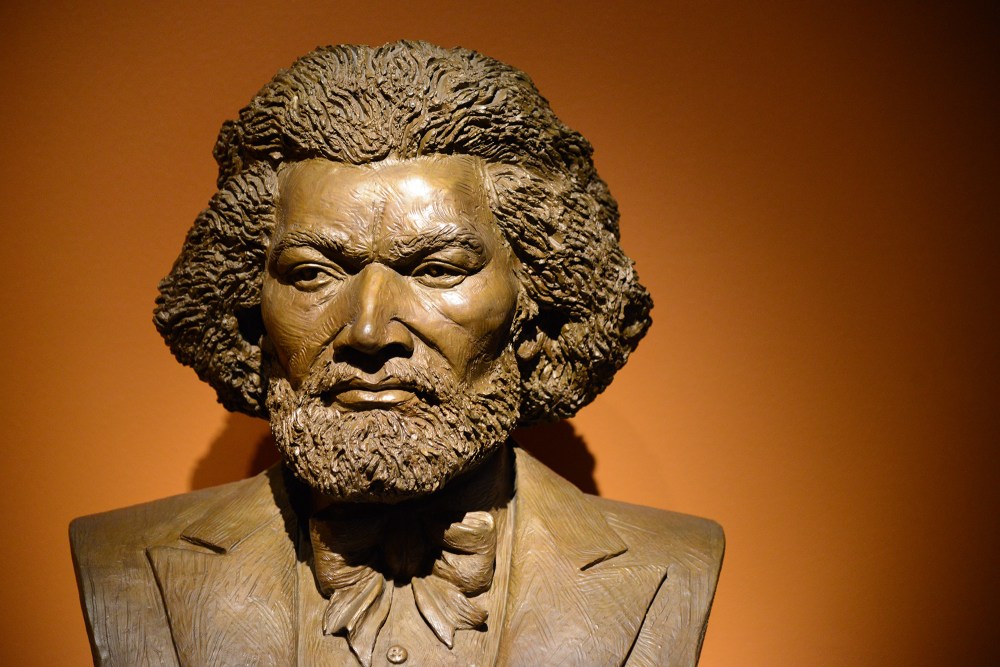
Seventy-six years and a day after July 4, 1776, when slavery still ravaged our country, a former slave spoke up about America’s annual celebration. Frederick Douglass delivered a brutal speech in 1852 which, to this day, serves as a lens through which many an American (myself included) views today’s holiday. Kai Wright has an eloquent piece up at Colorlines today which expounds on that concept, quoting at length what I feel is the most powerful passage, which Douglass delivered at the end:
What, to the American slave, is your 4th of July? I answer: a day that reveals to him, more than all other days in the year, the gross injustice and cruelty to which he is the constant victim. To him, your celebration is a sham; your boasted liberty, an unholy license; your national greatness, swelling vanity; your sounds of rejoicing are empty and heartless; your denunciations of tyrants, brass fronted impudence; your shouts of liberty and equality, hollow mockery; your prayers and hymns, your sermons and thanksgivings, with all your religious parade, and solemnity, are, to him, mere bombast, fraud, deception, impiety, and hypocrisy—a thin veil to cover up crimes which would disgrace a nation of savages. There is not a nation of the earth guilty of practices more shocking and bloody than are the people of these United States at this very hour.
The speech is called “The Meaning of July Fourth for the Negro,” but seems now more commonly known by a kinder version of that most declarative question: “What, to the Slave, is the Fourth of July?” Douglass’ words may be considered outdated to some. The savagery of slavery is gone, having left behind its potent spirit, racism, in the very foundation and girders of our society.
But when we see regular reminders from white writers about what it was like for white people in 1776, Douglass remains necessary. Writing in the Wall Street Journal, historian Thomas Fleming assesses what America looked like back in the day, never mentioning slavery once:
Those Americans, it turns out, had the highest per capita income in the civilized world of their time. They also paid the lowest taxes—and they were determined to keep it that way.
That must’ve been nice for them, but our African ancestors and their descendants continue to be plagued by an invisibility of experience which necessitates revisiting Douglass, and other historical accounts which address our country’s complicated past. Even current stories outside of a racial context, such as that about Secretary of State Hillary Clinton apologizing to Pakistan, remind me of what Melissa noted in her Footnote: that “Independence Day is more aspirational than actual,” and that one can wave the flag proudly for an imperfect country.
Salamishah Tillet, a past “MHP” guest and University of Pennsylvania professor (and my former classmate there), wrote a stirring piece for NPR on Tuesday about the lens through which she views the so-called American Dream — the legendary singer Nina Simone, who meditated on freedom in the clip above in 1969:
Flashback. The time is 1969 in New York. Donning a short afro, bamboo earrings and a West-African batik-patterned dress, Nina Simone sits in her living room for a documentary interview. The question posed: “What does freedom mean to you?” She starts off causally and impersonally and in a split second turns dead serious, she confesses, “I’ll tell you what freedom is to me — no fear! … If I could have that half my life, no fear.” She goes on: “It is something really, really to feel — like a new way of seeing.” Salamishah writes that, per the video clip above, Simone’s thoughts on freedom are followed on the PBS show by a rendition of Billy Taylor’s “I Wish I Knew How It Feels to Be Free”: In her hands, Taylor’s song becomes part prayer, part prophecy. Here, Simone lengthens the song until it feels like the whole room is ready for it to be over. Her ad libs themselves invite the audience to join her, transforming her singular mediation on freedom into a communal desire. While Taylor’s version brings us to church, Simone brings the church to the streets. This difference is as subtle as it is important. Taylor invokes an African-American sacred song tradition — 19th-century spirituals that could only sing of a heavenly versus an earthly freedom. Simone, on the other hand, transposes Taylor’s original into a group-participation song more suitable for a protest march than a Methodist pew. But instead of stripping down the musical accompaniment, she revved it up, inviting more and more people to bring freedom down to earth. Though we view our 236-year-old country through many disparate lenses, it has never been more essential that we see all of it for what it is, and accept just how imperfect it remains. Melissa’s Independence Day Footnote is below.
Jamil Smith Recommended


