








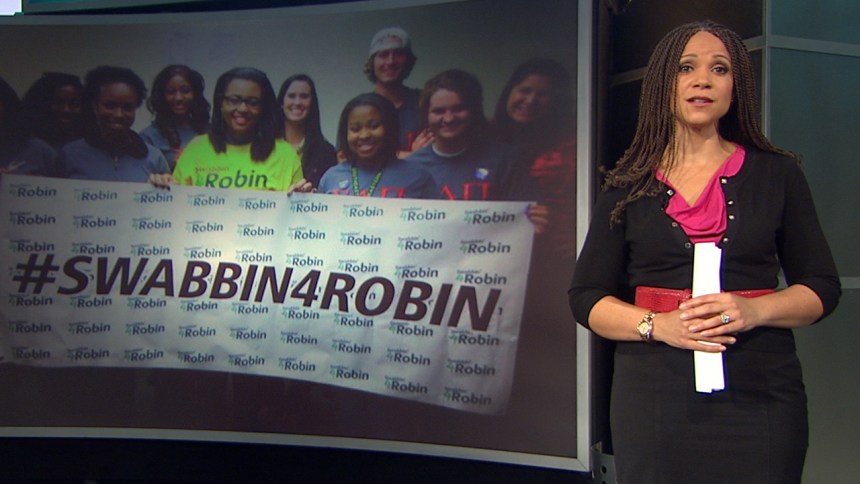
Melissa profiled Southeastern Louisiana University junior Whitney Christy as her Foot Soldier today. Rather than telling you why, I think I’ll let her tell you. Below, my interview with her.
LR: How did you come up with the idea for the “Swabbin’ 4 Robin” initiative?
WC: I was thinking of doing something for Robin Roberts because she is a model leader for our society and she is an alumnus from Southeastern.
I wanted to do a drive or at least get other students to wear her bracelet that she has to promote the National Bone Marrow Registry with Be the Match. When I looked at it, Natalie Rowe, a representative from Be The Match, contacted me and she said that Sally-Ann and Robin Roberts had been trying to start something on our campus for a few years now, but they wanted it to be a student-led project. She offered me an internship, so now I intern with Be The Match. We started a campaign, and actually one of the faculty members on our campus came up with “Swabbin’ 4 Robin,” but all of the planning has been a student-led initiative.
LR: How did you come up with the idea for the drives? Was it part of the internship?
WC: No. Christopher McKinley, he is an SGA (Student Government Association) liaison between the SGA on our campus and the student body, and he and I are good friends. I asked for his help on how to get the campaign out. Together, he and I met with campus administration, and we came up with events and ideas that we could do to get people to join the registry. We’re doing bone marrow drives at every athletic event. The reason we chose athletics is because Robin Roberts played on our basketball team, and we wanted to get the word out. Our girls’ basketball team is very active in the campaign. They were the first group of students to get trained to do the drive, and ever since then we have been getting a lot of organizations trained, and getting them to facilitate a drive, because there is a training process that goes with it.
LR: Have you done any drives yet?
WC: We’ve done four to date, and we have 253 people that have registered for the National Registry so far.
LR: How did the drives go?
WC: The first one was a little bit slow; we got about 20 to 30 people registered. But at our last event, at the last home football game that we had, we registered 97, and that was the record.
LR: My first thought when I heard your story was that you are doing a great thing, but I’ve also heard the stories about donating marrow being painful. How do you explain the actual process to students?
WC: It’s a two-part process. Eighty percent of the time, once you’ve done the swab, it’s done through cell transplant, just like giving blood. If you’re okay with donating blood, it’s the same exact process as giving plasma: they hook you up to the machine, and they take the stem cells from your blood, not the dark marrow. They take the stem cells that help produce your blood. It takes a few hours; you just sit and they do that part. There’s only one needle for the IV and that’s it. About 20% of the time they put you under anesthesia, and it’s outpatient surgery. They put a needle directly into your pelvic bone into the bone marrow, and they take the bone marrow directly out of your bone.
That’s the process there, but that’s not painful. You might be a bit sore for a few days. That process is done the least amount of times, because it depends on the person you’re donating to and their illness, and the treatment that their doctor wants them to have. Some people have a severe case where they need direct bone marrow, but 80% of the time you’re just giving your stem cells that are going to help them produce bone marrow.
LR: Once someone signs up for the registry, do you follow up, or does the information go directly to Be the Match?
WC: It goes directly to Be the Match. I collect all of the kits myself and I hand them to Natalie Rowe, the representative for the Southern region. I give them directly to her. What they do is they send them all- the swabbing kits- to the lab, and they send all of your personal information to their filing facility. It’s all separate, so all of the DNA is organized by barcode. They don’t really use your name until they need to contact you when they see that you have become a match for someone.
LR: How long do you spend with each person explaining it, doing the swab, and having them really understand what the whole process is like? WC: It typically takes about ten to fifteen minutes with each person. It depends on the type of questions they have. We want them to really understand what it is. We have a lot of forms they can take home and read. If they do decide to do the swabbing, and they agree with what it is and understand it, they can join the registry. But we also have a lot of forms they can take home, and really look into and read, if we might not have answered their question in as much detail as they would like. Throughout the whole process they have the chance to say no. If someone from Be the Match contacts them and says “Hello, you’ve been matched with a person in our database, would you still like to continue with the process?” at that point they still have the chance to say no. They’ll continue through a screening process and do more blood work, but before each step they are asked if they would like to continue with the process or they would like to change their mind and back out. We don’t want people to join and just do it without really thinking about it because you’re saving someone’s life in the long run and you don’t want to give them false hope that they will have a match. LR: Have you joined the registry yourself? WC: Of course. Christopher McKinley and I were the first students on campus to join the registry. LR: Are you trying to get money from students, or other ways? WC: Other ways. We have t-shirts that we’ve made; we have bracelets that are getting made. We’ve had a lot of people ask to donate because the age limit for Be the Match is between the ages of 18 and 44, just because those people are more receptive when they’re giving marrow, the chances are better with that age group. But if anyone is over that age limit, we tell them they can still be part of the team; they can still donate to the cause because we need money to test those people that are being registered. We have a donation website, it’s www.BeTheMatchFoundation.org, and our team is called Swabbin4Robin. LR: You started your chapter of National Society of Leadership and Success this fall semester. Not only have you done that, but with Swabbin4Robin you’ve actually had a chance to really learn and exercise some leadership. How has that been? WC: It’s been wonderful, but the best thing about being a leader is you have to learn to listen to people, you can’t just dictate a situation. You have to really learn to listen, and I think that has really helped to mold my leadership skills, because I always have ideas, I always have things that I want to do, but I have a team of members of my chapter, and they are always bringing me back down to reality and coming up with great ideas. I feel like learning from them has really helped me become a better leader, instead of just trying to make them into what I think a leader should be. They’ve helped me more than I can even imagine. You can learn more about becoming a bone-marrow donor at Bethematchfoundation.org.
Lorena Ruiz Recommended


