








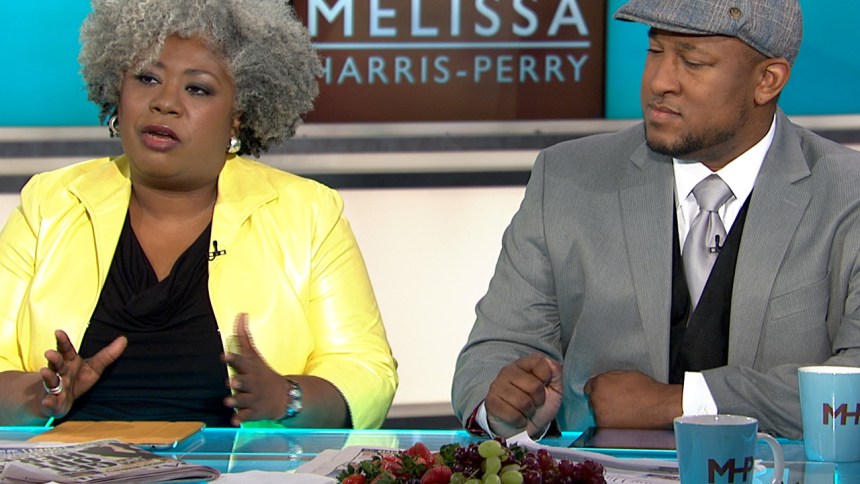
Before he delivered his speech at Chicago’s Hyde Park Academy on Friday, it was widely anticipated that President Obama would discuss and promote solutions to the issue of gun violence. He did touch on fatherhood, family values, and how promoting these can ensure economic and educational success. Yet the word “gun” was mentioned only four times in his speech.
Attending that same speech and standing behind him on the platform was Destini Warren, a student from Hyde Park Academy. She lost her older sister, Janay McFarlane, to a bullet hours after the speech. McFarlane, 18, was shot in the head while traveling to the store Friday night. A single mom with a 3-month-old, McFarlane had also attended Hyde Park Academy–but she had to drop out when she became pregnant.
McFarlane’s father was part of her life, but that did not stop a bullet from a killing her. Her death illuminates the flaw in the president’s speech: that if the black community had better families, present fathers, and stronger families, gun violence will abate. Following this logic, the president could have given a similar speech to Newtown, CT, about the Sandy Hook school shooting. He did not.
Policies are a lot more likely to stop gun violence than are speeches. But as long as the president is giving voice to the issue, why does he continue to use the same rhetoric that somehow makes black parenting culpable?
While some are upset about critiques of the president’s speech, the fact is, these proscriptions are based in a long history of what is termed “the politics of respectability.” The term–coined by Evelyn Brooks Higginbotham in her book on black Baptist women–focuses on “the reform of individual behavior as a goal in itself and a strategy for reform.” Recent articles about Beyonce and President Obama addressed the fallacy of “victim-blaming” for the ills of the society. The reality is, this type of talk has been around for a very long time. During the period of the Great Migration, respectability was promoted to keep black Southerners in line when they moved to Detroit, Chicago, and other urban areas.
When those moral reforms did not occur as quickly as churches and civic organizations liked, blacks in urban areas were branded as “pathological”–unable to rise above their circumstances like other immigrants in the urban space. [Fellow MHP guest] Khalil Gibran Muhammad’s book The Condemnation of Blackness: Race Crime, and the Making of Modern Urban America is an excellent book documenting how black people were branded as dangerous criminals in the early 20th century, while also being chastised for their own “pathology” that supposedly led them to criminal lives. Unfortunately, this tactic is the thesis for President Obama’s foundational stump speeches to African-Americans since running for and winning the presidency.
The president’s speeches on absent fathers, feeding kids Popeye’s for breakfast, or watching too much “Real Housewives” are all tropes of the politics of respectability. While he addresses white audiences about substantive issues about curtailing guns, our communities find themselves chastised. The implication is that black communities are responsible for the violence because they just are not good enough parents and citizens. Never mind the fact that the community had to petition the president to come to his hometown to address the issue of gun violence.
Simplistic, moralistic encouragements do not acknowledge the reality of how communities like Chicago’s South Side deteriorated, the reality of incarcerated daddies, limited jobs, and deteriorating infrastructure. The president’s prescriptions focus on promoting respectability and middle-class aspirations without wrestling with systemic economic and issues.
Without acknowledging poverty and institutionalized racism, how can the president’s moralizing be effective? Even the faith-based organizations he mentioned in Friday’s speech grapple with structural issues of racism, economics and incarceration in their communities, alongside parenting programs and education for youth. Moreover, his statements are part of the religious right and conservative Republican verbiage about the evil and ills of cities. Consider that the upcoming 2013 CPAC conference has a panel entitled “Fatherless America: The Headwaters of Poverty, Crime and Social Dysfunction.” When the Democratic president gives a speech that echoes decades-old Republican talking points, I get more than a bit concerned.
While President Obama laments the lack of community and fathers, the silence is deafening on cuts and school closures, limited fire and police services, and limited medical care. Those are local and state governmental issues that the federal government has limited control over. The erosion of family life in Chicago isn’t only about bad parenting, but systemic economic issues exacerbated by foreclosures and high unemployment. Add in the prison-industrial-complex with long incarcerations for African-Americans starting in childhood, and it is a bleak situation. People in Chicago know exactly what they are up against. If you want to know what the president missed, read Mikki Kendall’s Storify on Chicago life. It is illuminating. In his speech President Obama invoked the memory of Rev. Dr. Martin Luther King Jr, stating: “His goal was to free us not only from the shackles of discrimination, but from the shadow of poverty that haunts too many of our communities, the self-destructive impulses, and the mindless violence that claims so many lives of so many innocent young people.” That is true. Dr. King also confronted the evil structures of governments that were intent on maintaining the status quo for the privileged. When King moved to Chicago to protest for fair housing for black Americans, he marched against not just racists, but systemic racism. Dr. King realized morality was not the only thing that would alter America’s racist reality. Laws were needed. The same applies to the issue of gun violence in Chicago, and elsewhere. Anthea Butler is Associate Professor of Religious Studies and Graduate Chair of Religion at the University of Pennsylvania. See above Dr. Butler’s participation in our discussion of the president’s speech, and below Melissa’s interview with University of Chicago professor Waldo Johnson about the role family plays in violence and poverty. We’ll have more on this discussion tomorrow here on MHPshow.com.
Anthea Butler Recommended


