








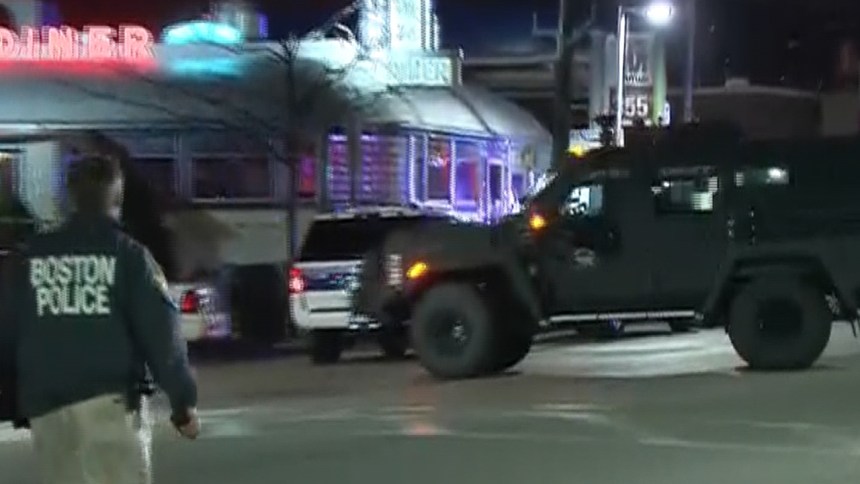
Many people around the world are now asking how two Chechen-American Muslims, brothers from middle class homes and reasonably well-educated, could carry out bombings to kill Americans in their hometown of Boston even at the cost of their lives. Although the Boston suspects did not kill themselves in the April 15 bombing, one brother’s death in a firefight suggests that they were willing to die in their cause.
While details are still emerging, it seems increasingly unlikely that the brothers Tamerlan and Dzhokhar Tsarnaev were acting for a specifically Chechen cause. Rather, their profile fits the model of self-radicalized terrorists—so-called “homegrown” terrorists—motivated to call attention to violence occurring against Muslims around the world.
Ninety percent of all suicide terrorist attacks are motivated by local nationalism, particularly as a form of resistance to perceived foreign occupation —for instance, the Taliban terrorists seeking to drive out US troops from Afghanistan are mainly Afghan nationals, and Hezbollah terrorists that aimed to evict Israel’s army from Lebanon were all Lebanese. But as we learn more about the Tsarnaev brothers, they do not fall into that ninety percent majority.
Instead, the emerging profile of the Boston attack strongly resembles the “black swans” of terrorism—the 10% of suicide attackers who are motivated by transnational injustice to kindred populations. This is effectively political activism gone wrong.
Although the brothers were ethnically Chechen, there is little to suggest that the Boston bombings were about Chechnya in particular. No evidence has been found that the two brothers were acting on behalf of a Chechen terrorist organization, nor that they took meaningful steps to support pro-Chechen independence groups, beyond a couple of links on one of the brothers’ YouTube page (alongside many other videos which give advocate globally-oriented jihadist causes). The older brother appears to have spent six months in Russia and so could have visited and possibly even received explosives training in Chechnya. But this does not add up to acting on behalf of the Chechen independence movement.
Indeed, such a close connection to Chechnya would be surprising. Chechen rebel leaders do not identify the United States as a target for attack, perhaps for the obvious reason that Washington routinely challenges Russia for its human rights abuses in the region. In fact, this week, the main pro-Chechen independence website distanced itself from the Boston bombers, referring to them as “strange.” Even the bombers’ uncle has distanced himself from his nephews, claiming they have brought “shame on the entire Chechen ethnicity” and is afraid that the bombings will cause America to “blame the world’s Chechens.” His language is quite telling.
Simply put, this case bears less a resemblance to September 11, 2001 than it does to the July 2005 London suicide bombings.
With 9/11, nearly all of the 19 hijackers came from Muslim countries perceived to be under military occupation by the United States. London was quite different. The four July 2005 London suicide bombers were a prime example of homegrown, transnational terrorists. Three were of Pakistani origin, one of Jamaican nationalit—none were from countries experiencing on-going Western military occupation, and so were not motivated by British policies toward their ethnic homelands. Although there was speculation that they were radicalized by social alienation or religious indoctrination, a year-long investigation by Britain’s MI5 that interviewed hundreds of their family members and acquaintances, casts powerful doubt on these easy presumptions.
Overall, the four London bombers were highly socially integrated and had tremendous respect for their social and economic conditions. Mohammad Khan, 30, was a “learning mentor” at a primary school with an exemplary employment record, spoke passionately about his work, and took part in a school trip to the Houses of Parliament in 2004. Shehzad Tanweer, age 22, drove his own red Mercedes, worked in one of his father’s several businesses, and was a trophy-winning cricket player who rarely missed his Wednesday night matches. Hasib Hussain, age 18, was known for going to night clubs and frequent discussions about cars, little different from many teenagers, according to his friends. Germaine Lindsay, age 19, was married to a British woman and living on government benefits. None had a history of outbursts or violence, or other signs of significant opposition to British life.
The Boston bombers have a similar socio-economic profile. Dzhokhar, an honors student, attended public school in Cambridge, was captain of his wrestling team (his coach called him “dedicated” and “well-adjusted”), and was the recipient of a selective college scholarship award by the city of Cambridge.
A friend offered CNN the following description: “a normal kid, he parties, he sometimes smokes—if you know what I mean. He was as American as I am—he was born and raised here.” This hardly fits the model of someone who is socially alienated. Tamerlan, who was older when his family moved to the United States, was less comfortable among Americans. He nonetheless was a Golden Gloves boxer, dreamed of representing the United States in the Olympics, and was said to have enjoyed the movie Borat. Again, hardly out of sync of mainstream American life.
What about religious indoctrination? This is also a poor explanation for the behavior of the London bombers. All four were Muslims, but all had secular upbringings. None were educated in Islamic schools (e.g. madrassas) and instead attended state schools and pursed modern studies. According to MI5, Khan and Tanweer showed no signs of religious extremism, while Lindsay was a recent convert to Islam who was frequently unfaithful to his wife. Hussain was particularly religious, undertaking a Hajj to Saudi Arabia in 2002. Most importantly, there is no evidence that any of the bombers were motivated by religious leaders. The Boston bombers were indeed religious Muslims, but millions of Americans are. That is hardly enough to consider someone to have been “indoctrinated.” Most importantly, there is little evidence of unusually long and close contact with religious leaders. They were not educated in madrassas. It is possible that the older brother Tamerlan was indoctrinated during his six months in Russia, but that only confirms the profile of a transnational terrorist. They commonly seek affirmation from like-minded elites for a stamp of approval to gain the training required to carry out an attack. (For instance, several of the London bombers traveled to Pakistan to meet with al-Qaida leaders in the months prior to their attack.) By definition, seeking out approval and training means one has already been self-radicalized. So what does motivate these black swans? In the case of the London bombers, it was a spiral of anger over perceived injustice by the West toward the Muslim world, particularly the experience of kindred Muslims under Western military occupation in Afghanistan and Iraq. Kahn and Tanweer left video will testimonials—martyr videos—that leave little doubt as to their motives. Kahn: “Your democratically elected governments continuously perpetuate atrocities against my people all over the world. And your support of them makes you directly responsible—just as I am directly responsible for protecting and avenging my Muslim brothers and sisters….We are at war and I am a soldier.” Tanweer: “What you have witnessed now is only the beginning of a series of attacks, which will intensify and continue until you pull all your troops out of Afghanistan and Iraq…You will never experience peace until our children in Palestine, our mothers and sisters in Kashmir, our brothers in Afghanistan and Iraq feel peace.” In sum, the Boston bombers fit the socio-economic profile of the London bombers—transnational, homegrown terrorists. We should not be looking to their Chechen ethnicity as a source of blame. The only thing we don’t know is whether they were angry over specific US policies in the Muslim world—but we should know soon. Robert A. Pape is Professor of Political Science at the University of Chicago and Director of the Chicago Project on Security and Terrorism and author of “Cutting the Fuse: The Explosion of Global Suicide Terrorism and How to Stop it” (University of Chicago Press 2010).
Robert Pape Recommended


