








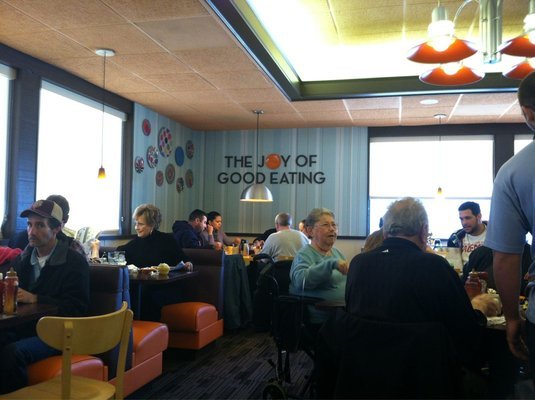
Teaching political science, writing for The Nation and hosting a political TV show have distorted my perception of the importance of electoral politics to ordinary Americans. People in my world pore over the latest polls and are breathless with anticipation nearly every Tuesday. But for most Americans, politics is background noise. On a cool, rainy Monday in April, I spent the afternoon at the Village Inn diner in Virginia Beach talking with the locals who frequent this retro community institution, which serves breakfast all day and bakes its pies fresh every morning.
Virginia will be critically important in 2012. Democrats will focus on black voters in Richmond, liberals in the DC suburbs and the growing Latino vote throughout the state. Republicans will press in rural areas, small towns along the North Carolina border and conservative areas on the western edge of the state. Both parties are likely to flood Virginia Beach, Hampton and Norfolk—a densely populated purple region, rich in swing voters and conveniently located a day trip away from the Beltway. I figured if there was anywhere to find politically attuned Americans, it would be in a place that will shortly become the center of the electoral universe. During my hours at the Village Inn, I encountered people with widely varying levels of political knowledge and sharply divergent points of view.
A small-business owner in his 40s bemoaned the idea that Americans would be forced to “choose between food and jail” if the individual mandate of the Affordable Care Act is allowed to stand. “How can the government force us to buy insurance if we can’t afford it?” This man was sufficiently informed to know that healthcare reform is under Supreme Court review, but he clearly didn’t understand the consequences associated with the individual mandate. Violating the mandate will carry a small fine, not prison time.
I spoke with a military mom whose son had just returned from a tour in Afghanistan. This spunky, 50-something white woman explained that she was a Republican but voted for President Obama in 2008. “Not this time, though,” she told me forcefully. “I am sick of him putting other countries before America.” She said that she learned a lot from Glenn Beck during the past four years, and she said she was disgusted by the president’s lies. She did not question his citizenship, just his honesty.
A few feet away, a large, multiracial, intergenerational group pushed together several tables to accommodate their dinner plates and their notebooks. They were part of the local Virginia Beach Democratic Committee and were meeting to discuss their strategies to help re-elect the president. They told me confidently that the Tidewater area in Virginia would help Obama once again turn Virginia blue in 2012. Each was an ardent Obama supporter, and several asserted that he would someday be understood as America’s best and most effective president.
A pair of undecided voters explained their opposition to both candidates in conscientious and accurate detail. How could they be expected to support the president when his military base closings were having a negative economic impact in their communities? Why would they trust Mitt Romney to look out for the interests of working families when his joke about a $10,000 bet made him seem so out of touch with their lives? In their view, neither candidate seemed to really get it.
What seemed more important than their varying ideas and information was the simple reality that they were all eating in the same local diner. Black, white, Latino, Democrat and Republican neighbors were choosing from the same menu and gathering at the same place. I sat in a booth talking with an older black man and his daughter about their unyielding support of the president. He mentioned that his last name was Chapman. An elderly white woman in the neighboring booth immediately interrupted. “Chapman! I’m a Chapman,” she exclaimed. Despite her disgust for Obama, which she shared with me in curt, dismissive tones, she warmed immediately to Mr. Chapman, and they chatted amicably across the banquette. Having grown up in Virginia in the immediate post–civil rights era, I do not take this kind of racial and partisan integration in public space lightly. Virginia may be a border state, but it was also the Confederacy’s capital. The residue of segregation coated the experiences of my childhood. I couldn’t help smiling to see an interracial hipster couple: the girlfriend leaned across the aisle to ask the severely groomed Navy seaman if they should order the chicken and waffles he’d just finished eating. Both Romney and Obama have Virginia highlighted as a battleground state. But it didn’t feel like a place where people were battling one another; it felt like a place where they were groping for some kind of common ground. Every single person was worried about jobs. Every single person was concerned about fairness. No one was particularly moved by the abortion debate. Every single person thought that at least one part of their government (either the president or Congress) was manipulating them and lying to them. Every single person felt reluctant to broach political conversations with neighbors or co-workers who, they suspected, disagreed with them. There was a respectful armistice at the Village Inn, but I am worried about the ways that 2012 may divide, rather than unify, this community and others like it. A diverse democracy requires us to be able to live near one another, to come together in public space and to engage across differences. In the coming months the people of Virginia will have their local airwaves bombarded with campaign messages, many of them negative, accusatory and even apocalyptic in their claims about the other side. My greatest hope is that during it all, these people will still be willing to have pie with one another at the local diner. Ed. note: This column first appeared in The Nation on Wednesday.
Melissa Harris-Perry Recommended


