








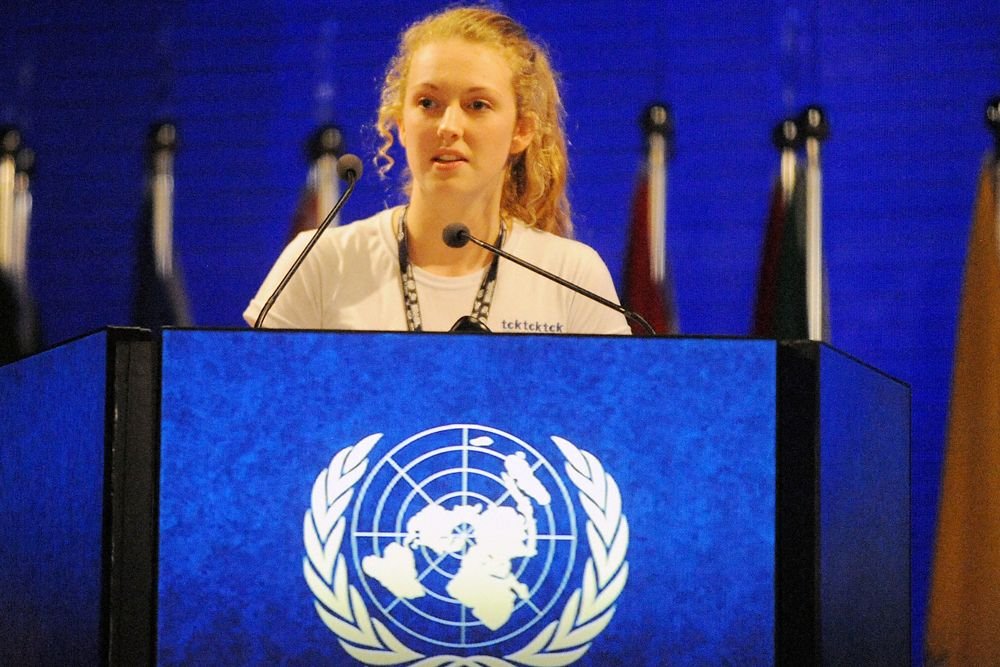
This week’s “Foot Soldier,” teenage activist Brittany Trilford, traveled over 7,000 miles (thankfully not by foot) to, more or less, give world leaders the business for their lack of action on the environment. But she wasn’t the first child to have done so: 12-year-old Severn Suzuki addressed the 1992 United Nations Earth Summit in Rio de Janeiro in a speech that helped her become known as “The Girl Who Silenced the World for Five Minutes,” a symbol of how startling it is to hear such direct truths, and demands, spoken out of the mouths of our children — particularly when those truths are about how those leaders treat the Earth.
On Wednesday, also in Rio de Janeiro, Trilford echoed many of the same sentiments as she opened this week’s United Nations Conference on Sustainable Development, delivering a speech that was more demand than greeting. She asked the world leaders present, “Are you here to save face, or to save us?” The day after her speech, I was able to ask the 17-year-old from Wellington, New Zealand some questions of my own.
How did you first come upon the “Date With History” contest?
It was run by TckTckTck, a collection of over 300 NGOs, and I came across the competition through an email that I received from one of my youth networks, because I’m quite into youth affairs back in Wellington. I saw a tiny, little blurb requesting a 2-minute video; I thought, “Sweet! Two minutes! I could talk for hours!” I managed to cut it down and get (three) minutes out of an hour, or something, and talked about the future I want. And then the competition lasted for about a month, with (online) voting, and the 22 videos with the most votes became the finalists — and then the jury voted on the winner, and voila!
Anyone in the world could vote?
Yes, anyone could vote.
I want to find out a little bit more about how you got involved with environmental activism. You say you love to talk; I know the feeling.
(laughs)
There are any number of things you could have done advocacy for; why the environment?
Well, in my video, I talk about bio-mimicry, and using nature as a design tool. That is very environmentally focused, but I think it covers the whole issue of sustainable development. There are three pillars of sustainable development, I’d like to think: there’s the environmental aspect, in which I’m very interested; and then there’s the economic, and then there’s the social — I think sustainable development covers all of those aspects. I think it’s really necessary to look at all three, and given the compartmentalizing nature of the U.N., it needs to be looked at as a whole. I look at the environmental aspects because I live in a city that is surrounded by natural beauty; I have nature all around me in Wellington. We have large coastlines, and you can go from the beach to skiing in the mountains in four hours. It’s very obvious, the beauty and wonder and abundance of nature — so I really wanted to use this wealth of innovation and inspiration and knowledge around us in a way to influence our system to make things renewable, to give life, and not create waste. And I mention that in my video.
You only had five minutes for your speech. How did you make the decision to talk about specifically what you addressed?
Yeah, that was really tough — I had so much to say! It was more about, “what do they need to hear?” than “what do I need to say?” The main thing that they needed to hear is that the youth feel frustrated, angry, and deprived of the future we want. It’s actually not even about the future we want — it’s about the future we need, even having a future. There is an intense urgency to create dialogues between youth and leaders. We need action right now. By the time there’s another conference, it’ll be too late. It’s what I really tried to drive home to these leaders.
In that light, there’s a lot of talk about the lack of political will in dealing with climate change. There’s the question of what we can do, then the question of what we will do. You seemed to be addressing the latter.
Yes, because I think we can.
Well, do you now feel more optimistic about the political will of these leaders after you’ve had this experience?
Probably not after this experience, but continuously, this cynicism that surrounds these kinds of conferences, this idea that they can’t do it is the exact mentality that stops them from doing it. You tell a child, “you can dance, you can dance” — and they can dance. It just depends upon the type of dancing they want to do, at the risk of sounding poetic. (laughs)
That’s an interesting metaphor.
I think it’s important that when we’re talking to these people, these leaders, everyone, about these issues that you’re really, really simple — this is how it is, this is the basic moral truth of what’s happening here — so they can, A), understand what’s going on and be angry when what they’re told doesn’t materialize. And then they can also continue the legacy, educate other people, and I think that’s the most valuable tool we have right now, that we can mobilize people to apply pressure. And we see it here in Rio. There’s a lot of inspirational and ambitious people here, all demanding action, all demanding change. I am hopeful. I am totally optimistic that they’ll hear what we’re saying; whether they choose to act on it is a different story — and it would be really sad if they didn’t take our advice because their job is to portray the will of the people. If they’re not going to respect them, what are they there for? They should lead by example, and by giving us what we ask for.
How long is the flight back home? Oh, man — like 36 hours, I think. When you eventually do get back there, what are some of the issues you’ll be confronting that are specific to Wellington, and to New Zealand? I saw that you mentioned to Amy Goodman of Democracy Now! that it’s snowing in Wellington for the first time in decades. What kind of climate issues are presenting themselves most directly where you’re living? I think there are a lot of issues that need to be thought about, and there are issues in Wellington…that face the world as a whole, and I think they need to be addressed, first and foremost. Local government has a huge responsibility to do things from the grassroots, to address what’s really happening on the ground, and they can do more. What they need to do needs to be bolder. We don’t have the time to wait and go through this council, and this person and that person. We need action to be taken now — I can’t say that enough. I’ll be trying to do my part in getting things done now. How important is it for young people to get involved? How important is it for someone who’s 17 to speak up, as opposed to those who are 47, or 57? I think (youth) are the most important people to get involved. When we’re talking about the future — “What do we want, guys? What do we want the world to look like in 40 years’ time?” — they’re not going to be around in 40 years’ time! We’re the ones who are going to actually bring these promises to life; we’re the ones who are going to have to live with them. It’s not actually relevant to them as much as it is to us. We’re representing our views because we have everything at stake. This is our future that they’re talking about. It’s like someone else deciding your life for you. This doesn’t make sense that they’re not taking our views seriously — well, they’re taking us seriously, but they don’t listen to us as much as I’d like them to, and be influenced by what we’re saying. And on the second question that you asked…at the next conference, we’re actually the ones who are going to bring them to life, and carry them on — and live with them. I think it’s important to have a youth view because of that. But then also because we haven’t been through all the training — I’m not policy-savvy, I’m not educated in all of that, so I can just say, “I’m confused. Can someone explain to me why you’re doing this, because this doesn’t make sense?” We hear that it would cost so much to be eco-friendly, and that it’s not economically viable. And then the second thing is, it just doesn’t make sense what they’re doing. Of course it makes sense to be eco-friendly. Saving on postage, things like that — we can just apply the basic, truthful, honest, realistic principles to what they’re saying, cutting through the technicalities. Are you thinking about continuing along this line in your studies? I’ll definitely continue with this sort of sustainable development line, and demanding action and the future that we want, and continue to fight for the right thing. I think there are a number of avenues for doing that, and it’s such a big world and there are so many things to do with your life. I’m looking to do science. Update: Melissa’s “Foot Soldier” segment featuring Brittany is below.
Jamil Smith Recommended


