








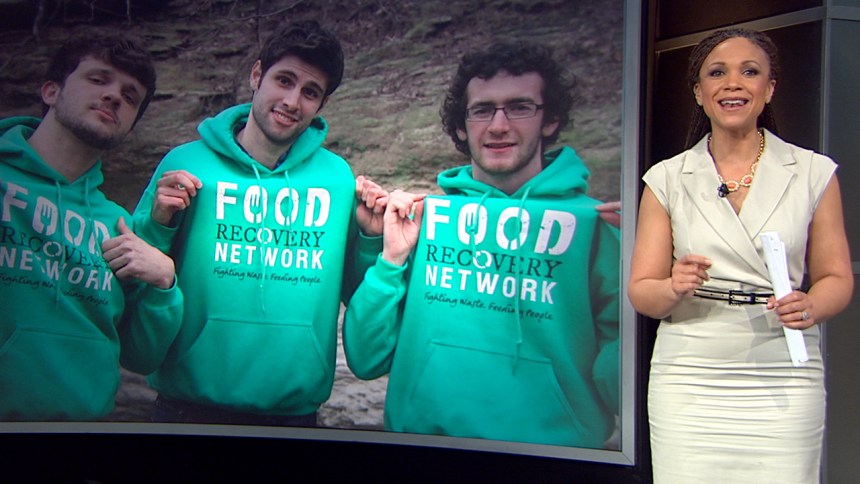
Host Melissa Harris-Perry profiled her newest “Foot Soldier” on Saturday: Ben Simon, a University of Maryland-College Park student who founded the Food Recovery Network, a program that recovers unsold food from college dining halls. Through student volunteers, the Network gets that food donated to neighborhood food banks and shelters.
I spoke with him this week.
Where did the idea come from to create the Food Recovery Network?
The idea came from us being at our school’s dining hall near the close of business, and seeing good food going to waste. We started asking the workers where the food was going. We got some answers that food was being thrown in the trash can. No one likes food being wasted; no one likes to see that. So we stepped into action. A lot of my co-founders and I have a history in hunger and homelessness community service and activism, so it was pretty straightforward for us to start the program. We knew there was a need in D.C., in Montgomery County and in surrounding counties in Maryland, and we basically just got the program started one night a week and grew from there.
How did you come up with a strategy? You saw there was a need, but what was your next step in implementing your idea and taking it forward?
We began talking to our department of dining services at University of Maryland. At first they had concerns about food safety and liability, which we get all the time. We talked them into trying it out for one night a week. They helped us come up with a procedure to handle the food safely. We told them about the Bill Emerson Good Samaritan Act which clears all good faith donors from any liability. It’s a pretty robust law that actually a lot of dining managers, restaurant managers don’t know about and should. We talked them into giving us a shot. From there, we built some trust, and they got to see that this program is not only giving these students a chance to serve the community, but also improving their bottom line by helping them reduce the amount of food that they had been wasting, and come up with strategies to re-purpose their food. They began to see that this program was good all-around for them to participate in. That was square one, getting it settled at the University of Maryland.
The second segment of our growth was when we asked ourselves a question, ok, it’s 2011, and this program didn’t exist going decades back. The University of Maryland was wasting tens of thousands of pounds of food every single year – delicious, good, edible food. So we asked ourselves a question, how many colleges and universities across America are still wasting all their food if it took UMD this long?
We then began doing some market research, and we found that about 75% of colleges and universities across America still don’t have a food recovery program. I called my friend, Ben Chesler, who was then a freshman at Brown University, and within a few weeks, they donated several hundred pounds of food. We’ve been growing since; we are now at 13 colleges.
Do you share your model when you get a new school on board.
Absolutely. You can liken us to a franchise, except we don’t charge a license fee. Our model is very similar across the different colleges, and we provide a lot of resources to students who are starting a new chapter. For example, we have a new chapter toolkit that we send to any student interested in starting a new chapter. You can actually download it from our website at foodrecoverynetwork.org.
What got you, Ben, interested in this type of work?
I myself have never been hungry, but I’ve witnessed hunger up close and personal, in different people in me community. We once had a homeless person live with us for over one year in my house, and it’s been something that’s been very close to heart. I see it as two different issues that we’re fighting, food waste and hunger. I think some people like to focus on the hunger part, but for me it was just as much about food waste as it was about hunger. I hate food waste. I can’t understand why we’re wasting literally billions of pounds of food. America actually wasted 34 million tons of food in 2010. So food is actually America’s number one waste stream. While hunger is very very important, food waste just basically rubs in the pain of hunger in that it’s so paradoxical how we can have on the one hand such abundance and on the other hand, people going around hungry in our community.
You’ve had some success in charity competitions, and more recently with Google. Can you tell me about that?
Absolutely. A lot of our funding has come so far from winning what’s called “pitch competitions.” They’re usually a six minute presentation format with a power point explaining your innovative idea to change the world and how you can do it and make it sustainable, and make it scalable. We have a very innovative model, and have been winning the grand prizes in several different pretty major pitch competitions. We won the University of Maryland Kevin Bacon’s Do Good Challenge, where the actor Kevin Bacon came out and challenged UMD students to do as much good as possible in 6 weeks. We won that, and we also won Ashoka’s Youth Ventures’s Banking on Youth competition, and that was another $15,000. At this point we’re still raising money, and going for major foundation funding. We’re still trying to find our first major funding partner, and we are an official 501c3 nonprofit. We recently received a Google grant, as you mentioned, that’s basically $120,000a year in free online advertising.
Your county has recently decided to get involved. Can you tell me more about that, and about a meeting going on this Thursday, Jan. 24th?
This past summer one of the Montgomery County councilmembers named Valerie Ervin heard about the Food Recovery Network and was like “wow, look at what these college kids are doing. This is amazing; I want to start a food recovery mission in Montgomery County.” This is one of America’s first county-wide food recovery initiatives, and the way we’re going about it is we’ve created a formal food recovery workgroup in the county, and we’ve brought together about 20 of the top stakeholders from the public, private, and nonprofit sectors. And we’re coming together over the course of this spring, and tomorrow’s meeting will be our second meeting to plan and implement a food recovery mission in our county. And so Montgomery County has pretty good statistics on the food waste in the county. They wasted about 58 million pounds of non-residential food waste in 2011. So from public schools, restaurants, farms, etc…
Is there any opposition to what you guys are doing? Does it require any approval or votes?
I think the number one reason why food recovery isn’t widespread in America–I told you earlier how only about 3% of food is recovered or composted–is inertia. That inertia is mostly due to fears over liability in food safety, and this feeling that this is just the way we’ve done business going back decades, why should we change that now. We’re really trying to build up momentum with local government as a partner.
From looking at your website, you seem to have a lot of things working in your favorite, benefits to all parties involved with very little cost. Absolutely. The way I always put it is it’s a win win win win win. It’s a win for literally everybody involved. It’s good for students, it’s good for the university and their image, it’s good for the donors and saving their money, it’s good for the environment. I might have mentioned that food is our number one waste stream in America, 40% of the food grown is wasted. And obviously we play an important role for the families and the kids that we donate food to. Have you run into cities that have tough regulations against donating food? One example I found is in New York City via the Huffington Post. Has that been a problem for your organization? Not really. Every local health code is a little bit different, but I think New York City is very unique in that. I’ve never heard of anything that severe as what Mayor Bloomberg has put in place. What are the next steps for the Food Recovery Network? That’s a great question; we just finished up a pretty intensive strategic planning session, so we have several 5–year goals. In 5 years we want to be in 1,000 colleges, donating a total of 20 million pounds of food over the next 5 years. Do you reach out to schools, or do students reach out to you? A lot of the time students will hear about our program and get in touch with us. The meeting I was speaking at today several people there said they have sons and daughters in college, so they’re going to pass it on and have them get in touch. We’ve also reached out to a lot of our friends in other schools. When we really want to target a school – in particular we’re trying to go after some of the larger schools – we will literally just send emails and try to make contacts with the student government and different environmental and social justice student groups, and go from there. What is in your future? What’s your plan for after graduation? I’m currently a part time student, and I actually have another nonprofit which I also founded. I split my time between school, Food Recovery Network, and my other project which is a tech startup called MyMaryland.Net. MyMaryland.net is a new website to connect Maryland voters with their elected officials in democracy’s first ever 24/7 online town hall. We’re launching in Maryland this spring but have a vision of going national. Both projects are really close to my heart, and I really have nothing else in my foreseeable future that I want to accomplish other than seeing through these other ideas. I’m really looking forward to going full time on them as soon as possible. What have you learned from founding, working on, and seeing the successes of Food Recovery Network? I learned that one of the most important things in any organization is building a strong team. At the Food Recovery network we really kept an eye out on other talent floating around out there. We looked to see who are the best student leaders in America, and made a connect with them to literally accelerate the growth of the movement as quickly as possible by bringing in the very best people.
Lorena Ruiz Recommended


