








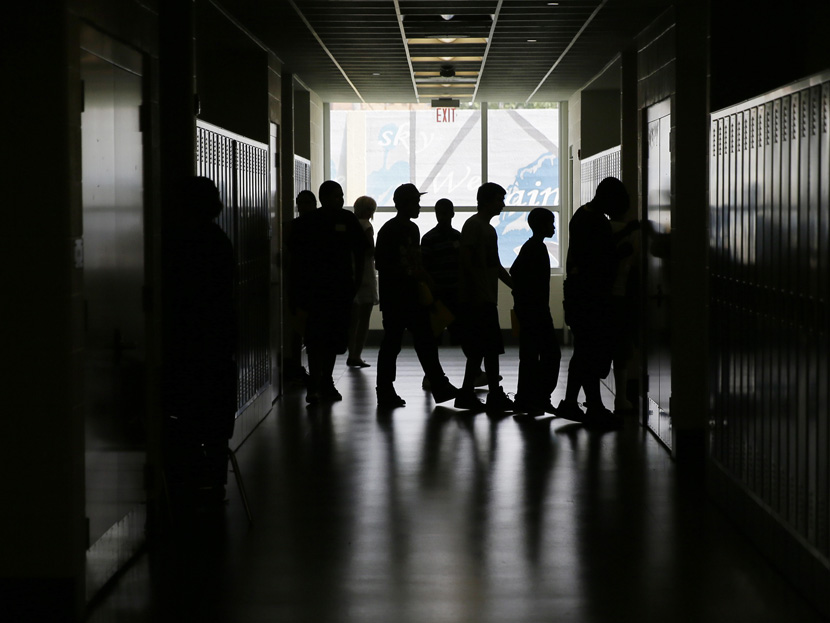
As the beleaguered Philadelphia public school district hobbles to the first day of school next week, it’ll be doing so with budget cuts so deep that many schools won’t have nurses, counselors or assistant principals.
Art, music and other enrichment programs in most of the schools have been limited or phased out completely. Thousands of students will be shuffled from 24 public schools that were closed over the summer to new schools, some of which will likely be in unfamiliar and perhaps unwelcoming neighborhoods.
As if those fires weren’t hot enough, the contract between the state-run school district and teachers union expired over the weekend. The school district is trying to squeeze concessions from the Philadelphia Federation of Teachers totaling $103 million, including salary cuts of 10% to 13%, in order to close a $304 million deficit. The union has balked at further pay cuts. The budget crisis has already decimated staffing at city schools. With the massive school closures announced last Spring, nearly 4,000 administrators, counselors and teachers were laid off, including every assistant principal in the city.
Until a new contract is ratified, the teachers will work under the terms of the expired contract.
“The entire community is watching Philadelphia,” Randi Weingarten, president of the American Federation of Teachers, said during a union meeting on Monday. “This is a metaphor for how a country, a state and a city actually treats its most vulnerable targets.”
“What we’re offering,” Fernando Gallard, a school district spokesman, told the Philadelphia Inquirer, “is a way out of this constant financial instability.”
The city and Mayor Michael Nutter scrambled last month to come up with a $50 million infusion that Superintendent William Hite Jr. said it would take to start school on time and would provide schools with the most basics needs. The money, borrowed by the city, allowed for 1,000 school district employees to be rehired. Many have called the infusion a Band Aid, as Hite has said it would take $180 million to safely operate the 136,000-student school system.
Lori Shorr, the mayor’s Chief Education Officer, said that while the state, school district and union are working to shore up teacher pay and ongoing revenue streams for the city’s schools, it’s not lost that the students are caught in the middle, and may suffer because of it.
“We are acutely aware that we don’t have as many people in the schools and the right people in the right schools to make it an optimal experience for kids, and that’s our goal,” Shorr told MSNBC on Tuesday. “I think that this is a crisis that was decades in the making, so there’s probably no magic bullet.”
One thing that could happen in the nearer term is a new funding formula for the school district, which would include sales tax provisions that could deliver $120 million annually to the schools. Meanwhile, Shorr said she worries about the impact that so many fights on so many fronts might have on school children.
“I’m deeply concerned about the school year,” she said. “I know what kids deserve and what they need and it’s not what we have in the schools right now.”
Jerry Jordan, president of the Philadelphia Federation of Teachers (PFT), painted a nightmare scenario of the return of schools next week in an op-ed published on Tuesday.
“As of now, when schools open on Sept. 9, students can expect a return to overcrowded classrooms and split grades; a shocking lack of guidance counselors (none at schools with fewer than 600 students); one school nurse for every 1,500 students; no money for books and supplies; and no librarians,” Jordan wrote. “These are the issues weighing heavily on the minds of PFT members, and are no doubt the primary concerns of parents and students… Although the city’s educators are not responsible for our district’s deficit, we all want to contribute to a solution for our schoolchildren. Unfortunately, elected leaders and district officials think teachers and school employees should be the primary source of funds to ease the crisis.”
Philadelphia parents and student advocates say there’s been a continued attack on public education in the city and across the state, led by Republican Gov. Tom Corbett.
Of the $180 million the school district requested, $120 million of it was to come from the state. But just $45 million of that has been approved. Corbett said he will not release that funding until certain criteria are met, including reforms under accusations of mismanagement by the city and school district. State Democrats say the reforms are being made and have demanded the release of the money. And the tension between Harrisburg and Philadelphia leaders has grown increasingly taut.
Jamira Burley, the executive director of the Mayor’s Office for the Philadelphia Youth Commission, said the impact of the school closures and budget cuts disproportionately affects students of color.
“It’s very much a state of emergency,” said Burley, who said upward of 90% of the students affected by the school closures were minority students. Many of those students live and go to school in violent communities, and will now be forced to attend new schools in neighborhoods that may have been at odds with their old neighborhoods.
“There’s hopelessness, a lot of people are scared. A lot of people are nervous and a lot of people have lost faith in city government,” said Burley, who has three siblings in the public school system. “I think there’s so much confusion and people are scared to send their kids to school, particularly young people who are going to a worse school than they are already at.”
With so many staffing cuts, safety has been a concern among parents, teachers and student advocates. Burley said the city is still trying to devise safety routes, similar to Chicago’s Safe Passage program, that provides unarmed staff to man positions along a designed route that students travel to and from school. But with just a week until school starts, Burley said there’s still “ a lot of confusion and not a lot of answers have been provided.” On Monday night, about 4,000 teachers attended a meeting to discuss the latest contract negotiations. Two-hours later, there was no agreement on what should happen next, a possible strike or tentative contract concessions. “I’d be fine with a strike,” Melissa Dunne, of Harding Middle School, told NBC 10. “I absolutely would. We need to show we’re not backing down.” “It’s clear the district is still trying to negotiate in bad faith around things that my students so desperately need,” said Anissa Weinraub. According to NBC 10, the union has only agreed to start contributing to healthcare and a one-year pay freeze. District officials say that won’t generate enough to rehire more laid off employees. Sonya Brintnall, a parent of two public school students who works as a speech therapist at a Philadelphia middle school, said that if the rocky run-up to the start of school is any indication of how the school year will play out, students, teachers and their parents are in for a tough year. “It’s totally insane, they’ve shuffled people all over, people who thought they were coming back to jobs, don’t have jobs, people who we thought were laid off are here suddenly,” Brintnall told MSNBC on Tuesday, when teachers returned to school to prepare for next week’s arrival of students. In Brintnall’s school, all of the operations officers and various support staff were laid off. They were the people who ordered supplies, checked people into the building and played a role beyond their job descriptions. Some were medical staff who administered medicine or kept children on their medication schedules. Others kept track of teacher and counselor assignments. “It seems really small but they all add up. There are just fewer people here, fewer adult bodies to support one another and the level of disorganization is astounding,” Brintnall said. “These kids, they deserve better. It makes me so sad. This is a year in their lives we’re not going to get back for them. This will be a lost year.”
Trymaine Lee
Trymaine Lee is an NBC News correspondent. Recommended


