








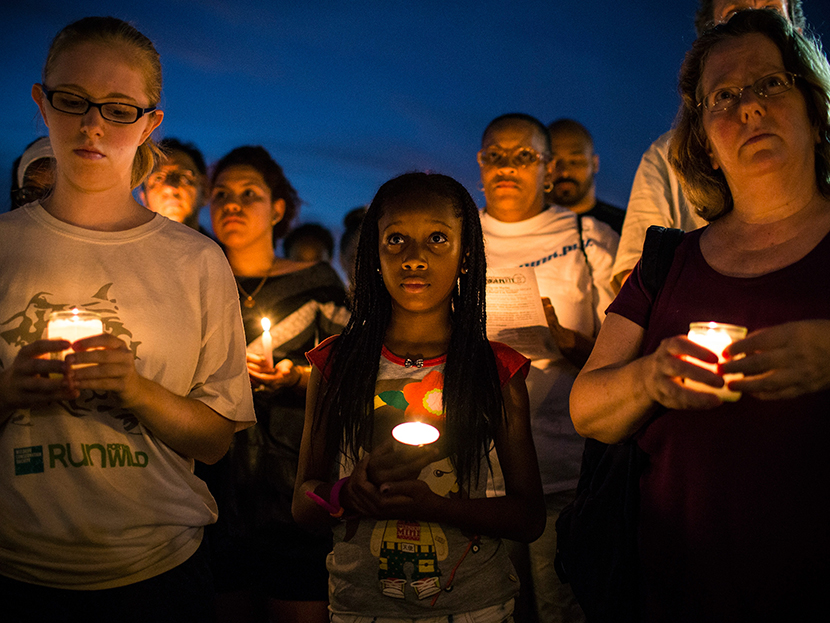
On Friday, President Obama took his remarks last year on the death of Trayvon Martin one step further. “If I had a son, he’d look like Trayvon,” he said last year. This time it was “Trayvon Martin could have been me 35 years ago.” Obama’s remarks deepened a national conversation that has been roiling since last week’s not-guilty verdict for George Zimmerman, one that Melissa Harris-Perry asked viewers to join.
NBC News executive Val Nicholas shares the president’s feelings, and the experiences Nicholas shared with msnbc add wrenching first-hand detail to “the fact that a lot of African-American boys are painted with a broad brush,” as the president put it. For Nicholas, it is not just the long-suppressed memory of being targeted by police simply because of the color of his skin, it’s the fact that “to this day, twice a day when I take the bus from New Jersey to 30 Rock, the seat next to me will always be the last one taken, and whoever sits there will try to sit as far over as possible to the point that they are practically sitting in the aisle.”
When there’s a young teen in the house, parent-child talks often revolve around curfews and dating. Dawn Wilson-Hawkins and her husband had to explain to their 14-year-old son that while “not everyone has ill intention, in the society that we live in today you simply must be on guard and aware of your surroundings.” As the president said in his remarks Friday, we should celebrate the thought that kids today “have more sense than we did back then, and certainly more than our parents did.” As Wilson-Hawkins pointed out, “not everyone views young black men in a positive light. Yet he cannot allow the negative views of some to define him.”
Fred Smallwood’s experiences growing up in Brooklyn gave him first-hand knowledge of both neighborhood violence and police tactics. His “biggest fear is that either my honor roll winning, physically challenged teenager or my honor roll winning fifth grader or my 22-year-old honor roll winning soon-to-be-college-grad son can easily end up a statistic.”
Because of the daily reminders that society does not trust black men–the moments that President Obama described, when the locks click or the store security guard follows you or someone clutches a bag–parents and guardians like Smallwood face a difficult tightrope. “I have to tell them to trust people but don’t trust people,” he wrote. “People see you for your actions first? No, they see you for your color first and they will remind you of it. Talk about a confusing message to come from your parent, especially for a young innocent child’s mind to absorb.”
While the death of Trayvon Martin and the George Zimmerman trial highlighted cultural assumptions about race, that’s not the only source of worry for mothers and fathers of children who don’t fit into conventional categories. Mara, mother of a teenage son who is openly gay, described how hard it is to raise a child with the knowledge that he or she might be targeted for discrimination or violence. “We talk about safety and how to respond to harassment and how my son can be safe in the world without compromising himself too much,” she wrote. “It’s a hard thing to tell your wonderful child to be guarded, to be aware, to watch out. But, sadly, it’s necessary.”
How does a parent reassure a child that society can be a safe and tolerant place–even if it requires work; that it can be the “more perfect union” Obama evoked? For Karen Cassidy, it requires involvement in community. She attends marches with her daughter and talks “about the myth of ‘others’ doing things and that we must do our part in all aspects of life. When we become complacent, those with a sinister, dangerous or unfair agenda easily fill that space.”
Many families were already all too familiar with the assumptions and issues at play in the Zimmerman case long before the verdict was read. As Traci Mitchel wrote, when the verdict came down,
No major conversations were required in our home because our three children were not surprised, and sadly they needed little explanation of how something like this could happen in America. From experiences both close to home and far from home, they are aware that simply because of their skin color, some people will always perceive them to be something other than what they are. How sad is that? Our only solace is that although they are aware of this harsh reality, they are still positive, loving and open human beings who still feel confident enough to pursue their dreams. Mitchel was not the only parent to think this way. The mother of Melissa Harris-Perry producer Jamil Smith offered simple, powerful advice in a post-verdict letter that many parents across the country, including President Obama, might give to their children. ”Please, please, please, please be vigilant, and be cognizant that, although it is totally unfair, you must always be aware that your skin color makes you a target,” she said. “Act accordingly, but stay strong.”
Meredith Clark
Meredith Clark is a freelance writer and editor. She was previously a senior news producer for "Patriot Act with Hasan Minhaj," a reporter with MSNBC.com, the digital politics and culture editor at Glamour and a senior news and politics editor at Refinery29. She has written for Vulture, Rolling Stone, Self, Marie Claire, Cosmopolitan, The Daily Beast and Bustle. Recommended


