








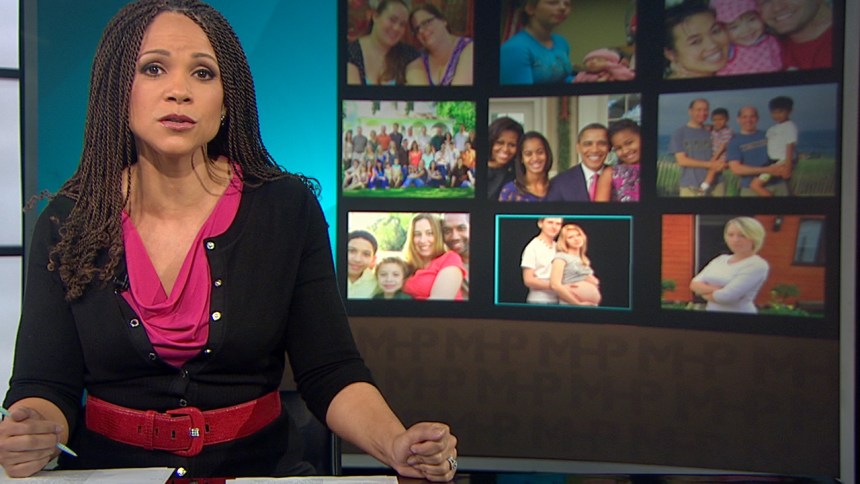
From popular culture to popular ballot initiatives, a new definition of family is being formed in America. Same-sex households are not just plot lines from television shows created to anger One Million Moms; they are becoming the “new normal” across the country. The challenge, now, is for lawmakers to create policies that accurately reflect this expanding definition.
Melissa Harris-Perry argued on her show Saturday that, as much as the country will push for marriage and family to be defined by cultural practices, policy really is a major factor in the strength and well-being of a household.
“Law is often blind to these families and to those where kids being raised aren’t the biological offspring of a married couple,” she added. “Narrow definitions of family can make everything from student loans to doctor visits that much harder, and it can also make adoption for loving LGBT familes or single women tough if they are banned from marrying or if policy treats them as though their households are unstable.”
Harris-Perry and her guests—Brooklyn Law School professor Marcia Garrison, msnbc’s Thomas Roberts, John Hopkins associate professor Lester Spence, and the Center for American Progress’ Aisha Moodie-Mills—discussed the expanding definition of family and looked at the “traditional” definition of marriage, concluding that, in order for households of all economic statuses and gender makeup to thrive, policy and politics must reflect the changing culture.
According to data gathered in the 2000 Census, the poverty rate for families with children is 9.4% for lesbian families and 5.5% for gay male families (compared to 6.7% for heterosexual married families)—an issue that is not often addressed in discussions about LGBT rights.
With more same-sex households forming across the country (an estimated one-quarter of all same-sex households are raising children, according to Census data), a discussion about LGBT rights that goes beyond marriage equality is becoming more and more necessary. Beyond marriage equality laws exists the need to reform the many economic policies that keep “non-traditional” families from providing for children.
“When we talk about these economic benefits of marriage, when we talk about our policies and how our social safety nets are failing families that are modern families, quite frankly, the new normal, we have to talk about LGBT families and the 2 million children that are being raised by parents who are in same-sex relationships or parents who are LGBT,” Moodie-Mills said. She noted that, in many places in the country, there are still antiquated laws that do not give unmarried couples the rights to support their children or families, from medical decisions to smaller things such as daycare pickup.
Moodie-Mills added, “If we were to figure out how to equalize our adoption laws to make sure that second-parent adoption is available for everyone… to make sure that gay couples or unmarried partners can jointly adopt, then that would carry the responsibilities of being able to safeguard and care for children, which is really what the family policies are about.” Without policies to help care for all children, regardless of where they came from or how their families formed, the economic divide between same-sex households and heterosexual households will increase, leaving children of LGBT parents to suffer economic consequences and stress as they struggle to make health care decisions, education decisions, and more. Families are not defined by simple categories of “father” and “mother.” Families are created by loving communities that have nothing to do with filling gender roles. And with one in five same-sex couples now living in marriage equality states, this “new normal” is certain to evolve into a permanent reality. “We can have whatever emotions we want to have about it,” Harris-Perry said, “but these are the new demographics that we face.”
Traci Lee Recommended


