









But every one of them could lose that health coverage in July—unless the state legislature renews this “private option.”
The Arkansas state Senate agreed to renew it this week. The House is working on it. They held four votes this week—coming close to passage, but didn’t quite make it. The Republican Speaker says he’ll hold votes every day until it passes, with the next attempt on Tuesday.
However if the bill passes, it will still have a major handicap: state agencies will be forbidden from spending any money—most of it federal money—to advertise or promote the “private option” to the people who need it.
The idea? To keep people from enrolling.
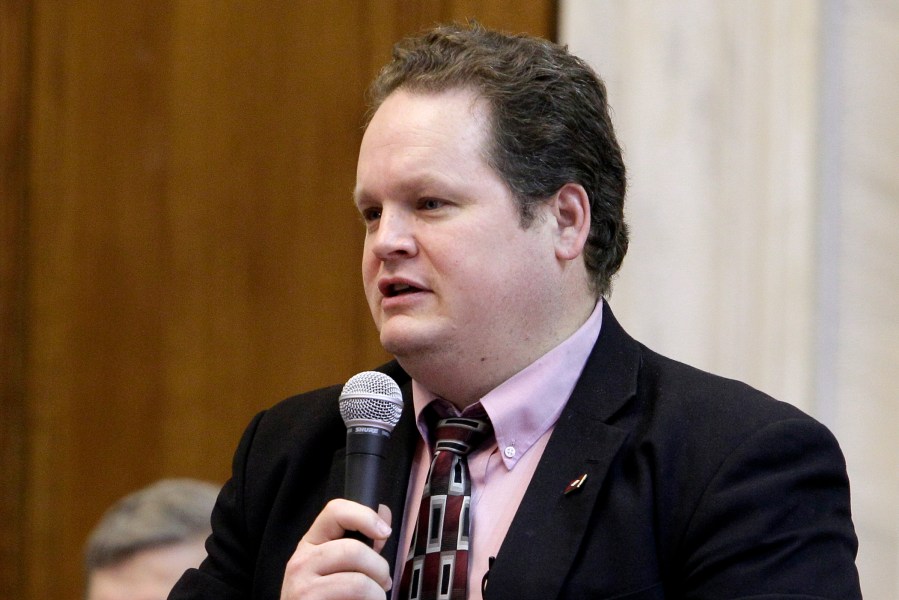
And that’s why my letter this week is to the sponsor of that particular amendment, Arkansas State Rep. Nate Bell.
Dear Representative Bell,
It’s me, Joy.
First of all, I want to thank you for being up front about why you want to eliminate advertising for the private option in Arkansas.
You said:
“without active marketing, you probably get declining enrollment. … We’re trying to create a barrier to enrollment.”
I see what you did there, representative. You said you want “a barrier to enrollment.” And you’ll probably succeed, since it was state advertising in the form of a direct mail campaign that was largely responsible for the private option’s enrollment success so far.
Last September, the state Department of Human Services sent out letters to 132,000 households that get food stamps, letting them know that they qualified for expanded Medicaid. Within a month, more than 55,000 people responded, saying they wanted to sign up. That is an enormous response rate. In direct mail terms, it’s practically revolutionary. Those people now make up more than half of those enrolled in the Medicaid private option.
But should we ask why you’d want to handicap enrollment so much? You say it’s because you’re a conservative, and you want to limit government spending any way you can. Sure. Except your state estimates that it will save $89 million by expanding Medicaid—just in the first year. It will save more than $600 million from now through 2021.
So there must be another reason. And thanks again for saying it yourself.
“I didn’t vote for this program originally, I don’t like it, I want it to go away. I would love to see the program fail. I do want a controlled failure.” I want to talk for a second about the people who would be impacted by your “controlled failure.” There were more than 500,000 people in your state without health insurance in 2012. 260,000 of them were adults with incomes less than 138% of the poverty line, making them eligible for the Medicaid expansion. Most weren’t eligible for Medicaid before the expansion because, in Arkansas, the only way to get Medicaid benefits was to make 16% of the poverty line or less—which last year was $3,768 a year for a family of four. If you made any more than that, you were not eligible for Medicaid. And that’s only for parents of dependent children. Childless adults were not eligible for Medicaid benefits—at all. Look, Representative Bell. This isn’t just an ideological debate we’re having in the abstract. People die without health insurance. Let me be more precise—in 2010, an estimated 394 people in Arkansas died because they didn’t have health insurance. I’ll say it again. 394 people in your state died in one year just because they didn’t have health insurance. And you not only want to create a “barrier to enrollment” so no additional people get health care from the private option—you want to sabotage the entire program so those 97,000 people already getting health care won’t get it anymore. And, Representative Bell, you’re doing it by refusing to spend federal money—money that costs your state government nothing but came, in part, from your own taxpayers. Your own people, who are more likely to die without the health insurance that you want to deny them. Can you just think about that? For a minute? Please. Sincerely, Joy
Joy-Ann Reid
Joy-Ann Reid is host of “The ReidOut” at 7 p.m. ET on MSNBC. “The ReidOut” features one-on-one conversations with politicians and newsmakers while addressing provocative political issues both inside and outside of the beltway. Recommended


