








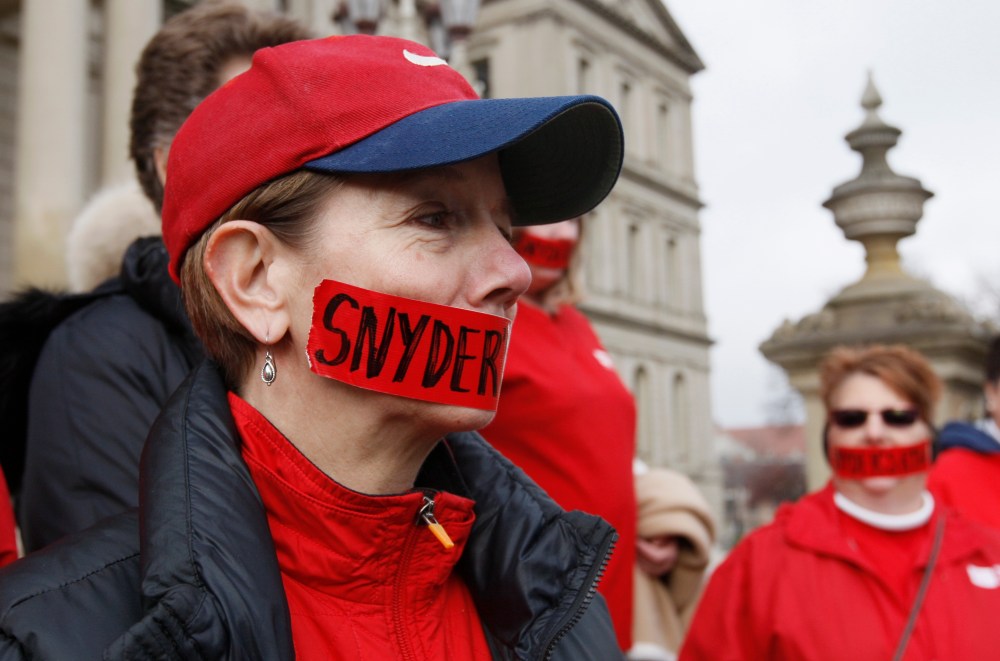
It’s been one week since the Republican-led Michigan legislature passed, and Governor Rick Snyder signed, new “right-to-work” legislation. Michigan is now the 24th state with right-to-work laws. Right-to-work prohibits union dues from being a condition of employment. But is “right-to-work,” or “freedom-to-work” as it is also called, a disingenuous term?
The Washington Post‘s Ezra Klein wrote last week, “The term ‘right-to-work law’ is a triumph of framing. Such laws do not, in fact, give you the ‘right to work.’ They give you the right to refuse to pay union dues when you work for a union shop, even though you get the wages the union bargained for, and the benefits the union bargained for, and the grievance process the union bargained for.”
So how was it possible that this flawed framework led to the passage of right-to-work in a state like Michigan that is home to one of the biggest unions in the nation? Sunday in #nerdland, host Melissa Harris-Perry explored the factors that made it possible for right-to-work to pass in Michigan, including the defeat of Proposition 2 on the November ballot, an initiative that would have ingrained workers’ collective-bargaining rights into the state constitution.
When asked on MHP whether Proposition 2’s failure opened the door for right-to-work, United Auto Workers president Bob King offered some regret. “We tried to do a preemptive block of that by doing Proposition 2. We didn’t do a good enough job on Proposition 2, lot of reasons maybe.” He added that while strategically there may have been some other choices made, that “it was the right thing to do… I wish we’d won at Proposition 2. But if we didn’t do Proposition 2 we’d be sitting here right now and they’d be passing ‘right-to-work’ and we’d be saying why didn’t we try to stop this before it came down?”
Just as the UAW and others tried to get Proposition 2 passed and collective bargaining in the constitution, there were those had been trying to get right-to-work on the ballot. So how was it that Governor Snyder came to sign these bills when he previously said “right-to-work” was divisive and not on his agenda? Nation contributor Josh Eidelson had this to say: “Well, we’re talking about a governor, Rick Snyder, who for one thing would have had to worry about being held accountable by the right if he hadn’t done this. This is someone who certainly spent a bunch of his own money in 2010 to get elected but got a huge assist from a spin-off of the Republican governors association, the not-very-interestingly named RGA Michigan 2010. The top donors to that group all had ties to ALEC, the group that connects right-wing legislators, corporations and model bills like right-to-work. We’re talking about people like Paul Singer who used a controlling interest in Delphi to make a lot of money off the auto bailout and eliminate all of the union jobs at Delphi. We’re talking about the Michigan chamber of commerce. About David Koch himself. About the Amway family, the DeVos’ who are basically the Kochs of Michigan. And we had the head of this family not only publicly threatening to get this on the ballot but, according to msnbc, democrats say he was privately threatening republicans that he would primary them.” Is “right-to-work” just a new form of union-busting? Yes, said Ed Ott, the former Executive and Political Director of the New York City Central Labor Council: “When these guys talk about freedom they’re talking about something different than I think a lot of normal, everyday working people are. They’re talking about the freedom to do what they want, when they want to, in the workplace to anybody they wish. And the Constitution does not extend to the workplace. That’s the reality of every working person and these guys know it. They want control back and unions are in the way.” “This is part of a national attack on labor. It’s part of a national voter suppression. Democracy suppression. Really income suppression for working families. So it’s building broad coalitions I think with civil rights groups, women’s groups, environmental groups, LGBT community. It is talking about what kind of America do we want? These folks, I mean they just lost 2012, and they lost it in large part because they were so extreme and they come right back being even more extreme. It’s really important to know in Michigan ‘right-to-work’ is in some ways minor compared to what they’re doing to women’s reproductive rights, what they’re doing to education, what they’re doing to taxation. This is a very right-wing ideology taking over the Republican agenda in Michigan.” See below the second half of the discussion which aired on Sunday’s MHP.
Shanta Covington Recommended


