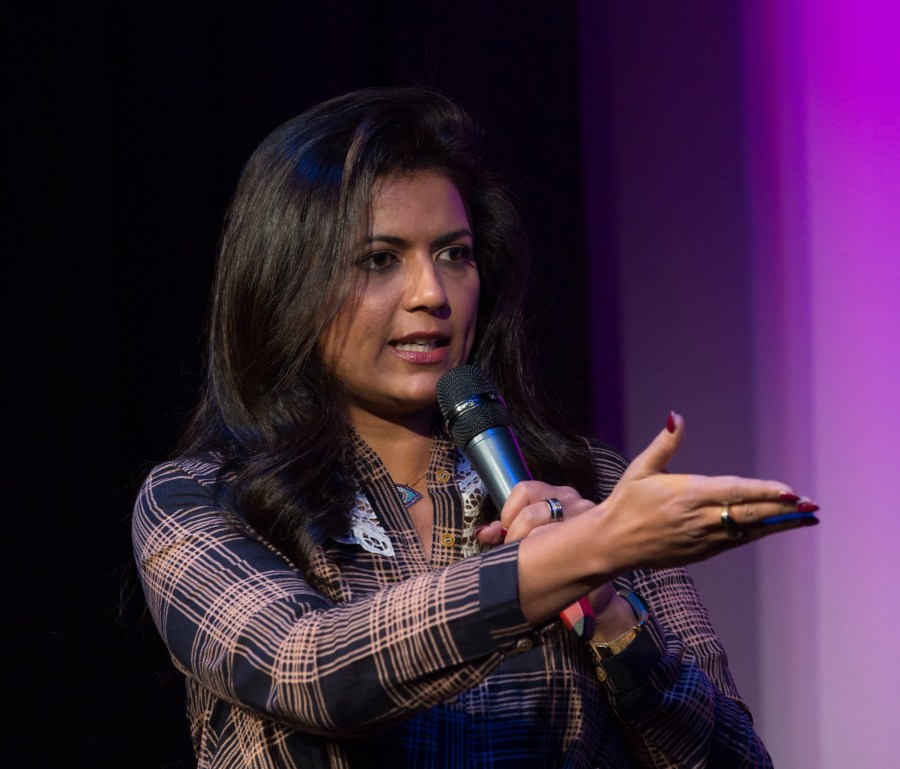
Before she turned 30, Mona Shaikh never could have imagined that she would become a voice for diversity and gender equality in comedy.
Long before she was doing stand-up and producing Minority Reportz—a popular Los Angeles comedy show that has featured comedians including Margaret Cho and Tiffany Haddish—Shaikh grew up in Pakistan under strict gender restrictions. She was expected to marry a much older man and have children at a young age. She endured physical abuse for decades at the hands of family members and an ex-husband.
“Never in my wildest dreams would I have thought that I would be in a position to speak up and say the things that I’m saying,” said Shaikh in an interview with Know Your Value. “But, I knew that I would fight for equality because I had been beaten down by a culture and a system that tried to take my voice away for the longest time.”
Finding her voice
Today, Shaikh cracks jokes on stage about the TSA profiling her at the airport, about suicide bombers and burqas. But she is a very different person than she used to be.
Born in Karachi, Pakistan as the youngest in a family of four older brothers, Shaikh was raised to be quiet and obedient. Her mother was a housewife, and her father owned a successful car business. Her father was very physically abusive toward her and her mother, she said.
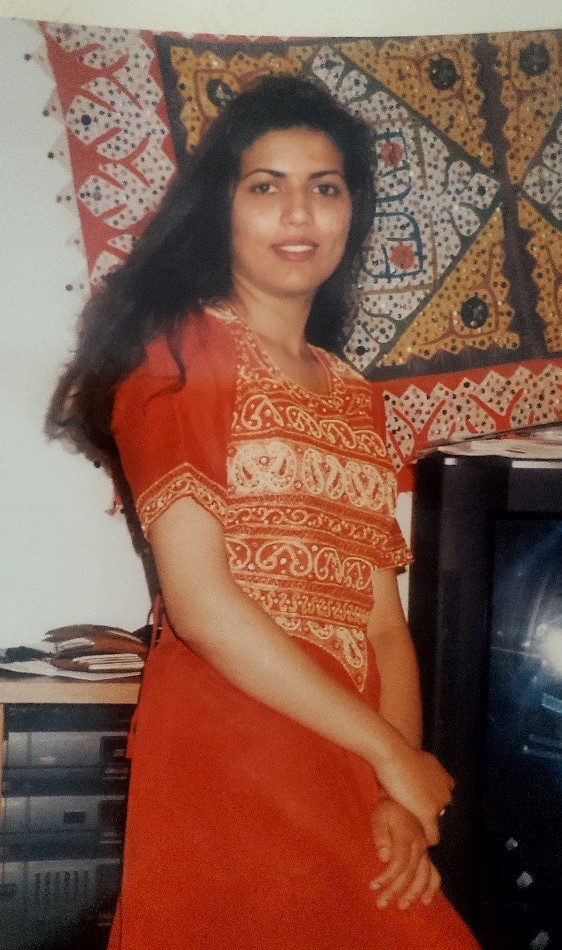
“Once he was slapping me so hard that my stud earrings came out of my ears,” recounted Shaikh. “When you come from so much domestic violence, you think that’s normal.”
After two of her brothers contracted polio, the kids moved to the U.S. to receive treatment. The family also felt unsafe after receiving death threats due to a relative’s political affiliations. When Shaikh was 15, she eventually moved to Jersey City. Her adult brothers, who were also physically abusive toward her, became her legal guardians. While her mother helped the kids relocate, their father never wanted to leave Pakistan, so her parents stayed in their home country.
When she was almost 18, Shaikh told her family that she wanted to become a stage performer. It was a dream she’d kept secret since she was a little girl, inspired by Bollywood movies. They responded by giving her an ultimatum: go to college and become a physical therapist or go back to Pakistan, where she’d be married off, Shaikh said. At the time, a 40-year-old doctor living in Boston was interested in her, and offered to pay for her college tuition.
Instead, a naive Shaikh ran off to live with her 65-year-old acting coach in New York, whom she had been seeing in secret. She began a career in finance, and eventually married the coach when she was 22. While her husband supported acting generally, he was verbally abusive toward Shaikh and told her she had no talent, she said.
“When you come from the kind of mentality I came from, I couldn’t differentiate abuse from a fake blanket of love,” said Shaikh. “I knew nothing about life. I was a child when I met him.”
Almost a decade later, at age 27, Shaikh divorced her husband and began auditioning for stage roles and building confidence. One day, a prominent coach told her that she was funny. Armed with encouragement, she started doing stand-up around the clock. She ultimately moved to Los Angeles to pursue her dreams. She would later open for Jay Leno, and host Comedy Juice night with Dane Cook at the Hollywood Improv.
“A lot of people would have thought I was nuts to start stand-up at 30,” said Shaikh. “But if you’re funny, you’re funny. That’s the most empowering thing that I love about it. It’s about the craft.”
Shaikh eventually reconciled with her parents. Her father apologized for the years of abuse before he died in 2005. Her mother came to see her perform on stage and was proud of her.
“I have this deep loyalty and deep love for America. Coming to the U.S. helped heal our family in a way that no one else could,” she said.
An advocate for gender parity in comedy
However, Shaikh also began to experience a dark side during her standup career. Comedy venue emcees would resort to terrorist jokes when she performed. And in 2013 in Beverly Hills, Shaikh recounted on stage how she was physically attacked by a woman who called her a terrorist. She suffered from a herniated disc after the incident.
A Karen once attacked me in a hate crime at the Beverly Center…and got away with it. THIS IS A TRUE STORY!
— Mona Shaikh (@monascomedy) April 30, 2020
Watch full episode: https://t.co/PQieH3mr2L
.
.
.#karen #hatecrime pic.twitter.com/8P9OI3B2PU
She began to feel alarmed by misogyny in comedy. This time, she felt she had the power to do something.
Shaikh is now an outspoken advocate for gender and diversity recognition in comedy, which has fallen far behind other industries in terms of parity. The top 10 highest paid stand-up comedians in the world are men, with the exception of Amy Schumer who falls at number seven. A recent survey by career data site Zippia found that 85 percent of stand-up comics are men, while less than 12 percent were women (3 percent of respondents were marked “unknown.”) “The higher up you go in the hierarchy chart, the fewer women you will come across,” said Shaikh. “It’s changing slowly, very slowly. Most of the time, the clubs like to stick with the female comics they know…“I tend to be the only woman in lineups, which is ridiculous because there are so many female comics. I know, because I book them.” Further, women in comedy are unprotected from harassment and discrimination. Shaikh herself has spoken to the Hollywood Reporter about an actor who accosted her after a show. “Stand up comedy doesn’t have an HR department. We can’t go to someone with authority and report comedians to say ‘this audience member or this comedian keeps cornering or assaulting me.’ If you tell a club owner, they’ll often see you as the problem and you’re not going to work there again.” After working in stand-up for several years, Shaikh launched Minority Reportz in 2015 at L.A.’s premier venue The Comedy Store. “I approached The Comedy Store and said ‘look, you guys don’t have any shows that showcase people like myself,” she said. “Can you let me produce a show?” Minority Reportz sold out on its first night, making Shaikh the first Middle Eastern and South Asian comic to produce a successful show at the venue. She has since taken Minority Reportz across the country and attracted celebrities of all stripes to lineup. Minority Reportz is an outlet for comedians from all backgrounds. After her long journey, it is also Shaikh’s opportunity to give back. “I thought my voice didn’t mean anything. I was just dismissed as a nobody. I didn’t have any value of any kind. Now that things have changed, I have worked really hard for where I’m at, what I do, I feel like it’s time to pay it forward.” In addition to producing upcoming dates and a TV adaptation of Minority Reportz, Shaikh is developing a one-hour stand-up special and an East Coast tour. For women who dream of doing stand-up, Shaikh encourages them to step to the stage. “A lot of female comics get scared and intimidated. But I feel like fear is a liar,” she said. “You can’t let fear dictate and run your life. Do not let anyone get in the way of your ambitions.”
Halley Bondy Recommended