









When Brandi Chastain fell to her knees and ripped off her jersey after the U.S. women’s soccer team won the World Cup in 1999, millions of young girls took note. And some of those girls—now women—are about to represent the United States in the 2023 FIFA World Cup next month.
The U.S. team hopes to firmly place its stamp on the sport by winning the competition for the third time straight—a historic first for any men’s or women’s soccer team.
Globally, soccer is the most-followed women’s sport. And this World Cup will be the biggest women’s soccer competition to date, with 32 teams (up from 24 in the last two World Cups) and matches in two different countries—Australia and New Zealand. One million tickets have already been sold.

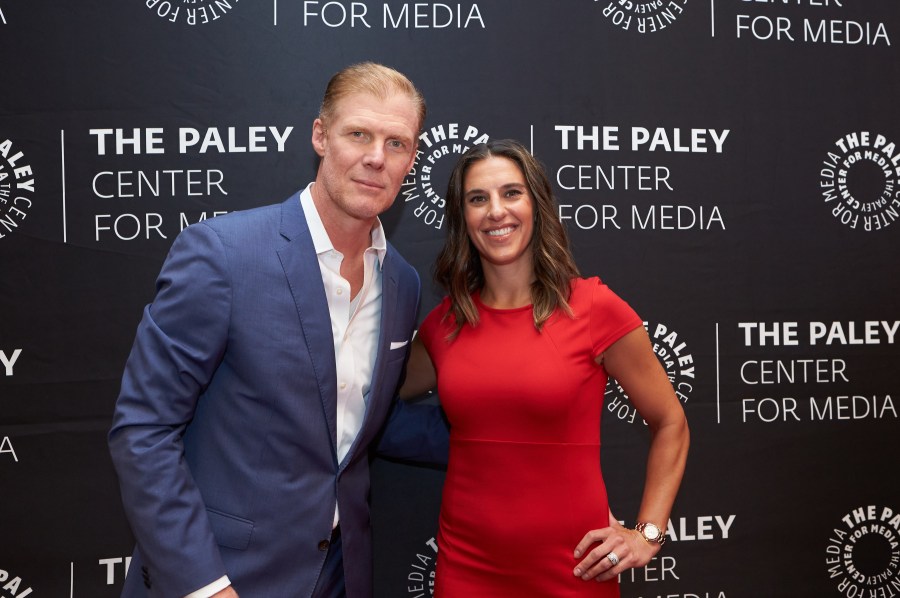
“I’m really excited for this World Cup,” said Carli Lloyd at a recent event at The Paley Center for Media in New York City. Lloyd, who won two World Cups and two Olympic gold medals with the U.S. women’s soccer team, appeared on a panel along with Alexi Lalas, an Olympian and National Soccer Hall of Famer and Karina LeBlanc, a two-time Olympian and five-time member of the Canadian World Cup National Team.
“This [World Cup] is going to be the biggest, the best, the most competitive—and this is what all women deserve,” said Lloyd. “The 2023 team is going to be the ’99 team for us. It just keeps getting better.”
Soccer has soared in popularity
Karina LeBlanc vividly remembers Chastain’s iconic reaction in that 1999 championship game. Just 18 years old at the time, LeBlanc said that “’99 shaped it for so many of us.”
The game certainly has grown in size and importance in America in the last 24 years, propelled in large part by the four World Cup victories and four Olympic gold medals won by U.S. women’s teams. Those wins sparked major interest in younger viewers, who began taking up the sport in droves. According to the National Federation of State High School Associations, the number of female high school soccer players increased from 23,475 in the 1978–1979 school year to 374,773 in the 2021–2022 year.
Lalas cited the money, resources, and laws that have supported the sport in the last two decades as reasons why the U.S. has a head start on the competition this year. He said, “There’s a reason why the U.S. is so good. It’s because of not just the 11 that are there, but the depth [of talent] that we have.”
He described the thrill and anticipation of watching lesser-known players grab the spotlight on the world stage. Part of what drives them, he said is that “multiple generations” have now “grown up watching this team, watching Carli and all of these players and wanting to be there. We all stand on the shoulders of others.”
The U.S. win in 2015 was another game changer
While competing with the U.S. team, Lloyd could literally see the change in soccer’s popularity firsthand.
Lloyd’s first World Cup was in Beijing, China in 2007, and even though the team drove around in a festive bus decorated with logos and sponsor names, she said, “you didn’t really feel like you were at a World Cup, per se. The stadiums were [only] semi-packed with fans.” The 2011 World Cup in Germany “was a bit better, but still you just didn’t feel that vibe that excitement,” she said.
It wasn’t until the U.S. women’s team won the 2015 World Cup in Canada that Lloyd viscerally felt women’s soccer “explode” on the world stage. Lloyd herself scored three goals in 16 minutes and received the Golden Ball as the competitions top player. She helped the team bring home a second straight win in 2019. Lloyd retired from the sport in 2021, and this year, she will watch the action from the sidelines and provide commentary with the Fox Sports broadcast team. Women’s soccer has changed the world in more ways than one. In 2021, U.S. viewership of the National Women’s Soccer League increased by nearly 300 percent, causing FIFA to schedule the 2023 U.S. World Cup matches during prime time. U.S. players forged new paths for female athletes by winning a lengthy legal battle to secure equal pay. And the U.S. Women’s National Team strives to inspire the next generation with the SheBelieves movement to encourage young women and girls to reach their dreams—athletic or otherwise. Lloyd touched upon the fact that belief is essential since the World Cup is a mental competition as well as a physical one. “When you get to a World Cup, it is so incredibly hard to lift that trophy at the end of seven days, said Lloyd when asked about the U.S. team’s chances for a third straight win. “There’s so much you have to navigate. There’s lots of unknowns.” Regardless of how the competition plays out, soccer will soon have a new legion of fans. Lloyd, Lalas and LeBlanc all very aware of the honor and responsibility of introducing younger players to soccer. Pointing out the obvious enthusiasm of a young fan in the audience at The Paley Center, LeBlanc said, “As players, you try to think of that legacy piece and leave the game better than when you got into it.”
Rosie Colosi, TODAY
Rosie Colosi is a reporter for TODAY Parents. Recommended


Keeping the ball rolling
