








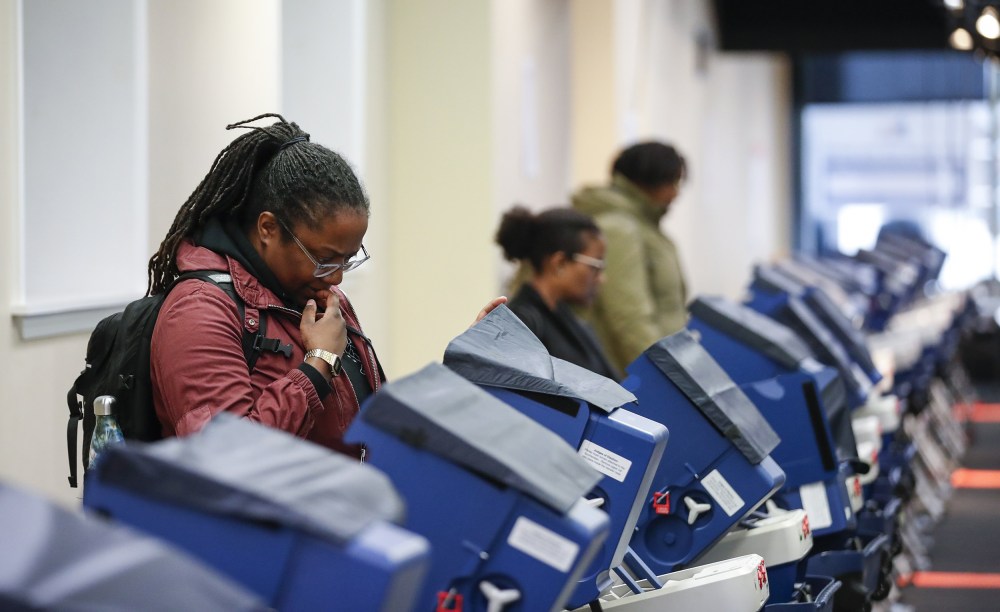
If you are anxious about the election tomorrow, or simply exhausted from the negative ads and endless conjecture, let me offer you a fast-forward button. The story of the 2022 midterm election will be how women, of all ages, came forward to buck turnout trends and define the direction of this country for the next two years.
Before we can fast-forward, we must rewind to June 24th, when the Supreme Court overturned Roe v. Wade. Negating nearly a half century of precedent confirming the right to an abortion appears to have turned a routine “kitchen table” issue election into a main course for voters of all ages and demographics.
We immediately saw the impact on Vote.org. Women rushed to our site to register to vote. Nationally, registrations jumped 332 percent with a 500-plus percent surge in traditional battleground states including Arizona, Michigan, Ohio, Pennsylvania; and a few states you wouldn’t expect: Indiana, Missouri, Tennessee and Texas. However, nowhere was this more pronounced than Kansas, where a ballot initiative on abortion access was coupled with a 1,000 percent spike in registrations.

Historically, almost no sitting president’s party does well in the midterm election. The party out of power has voters who are generally more motivated, which has tended to lose it an average of 28 seats in the House of Representatives and four seats in the Senate. That anti-incumbent trend generally continues down-ballot to state and local officials. While inflation and the economy remain top issues for voters, nothing seems to be driving early turnout more than the Dobbs decision. The biggest story of this election could be women voters, who are poised to upset historical norms and determine the outcome in many states.
In Pennsylvania, women 18-29 have already voted at four times the rate they did in the 2018 midterms and those women are 20 percent more Democratic, leading to a 10-1 partisan split. Women 30-39 also now have a 10-1 partisan split combined with a shocking 10 times increase in raw votes from 2018.
Shifting to Michigan, we see the story unfold. Women aged 30-39 have a five-fold lift on total early votes cast with a 9-1 Democratic advantage, compared to 2-1 in 2018. Women aged 50-64, who were evenly split between Democrats and Republicans in 2018 are now favoring Democrats more than 2-1 and have cast twice as many ballots as 4 years ago.
This trend is repeated in state after state after state. In Wisconsin women aged 40-49 went from a near even split to a 2-1 Democrat favorable split with a 50 percent lift in votes cast. In Arizona, women 65-74 who early voted were 3 percent more Republican in 2018 and are now 7 percent more Democratic, with an increase in total registered Democratic votes and a decline in total registered Republican votes. This midterm election could have the highest turnout of any in decades, if trends continue. No matter which side of the issue voters fall, the health of our democracy will be determined by high voter turnout and the deep engagement of voters from all walks of life. Forty million Americans have already voted, and if the trends seen in this glimpse of the future holds, we will be talking about how women made their voice heard, and caused an “outlier” election for decades to come. For those of you who haven’t voted early, Election Day is your chance to define the direction of your community and country. Celebrate that awesome responsibility and go vote. But one thing is abundantly clear: women are tapped into the fallout from the Dobbs decision, women are registering to vote, women are casting their ballots and in this consequential election, the power of our votes will make a huge difference in the future of our country. And it won’t be the first time.
Andrea Hailey
Andrea Hailey is the CEO of Vote.org. For everything you need to vote, visit Vote.org Recommended


