








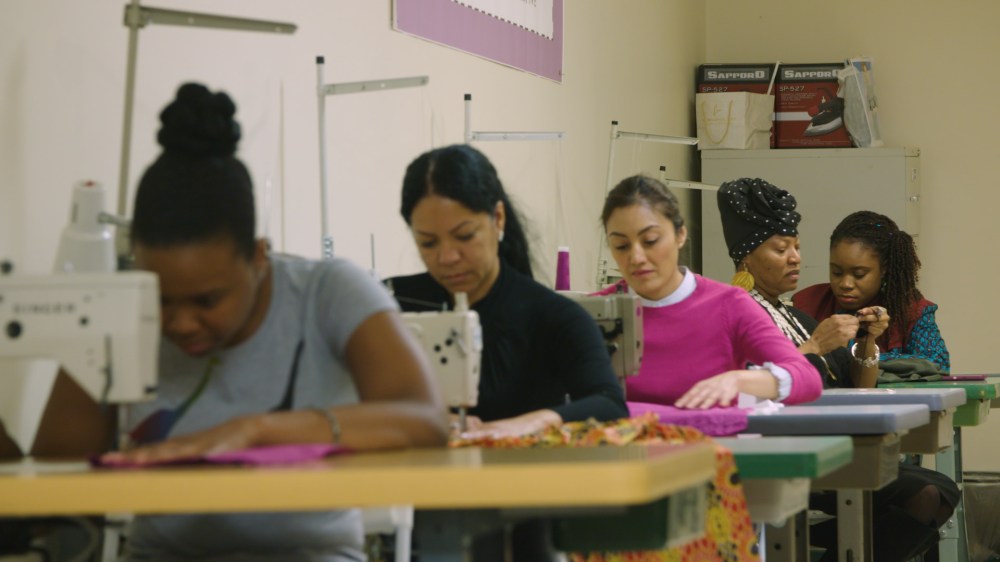
Christina Ivory admits that she didn’t know how to make anything a year ago when she began working with Custom Collaborative, a New York City-based non-profit organization that trains women for careers in fashion.
Having moved into a shelter with her two daughters to escape domestic violence, Ivory turned to the organization to help piece their lives back together. Now, the sewing machine she bought with her earnings from Custom Collaborative’s training program and the scrunchies and tote bags she began sewing in the shelter have generated enough funds for her and her daughters to move out of the shelter and into their own place.
“[My daughters] call me Wonder Woman,” a tearful Ivory told NBC’s Joelle Garguilo during an interview for Know Your Value.

Ivory is one of 43 women to graduate from Custom Collaborative’s 14-week paid training institute, which enables women from low-income and immigrant communities to begin their careers in fashion and eventually work as designers, entrepreneurs, pattern makers and seamstresses.
The organization is the brainchild of 50-year-old lawyer Ngozi Okaro, who founded the nonprofit in 2015 and instituted its first class of a dozen trainees in 2016.
Okaro told Garguilo that she wanted to focus on fashion because she sees it as an industry where women and minorities have historically been locked out.
“It’s someplace where women have traditionally formed the backbone of the industry and made the least amount of money,” Okaro said, “and so really what we’re trying to do is equalize and make this industry more fair to women and more supportive.”
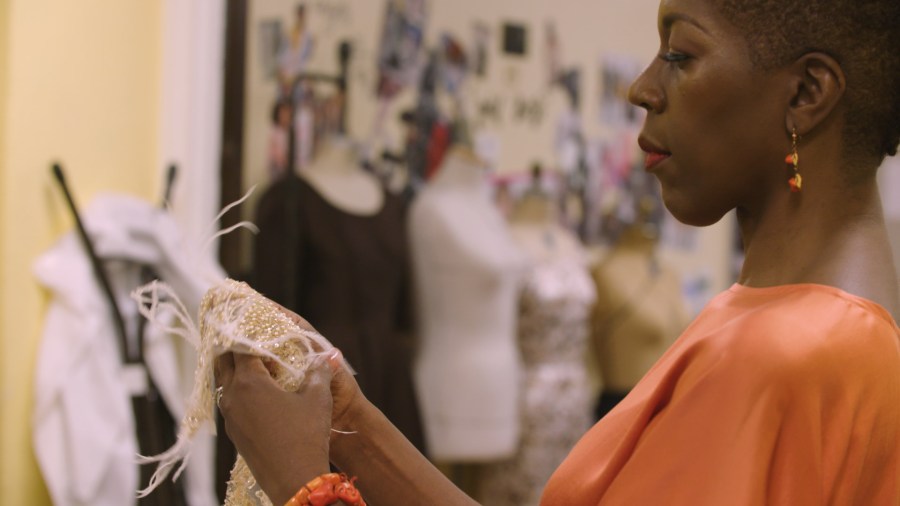
The organization prides itself on “sustainable fashion,” which includes objectives to reduce environmental impact by upcycling fabric waste as well as a commitment to fair wages.
Through the training institute, a group of a dozen women meet for 30 hours each week to learn how to design, sew and sell sustainable fashion. Beyond design and sewing, the women are taught about entrepreneurship and personal finance. In February, the group launched its eighth cohort of participants, and runs three training institutes per year.
The women who are selected for the program are paid a training stipend and given a metro card to get back and forth — a crucial benefit, as 96 percent of the participants live below the federal poverty line, which is under $13,000 in yearly income for a single person and just above $26,000 for a family of four.
Eight in 10 women are mothers, and more than half live in unstable housing. Around a quarter of participants tell Custom Collaborative that they’re survivors of domestic violence, while a similar number report being involved in the criminal legal system. (Because these stats are self-reported, program administrators told Know Your Value they assume the numbers are even higher.)
“It seems to me like women have more barriers,” Okaro told Garguilo. “[For] the women who we serve, we just look at, how do we make this a safe space, so people who have been survivors of domestic violence or any number of other issues can come here and learn and thrive and be who they really were meant to be.” After the training institute, the organization involves graduates in a “business incubator” so that participants can continue to gain skills in fashion and business and be connected to work opportunities. “People come to us saying I want to hire someone as an employee or I need help making a sample or patterns, and so then we can hire the women in our network to do that work for them, so we’re really a connector in that way,” Okaro said. Beyond that, Custom Collaborative has launched a worker-owned cooperative, whereby eight of its graduates have joined together to form a business manufacturing clothing for other designers. Ivory’s own scrunchies are for sale at NiLu, a boutique that’s partnered with Custom Collaborative in Harlem. “A couple months ago, I [didn’t] believe in myself,” Cristina, a native of Brazil, told Garguilo. “But now I feel like… everything is possible when you believe [in] yourself.” She called Okaro “the angel that God bring into my life.” As the daughter of an immigrant, Okaro identifies with the struggle people from other countries and from lower economic backgrounds face. “You know, being a black woman, having had certain experiences and see[ing] people around me who are equally talented, have even worse experiences than I have — it really propelled me to say, ‘What can we do about this?’ Whatever it is that I can do to equalize the playing field for other people, that is what I would like to do,” Okaro said. “There needs to be more justice in this world. And my job is to be part of making that happen.”
Erin Delmore Recommended


