









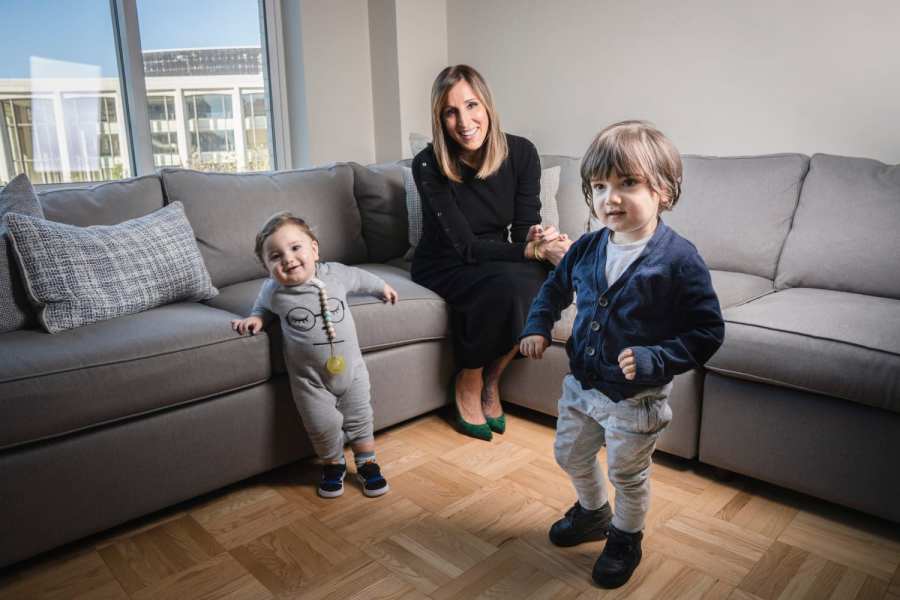
My second baby is now 15-months-old. Noor is sleeping through the night, growing well and seems fairly happy (he is a toddler after all).
I spent four months at home with Noor after he was born. Before that, I spent six months at home with my first son, Azur, as I was in the middle of changing jobs. I recognize and understand how blessed I was to have the opportunity to spend so much time with both kids during my maternity leave.
It was especially important because my husband has his own business. So, while he can dictate his own schedule, if he doesn’t work, he doesn’t get paid. That’s why he only took one week off.
I still think about my maternity leave and how amazing it was to have the time to recover psychologically and physically, while also bonding with my children.
It wasn’t easy, however. I dealt with an incredible amount of anxiety going into both deliveries and subsequently after. I worried about my job security and what stories I would miss. I wondered if I could handle one, then two, kids. I questioned if I would be a good mom (let’s be honest, I still worry about this). I stressed over how I’d be able to juggle the demands of work and home after the dust settled.
Then there was the general anxiety I developed from the rush — and drop — of hormones after giving birth. There were times I felt incapacitated. Luckily, I was home and able to deal with it. But that’s only because of the maternity leave offered by NBC, 16 weeks. That’s something most women and men in this country do not have.
The facts are clear: Having the time to bond with your child and being able to provide them the nutrition they need when they need it, makes for a stronger and happier baby and mother when she does eventually return to work.
RELATED: 6 companies redefining parental leave
In addition, dads who have paid parental leave are not only able to support their partner through recovery but have the opportunity to bond with their children.
But, 25 percent of women have to go back to work within two weeks just to make ends meet. And the median paternity leave for new dads is just one week, according to a 2017 Pew survey. And a Boston College study found that less than half of dads who were offered six weeks of paid paternity leave actually took the whole six weeks.
For a country that prides itself on family values, we are the only industrialized nation without a federal paid family leave policy for both women and men. This has to change.

I recently chatted with my co- anchor, Ayman Mohyeldin, who took advantage of the parental leave policy at NBC back in early 2019, taking 16 weeks after the birth of his second child. At NBCUniversal, primary caregivers are given 16 weeks paid leave with up to an additional two months unpaid.
Ayman and I spoke about our experiences and how it’s no longer a blessing for parental leave but a right. Here are some highlights:
Yasmin: So why was it important for you to take paternity leave with your second child?
Ayman: I felt like the first time around, we probably were relying too heavily on too many people and the second time around, I just wanted to have more ownership of that initial couple of weeks. We had just moved into a new house. I knew that it was going to require a lot of work to get the house to be functional. But above all, I knew that [my wife] Kenza had just started a business, and I wanted to be available.
RELATED: Paternity leave is a lifesaver for working moms … But are dads taking it?
Yasmin: Did you have a different experience? Because I know, you took two weeks with Dora, and now you will have taken four months with your second child, Idris, when all is said and done.
Ayman: To be honest with you, my focus wasn’t so much on Idris. My focus was more on Dora. In some ways, that would have been different if I had taken the first 16 weeks off with our first child. But just by circumstance, the division of labor ended up being me taking care of Dora, and in doing so Kenza focused physically and emotionally on Idris and herself.
Yasmin: You’re incredibly lucky to have had the opportunity to take parental leave as you well know. Especially being a father…
Ayman: There’s a big misconception, just generally in our culture, that somehow if you take paternity leave, you’re at a disadvantage at work, that you are somehow gaming the company and people are like “Oh wow really, did you enjoy your 16 weeks off?”
Everybody treats it like a vacation. When in reality, we would never treat it as a vacation or time off if a mother takes 16 weeks off. So there’s definitely a cultural double standard, that you are not serious about your work. Which is no doubt the same pressure that women have been facing for years. But it’s different slightly in the sense that because there’s a gender perception that guys are supposed to be putting their careers over their families. Yasmin: So what inspired you to do it, in spite of those anxieties that you were facing career wise? Ayman: For me, it was to make sure that my wife was healthy and that her mind was in the right place and knowing that she was fully supported in every way. I think it’s also a testament to the company that at the end of the day, they have this policy and they definitely allow you to take it. Every single study that I have read in literature about the science of taking paternity leave, reinforces the overall health of the family, which means postpartum depression among women plummets when parents are both there. Let me tell you very honestly, there are people in my own family who questioned my decision. Like asking me, ‘Are you sure that’s a good decision? Are you sure you want to do that?’ They told me that ‘being away from the screen for such a long time, people may forget about you or what you’re building or what you are’… I mean you know how it is. Yasmin: So how do we move the needle on the perception of parental leave in the U.S.? Ayman: I think talking about it is very important, putting the spotlight on it, showing the benefits of it, making sure that people understand the consequences of not allowing people to take it. I think coming back and getting back on TV, doing all the work that we do, working crazy, showing people there’s no negative aspects to our career. The perception that our bosses are somehow going to be disappointed with us for taking this time off — that’s absolutely not been the case. Beyond the policy, just on the human level, we need to remember that you’re never going to have these moments again, you’re never going to be able to live these moments again with your kids, so do it and be there and be supportive. But then there’s the element of a self-imposed anxiety, which is, for example, ‘I’m not going to be here for the Mueller Report.’ Or ‘Oh my god. I’m not going to be here for the impeachment hearings.’ That makes leaving a little bit harder, because we work ourselves into this frenzy — like I missed the big story that could have defined my career. But there’s always another big story. Yasmin: So if there’s one piece of advice you would give a father who is contemplating on whether or not they should take the leave because they have the opportunity to do so, what is it? Ayman: Take the leave. Take as much as you possibly can. Speak to your bosses about it, build yourself a support network. I think it’s very important to find like-minded people who understand what you’re trying to do because sometimes as we’ve mentioned the pressure from colleagues and relatives and friends, in of itself is more detrimental. But I learned a lot from people who had done it and that is what gave me the courage to say I’m going to try doing this, even if I am on air and let’s see if it moves the needle forward. I remember reading about the Dove Pledge . The company has a pledge and asks people in various industries to sign that pledge to commit to taking paternity leave. I learned about it through Alexis Ohanian, Serena Williams’ husband. He wrote an open letter about it. And he is somebody who you think of in his own world, a huge success. He actually wrote about how he walked away from that so he could focus on their baby and that re-energized him and re-invigorated him. I think he’s a great example. So, when I read his open letter and I saw him talk about that and advocate the positions that he did, I said if he can do it, why wouldn’t I be able to do it? Hopefully someone else who reads this will also feel like they can too.
Yasmin Vossoughian
Yasmin Vossoughian is an NBC News correspondent. Recommended


