









Nearly one in four pregnancies ends in a loss. So chances are, not only do you know one person who has suffered a pregnancy loss, but you probably know multiple people.
Couples often wait until they’re out of the first trimester to share the news they’re expecting. So if they experience miscarriage early on, in many cases, it means suffering in silence. It can feel just as devastating, however, for a couple who has shared the joyful news that a baby is on the way, only to experience the unthinkable and have to relay that message.
It can be difficult to know how to respond to a loved one, friend or co-worker who has lost a baby. In honor of National Pregnancy and Infant Loss Awareness Month, Know Your Value spoke to three experts about helpful things to say to make a meaningful difference.
Listen to what women are saying
Before you try to find the words, first try to put yourself in your friend’s shoes and truly consider all of the emotions she might be feeling.
The U.K.-based Miscarriage Association wanted to know the best phrases to say to women who had experienced a pregnancy loss—so they used social media to ask affected women themselves. National Director Ruth Bender-Atik explained the organization asked women to use the hashtags #say or #dontsay, along with the lines people actually said to them.
“What worked for person A doesn’t work for person B,” said Bender-Atik on the findings. “It confirmed our knowledge that people are different and respond in different ways.”
As a result, the Miscarriage Association developed the #SimplySay campaign to offer suggestions on the rights words to say. “Sometimes just in saying, ‘I’m here,’ you’re going to give so much more comfort than talking,” said Bender-Atik.
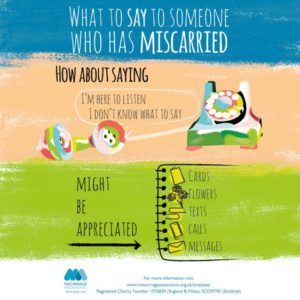
Meaningful things to say to someone who has suffered a pregnancy loss:
Experts say simplicity is best. Jessica Zucker, Ph.D., a Los Angeles-based psychologist specializing in women’s maternal and mental health, knows this from personal experience. Though she is currently a mother of two, she has been pregnant three times. Her second pregnancy ended abruptly at 16 weeks. She began the #ihadamiscarriage campaign to provide “a place for people to experiment with their voices and vulnerability.”
Zucker stressed that the “amount of weeks one is pregnant is not necessarily commensurate with the emotional response that follows.” Loss is loss, no matter when it happens—a miscarriage at seven weeks can feel just as shocking and overwhelming to parents as a stillbirth at eight months. We don’t always know the circumstances or emotional lead-up to the loss. One of the very best things you can say, according to Zucker, is: “I’m here if you want to talk to me about your experience.”
Amy Morin, a psychotherapist and author of “13 Things Mentally Strong People Don’t Do,” is also no stranger to grief, having lost her mother at 23 and her husband at 26. “Don’t have expectations about grief,” she said. “We tend to pass judgment that people shouldn’t be as sad or grieve for as long” for a pregnancy loss, especially if it’s an early loss. She continued, “Treat it the same as a death in the family.”

And don’t neglect the father or partner who lost a child. Morin said, “People are much less likely to say something to fathers, but dads are grieving, too.”
Here are some other lines experts said to consider:
“I’m sorry.”
“I’m so sorry for your loss.”
“I’m sorry to hear the news.”
“I’m thinking of you.”
“I’m not sure what to say or do but I am here and I am so sorry.” “Please let me know if there’s anything you need.” “I’ve been thinking about you a lot—sending you my love.” “I’m here if you ever need to talk.” “What can I do for you?” People in the midst of shock often want help but won’t know how to tell you to help. Circle back and re-offer to help later on. Or say, “Have you thought of anything I can do to help you? Many people (thinking they are helping) often turn to clichés and comparisons, like “everything happens for a reason,” “at least you have a healthy child at home,” or “at least you know you can get pregnant.” Zucker said that phrases like these “minimize emotional impact. We say them to get rid of our own discomfort.” We should really stop and have empathy for the other person and find a sincere expression of sympathy rather than a cliché. Morin agreed: “The tendency is to bring it up so you can check saying something off your list. Don’t make it about your feelings.” It can be extremely daunting to figure out what to say to a grieving co-worker—especially if she’s someone you see almost every day but don’t spend time with outside the office. Many times, the affected parents will have had a conversation with their supervisor, who can help relay information about what your co-worker may or may not want. Zucker cautioned that “not everybody wants or needs to be open about their loss.” Morin said that timing plays a critical role in expressing sympathy at work: “You may just want to walk up to their desk in the middle of the day and get it over with, but you may have disrupted your co-worker when they were in the middle of writing a report and weren’t even thinking about their loss. The beginning or end of the day when things are quieter might be a better time.” If you’re still having trouble finding the right words or can’t make the timing work, you might try leaving a signed card. It can be tricky to find this sort of card in your local drug store, but both the Miscarriage Association and Zucker sell thoughtfully worded cards for this purpose. Regardless of what you say, do not have any sort of expectations for the type or tone or timing of a response. Your friend or co-worker may not respond at all. But she’ll know that you were there for her at a rough time.
Rosie Colosi, TODAY
Rosie Colosi is a reporter for TODAY Parents. Recommended


What to avoid saying

How to express sympathy to a co-worker
