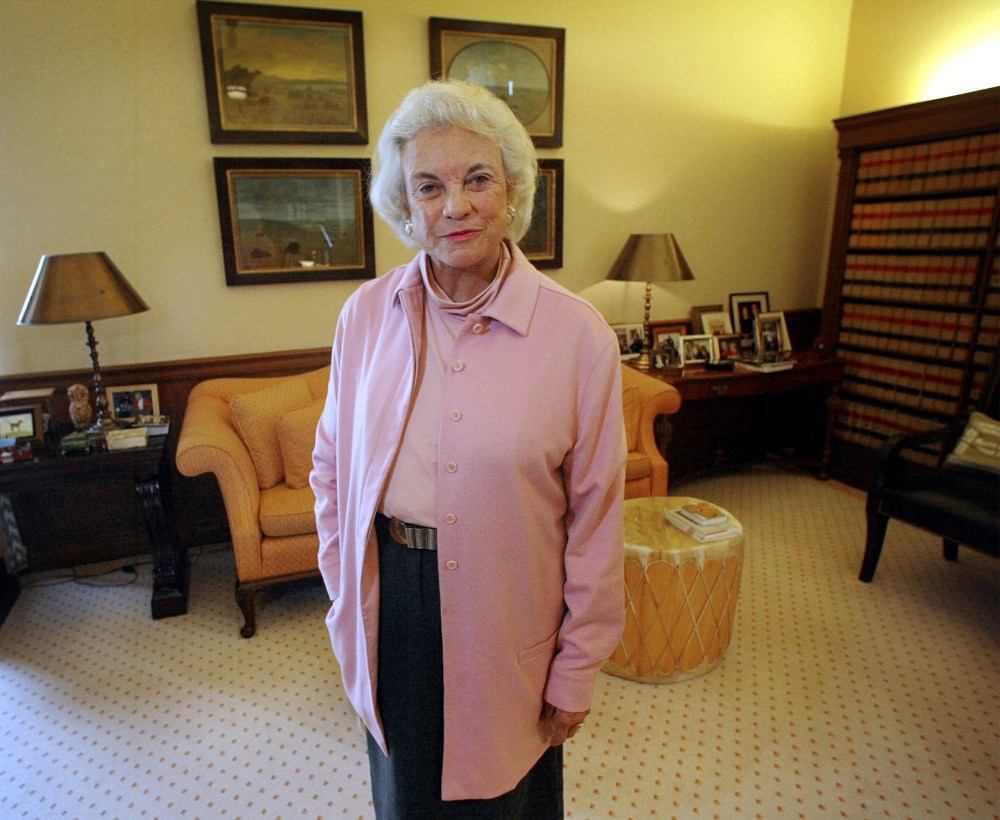
Tributes to a luminary such as Sandra Day O’Connor, now 90 years old and retired from public life since 2018, are likely to focus on her stature in the legal world and her path-breaking appointment as the first female U.S. Supreme Court Justice. Less well known, but equally remarkable, is the unusual course she followed as she built her stellar career.
Justice O’Connor took a five-year career break in the early 1960s —when such a move was considered career-ending, because her babysitter quit and she couldn’t find a replacement. Yet, despite the long odds against her, she relaunched her full-time legal career and reached the pinnacle of her field. Fifteen years ago, I had the opportunity to hear directly from Justice O’Connor about how she navigated those milestone moments.
My co-author Vivian Steir Rabin and I were writing our book “Back on the Career Track”(Hachette 2007), the manual-to-be for career reentry after a multi-year career break. It was a novel idea at the time, often met with skepticism, and we were on a mission to find high-profile “relaunchers” whose experiences made them early role models for the concept. We were thrilled to meet and interview Justice O’Connor in chambers in March of 2005 as part of this effort.
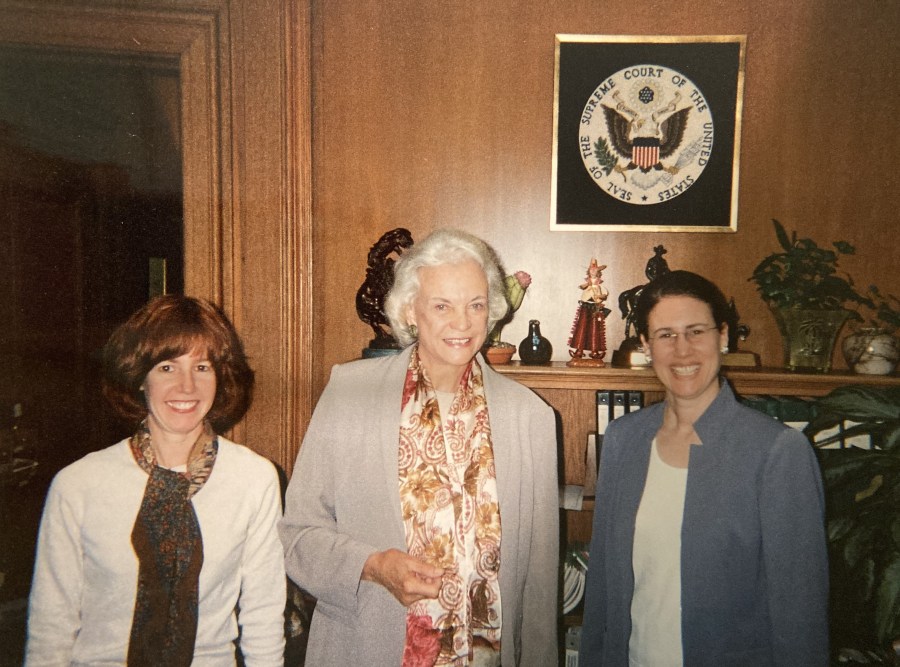
Much of Justice O’Connor’s story is legendary: she grew up on an Arizona cattle ranch and graduated third in her class at Stanford Law School in 1952. Her classmate and future Chief Justice of the Supreme Court, William Rehnquist, graduated first.
Yet O’Connor, whose academic success included serving on the Stanford Law Review and being elected to the Order of the Coif legal honor society, could not find a job at a private law firm because she was a woman. “I couldn’t even get an interview without pulling strings to get someone’s father to talk to me” she told us.
She ended up taking a job as deputy district attorney of San Mateo County in northern California. A year later when her husband, also a Stanford Law School alum, graduated and was immediately drafted and posted to Frankfurt, Germany, O’Connor went with him, working as a civilian lawyer for the U.S. Army.
In 1957, the O’Connors returned to the U.S. and settled in Phoenix. Still, no private law firm was interested in hiring her, so along with a partner, she set up a law office doing whatever walk-in client business came their way. “Not exactly Supreme Court material” she recounted.

Later that year, she gave birth to her first son, and two-and-a-half years after that, in 1960, her second son was born. “I had a wonderful babysitter,” O’Connor recalled. “But she left after my second child was born. It was a disaster for me because there were no daycare centers in those days and I tried, but I could not find another competent sitter. So, I had to leave my job.”
Thus began O’Connor’s five-year career break. Two years into it, in 1962, her third son was born. She expressed to us the same concerns we heard from relaunchers then and now.
“With all the trouble I had before, I was really worried that I would be unemployable, but I had to take care of those children. To keep my foot in the door, I realized I had to do something in the field even if it didn’t pay. I wrote and graded bar exams for the state of Arizona, which kept me current in the law. I set up a lawyer referral plan for the local bar association which was a good way to get acquainted with other lawyers. I took a position on the county planning and zoning board and agreed to be a juvenile court referee. I also accepted some small bankruptcy appointments.”
O’Connor told us that by the end of 1964, “I became busier than I wanted to be. I was putting in more hours than if I had a full-time paid job. Of course, no part-time jobs existed back then.” However, her volunteering turned out to be the key to her career relaunch.

She had served as vice chairwoman of her county Republican Party and moved up in state politics, hosting large events and working on Arizona Sen. Barry Goldwater’s 1964 presidential campaign. O’Connor’s volunteer work in Arizona Republican politics and the network she built through it were crucial elements in her return to the paid workforce in 1965 as one of the state’s assistant attorney generals. “I loved the job,” she recalled. “It was the most fun I had in my career.”
But she wanted to work part-time. And that was a hurdle with no precedent. Here’s how she went about it: “First I tried to make myself indispensable. Then I proposed working two-thirds time. I told them I would make them a great deal, because they’d only have to pay me for half-time and I’d work two-thirds time.” Eventually her office agreed, and she continued in this role for four years until being appointed by the Maricopa County Board of Supervisors to replace an Arizona state senator who had resigned. She was re-elected for the post two consecutive times and became Senate majority leader in the Legislature before leaving to run for and win the election for judge of the Maricopa County Superior Court of Phoenix. She served for four years and then was appointed by Arizona Governor Bruce Babbitt to the Arizona Court of Appeals in 1979. Two years later, President Reagan appointed her to the Supreme Court. “I’m the only Supreme Court justice with experience in all three branches of government,” she told us. In the 60 years since O’Connor began her career break, the workplace has become far more accepting of the relaunching concept. Currently, 28 percent* of the Fortune 50 have their own return-to-work programs aimed specifically at hiring career reentry professionals. But there is still a long way to go, as less than 6 percent* of the broader Fortune 500 have done the same. Our interview with Justice O’Connor stands out even now, over 15 years later, as the highlight of our book research. O’Connor’s illustrious legal and judicial career was her crowning professional achievement. But it is her lesser-known legacy as a relauncher that helped change the game for progress in the American workplace. Justice O’Connor’s trail-blazing example proved what was possible: that a career break is not a permanent roadblock, but rather a life-changing, character-shaping step along the way. She remains my personal hero. *iRelaunch estimates Carol Fishman Cohen is the Chair and Co-founder of career reentry firm iRelaunch, which runs the iRelaunch Return to Work Conferences, works with over 100 employers on in-house return to work programs, and leads a community of over 81,000 “relaunchers.” Her TED talk “How to get back to work after a career break” has nearly 3.5 million views. She hosts the 3,2,1 iRelaunch podcast and writes regularly for Harvard Business Review on career reentry topics.
Carol Fishman Cohen Recommended